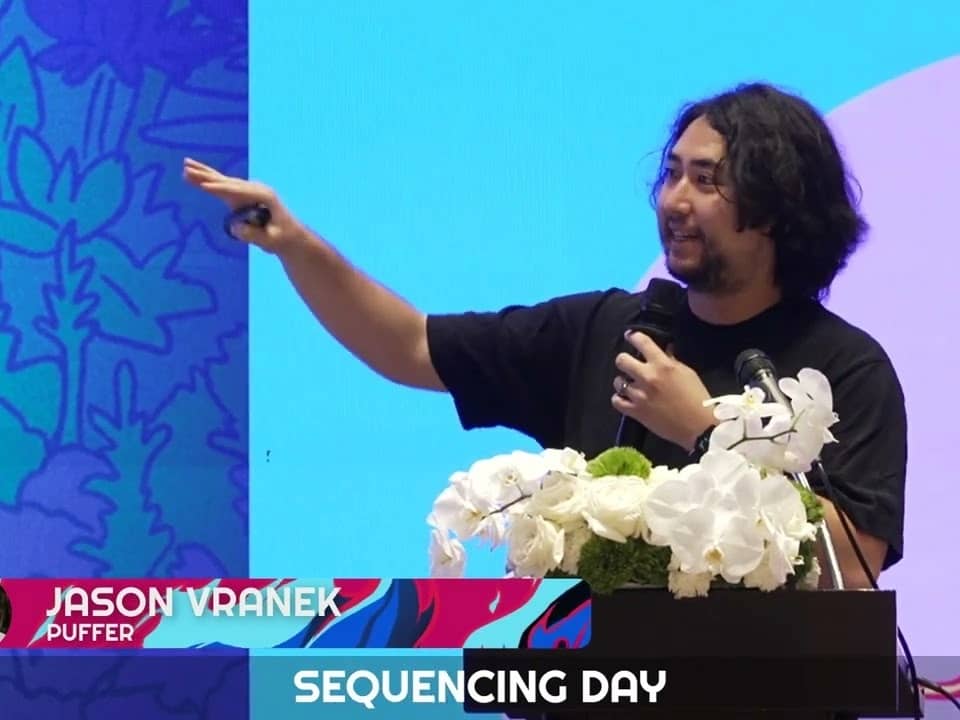
Jason Vranek
Jason Vranek is a software engineer and researcher whose work spans blockchain infrastructure, verifiable computing, backend development, and computer architecture. He is the co-founder and CTO of Puffer Finance and previously worked as a research engineer at Chainlink Labs and a graduate student researcher at the VAMA Group at the University of California, Santa Cruz. [6]
학력
Vranek graduated from the University of California, Santa Cruz, with a BS in Computer Engineering (2018), a Master’s in Computer Science and Engineering (2020), and a PhD in Computer Science and Engineering (2022). [2]
경력
Vranek began his career as a Programmer for the LEEPS Lab in the Economics Department at the University of California, Santa Cruz, from January 2016 to January 2017, developing high-frequency trading experiments using Django, the NASDAQ OUCH protocol, and JavaScript. From September 2017 to June 2018, he worked as a Class Tutor at the university, supporting courses in microprocessor system design and mechatronics. In 2018, he also contributed to a senior design project involving an autonomous, cloud-based parking system, developing a Python backend with Flask, a REST API, and a JavaScript-based administrative interface.
From January to October 2018, Vranek worked as an Associate Software Engineer at Innovation Matrix, Inc., where he migrated a quotation system's database to AWS and developed a Python web application to coordinate sales information between US and Japanese teams. From October 2018 to June 2019, he developed Flowrs, an independent backend engineering project that implemented a continuous exchange market design, initially in Python and later in Rust. He subsequently worked as a Graduate Student Researcher at the VAMA Group at the University of California, Santa Cruz, from June 2019 to March 2022, developing open-source hardware accelerators in Chisel for verifiable computing. From March to June 2020, he also served as a Teaching Assistant for the university's CSE 120 Computer Architecture course, covering topics such as RISC-V assembly, processor architecture, pipelining, and memory systems.
In January and February 2022, Vranek worked as a contract Research Engineer at Chainlink Labs. He began contributing to Puffer Finance in February 2022 and continues in that role. [3]
인터뷰
Expected Yields
In a March 2024 interview on Galaxy’s Infinite Jungle podcast, Vranek discussed Puffer Finance’s approach to liquid staking and restaking, focusing on making validator participation more accessible to home stakers. He explained that Puffer’s permissionless validators operated with low bond requirements, while separate operators handled restaking through Actively Validated Services (AVSs), allowing Puffer’s liquid restaking token holders to receive associated rewards without running AVS software themselves. Vranek described the use of Secure-Signer and temporary safeguards to address technical and security limitations, and said the team would prioritize AVSs with manageable slashing risks. He noted that restaking could provide an additional revenue source for validators, although the sustainability of incentives and the risks associated with slashing remained uncertain. The discussion also covered the distinction between Puffer’s permissionless validator layer and its temporarily permissioned restaking operators, as well as capacity constraints affecting AVS participation. Vranek outlined plans for Puffer’s mainnet launch and for converting deposited stETH into native ETH to support its validators, while the conversation addressed EigenLayer’s staged rollout of operator delegation, AVS participation, incentives, payments, and slashing features. [4]

발표
Universal Preconf Registry
At Devcon Sequencing Day in December 2024, Vranek discussed how rollup fragmentation affected interoperability, liquidity distribution, user activity, and Ethereum’s fee revenue. He explained that based rollups could allow Ethereum validators to sequence transactions across multiple rollups, while pre-confirmations could give users faster transaction commitments backed by economic penalties. Vranek presented the Universal Registry Contract as a proposed standardized, immutable registry where validators could register and face slashing for failing to honor their commitments. The design aimed to reduce switching costs and reliance on individual providers, use ETH as collateral, and maintain gas efficiency through compact operator commitments, optimistic registration with fraud proofs, and flexible slashing contracts. He described a workflow in which validators register, authorize delegates through off-chain signatures, and issue pre-confirmations to users, with penalties applied when commitments are broken. Vranek also reported progress from a collaboration among multiple teams during Sequencing Week, while noting that broader agreement and standardization were still needed. [5]