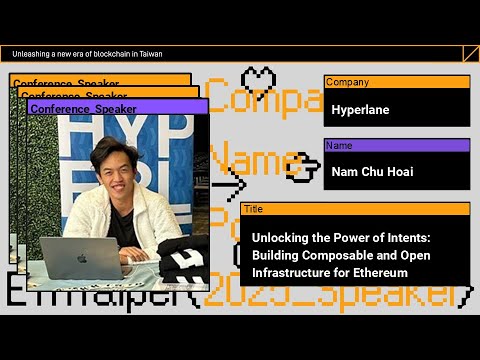
Nam Chu Hoai
Nam Chu Hoai is a software engineer and technology entrepreneur with a background in full-stack development, blockchain infrastructure, and decentralized systems. He is the Co-Founder and Chief Technology Officer of Abacus Works, previously a software engineer at cLabs and Wellframe, and co-founder of the startup Credport. [6]
학력
Hoai graduated from Boston University with a BA in Computer Science in 2014. [1]
경력
Hoai began his career in 2008 as a blogger for Blogwerk AG, contributing to neuerdings.com, a German technology blog. During this period, he also developed his own iPhone application, Nam's Remote, handling prototyping, design, development, and marketing. In 2010, he worked as an event photographer for virtual:nights:media and as an iPhone application programmer for betterplace.org. He subsequently joined Apture as an intern in 2011, contributing to both its Python backend and JavaScript frontend. From 2010 to 2014, Hoai studied Computer Science at Boston University, where he received a Trustee Scholarship. During his studies, he co-founded Credport, a trust platform for collaborative consumption marketplaces, and helped build its underlying technology. The startup participated in the Summer@Highland program and Startupbootcamp Berlin. From 2014 to 2015, he also worked as a freelance full-stack web developer.
In June 2014, Hoai joined Wellframe as a Software Engineer, helping develop the company's software from early hospital pilot programs to enterprise deployments. His work primarily involved web development using Ruby on Rails and React, alongside technologies including Scala, Elasticsearch, and Google Cloud Platform/Kubernetes. From September 2016 to May 2017, he also served as a Global Entrepreneur in Residence at the Venture Development Center at UMass Boston, supporting students and the broader community through software development, entrepreneurship mentorship, and office hours. In August 2018, he joined cLabs as an early Software Engineer, contributing to the development and launch of the Celo platform across its technology stack. His responsibilities included designing the identity protocol and its smart contract and off-chain implementations, working on blockchain consensus, and developing asynchronous processes for the mobile wallet. He eventually led the Contracts and Primitives team and worked on special projects before leaving in March 2022.
In April 2022, Hoai co-founded Abacus Works, where he serves as Chief Technology Officer. His work focuses on building the technology behind the organization's interchain infrastructure. [2]
발표
Hyperlane
In a March 2025 keynote at ETHDenver's ETH Composability Day, Hoai discussed the fragmentation of the Ethereum ecosystem resulting from its growing reliance on rollups and the challenges this created for users and developers operating across Layer 2 networks. He outlined efforts to improve interoperability through standardized message passing and intent-based systems, emphasizing that messaging standards needed to account for relaying mechanisms and their associated costs to avoid creating incomplete abstractions. Hoai identified ERC-7683 as a promising standard for intents and introduced the Open Intents Framework as a collection of reusable, open-source components, including solvers, rebalancing bots, and modular contracts, designed to simplify the development of cross-chain applications. He explained that open frameworks let development teams retain control of their infrastructure while also giving others the option to use external service providers. He also emphasized the importance of incorporating sensible security defaults, given that many users and developers would rely on the framework's initial configurations rather than customize them. [3]

Power of Intents
In an April 2025 presentation at ETHTaipei, Nam Chi Hoai discussed how Ethereum’s rollup-centered roadmap had reduced transaction costs while fragmenting the experience for users and developers interacting across networks. He outlined approaches to improve interoperability, including chain-specific addresses, standardized message passing, and intent-based systems that let users specify desired outcomes while solvers handled transaction execution. Hoai presented the Open Intents Framework as shared, permissionless infrastructure comprising solver software, smart contracts, and user interface templates, enabling smaller rollups to offer intent-based interoperability without developing all the necessary components independently. He also discussed the limitations of intents, explaining that solvers effectively extended funds to users while waiting for transactions to settle, making the model unsuitable for every use case and reinforcing the need for faster native interoperability between rollups. He emphasized the potential of open, protocol-agnostic frameworks such as Hyperlane to support broader interoperability and reduce dependence on closed infrastructure providers. During the Q&A, he discussed Hyperlane’s framework-based strategy as an alternative to better-funded competitors and explained how Uniswap's developing Compact system could use a Hyperlane-based arbiter to verify cross-chain transaction fills. [4]