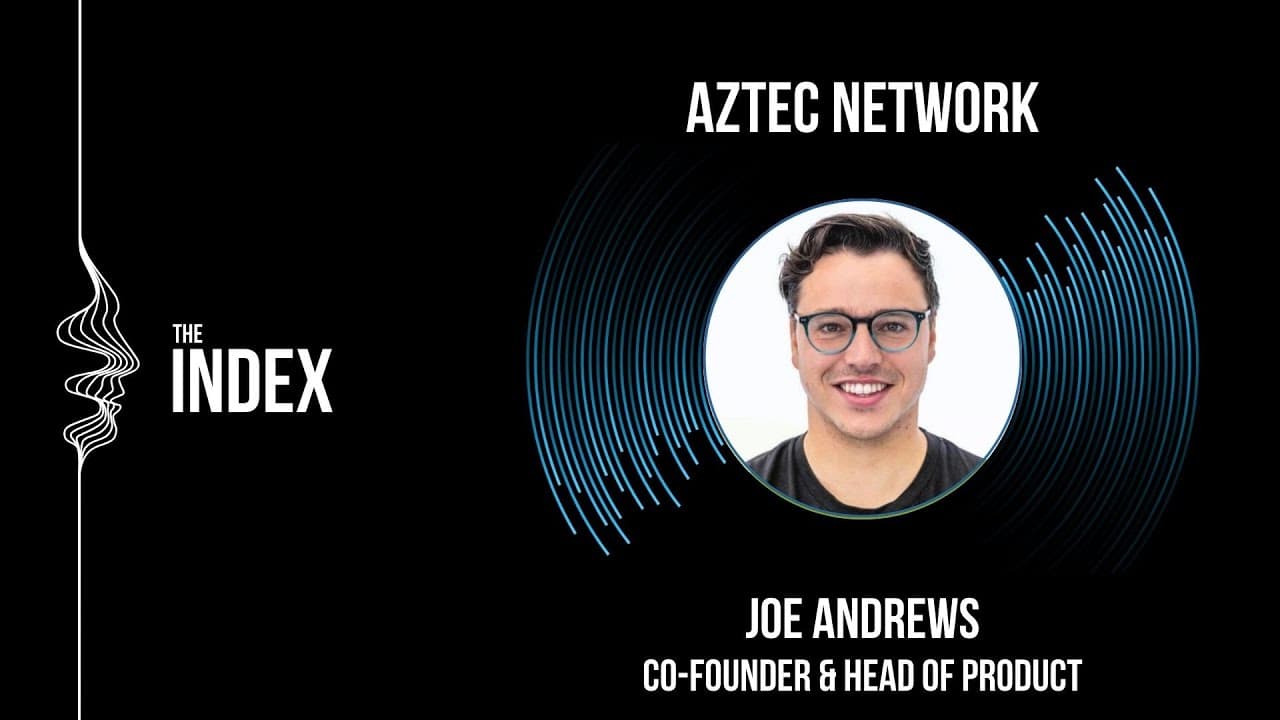
Joe Andrews
Joe Andrews is a technology entrepreneur and product leader whose career has spanned software engineering, food technology, blockchain-based financial infrastructure, and zero-knowledge technology. He is currently CEO of Aztec Labs, following eight years as Co-founder and Head of Product at Aztec, where he worked on the design and development of the Aztec network. [5]
Education
Andrews graduated from the Imperial College London with a BEng in Materials Science in 2013. [2]
Career
Andrews began his career with a Year in Industry placement at Invensys Controls from October 2009 to June 2010, working on engineering and process improvement projects. He later worked as a Software Engineering Intern at Carhoots.com from June to September 2013, focusing on JavaScript development, automated deployment, and analytics. From July 2013 to August 2014, he was Co-Founder & Lead Developer at Chefler, where he developed the company's web application, backend infrastructure, payment systems, database architecture, and delivery-routing technology.
From August 2014 to September 2017, Andrews served as Co-founder & Chief Technology Officer at Radish, a food delivery company operating in San Francisco and Chicago. He subsequently became an EF9 Cohort Member at Entrepreneur First from October 2017 to March 2018 and Product Lead at CreditMint from February 2018 to March 2020, where he worked on a blockchain-based syndicated loan platform for corporate debt.
Andrews joined Aztec as Co-founder and Head of Product in February 2018, working on the design, development, and launch of the Aztec network. He held the position until February 2026, when he became Chief Executive Officer of Aztec Labs. In his current role, he works on privacy products based on zero-knowledge proofs. [3]
Interviews
Aztec Alpha
In an April 2026 interview at EthCC, J Andrews discussed Aztec’s privacy-focused blockchain infrastructure and its use of cryptography to provide privacy without relying on intermediaries or permissioned nodes. He explained how Aztec supports private value transfers on Ethereum through a token standard that allows assets to be transacted confidentially, as well as private on-chain identities that enable users to prove attributes such as age, ownership, or financial credentials without disclosing unnecessary information. Andrews also described encrypted storage and transfer of private data, including applications involving regulators, auditors, and other parties where transaction records need to remain confidential while meeting compliance requirements. He further discussed private computation, which allows sensitive data to be processed within transactions, with potential applications in areas such as machine learning, biometric verification, and complex proofs. [4]
Ethereum L2 Privacy
In a December 2025 interview on the Index Podcast, Andrews discussed Aztec’s focus on privacy and zero-knowledge cryptography as an Ethereum Layer 2. He explained that improving user experience was important to making privacy features broadly usable, comparing the process to how security standards such as SSL became integrated into the internet. Andrews discussed developments in zero-knowledge proof systems, including Noir, and their use in applications such as credential and passport verification. He also described Aztec’s efforts to develop a decentralized Layer 2 using open-source validators and cryptographic mechanisms rather than a centralized sequencer. The discussion also covered participation in Aztec’s testnets and the use of zero-knowledge credentials for identity verification as part of the development of private and decentralized blockchain infrastructure. [1]
Aztec vs StarkWare
In a July 2025 talk at NoirCon, Andrews and Maya Dotan of Starkware discussed privacy, zero-knowledge proving systems, and client-side applications. Andrews emphasized privacy by default, particularly for sensitive information and anonymous interactions, while Dotan discussed the development of faster and more accessible proving systems, including client-side proving. They examined how generating proofs locally could reduce data exposure and support privacy and security in applications such as smart contracts and IoT devices. The discussion also covered the integration of client-side proving with programming languages such as Cairo and Noir, lightweight proving environments, recursive proof systems, and the ability to perform complex computations off-chain while verifying results on-chain. The speakers concluded by discussing performance benchmarks, upcoming releases, and potential interoperability between Noir and Starknet infrastructure. [6]