0% read
Last updated:
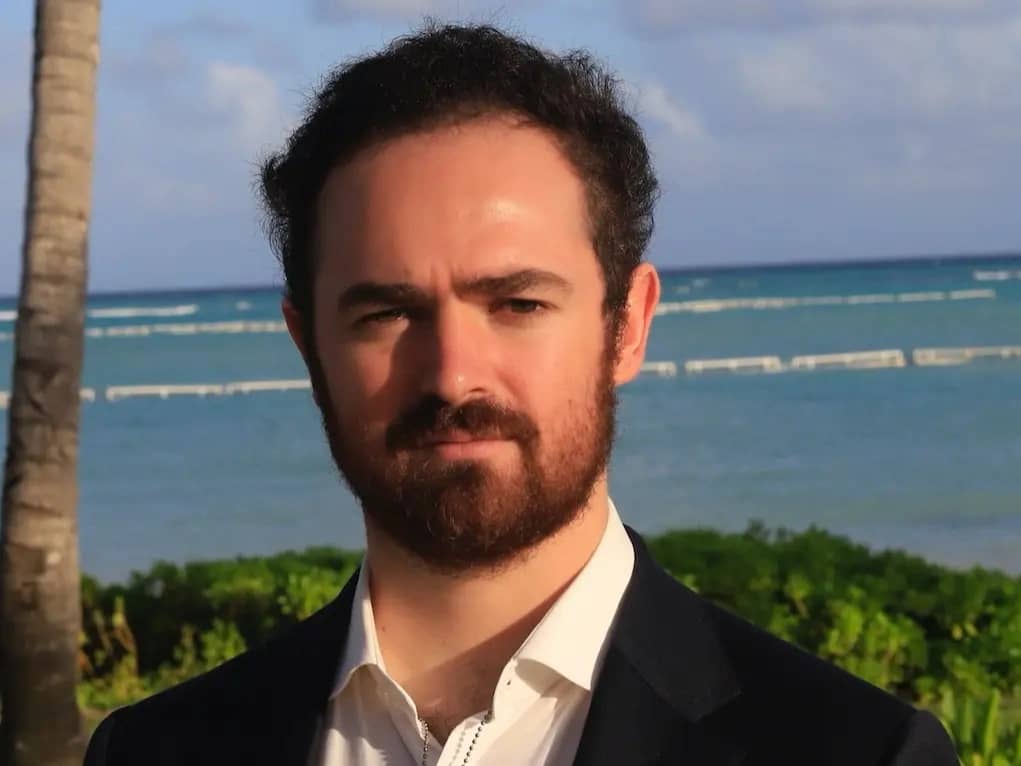
Dryden Brown
Dryden Wilson Turnbull Brown is the Co-Founder and CEO of Praxis, a venture-backed startup and digital nation with the stated goal of building new cities organized around shared values, Web3 and technological acceleration.[1][2] Brown and Praxis describe the project as the first "Digital Nation" or "sovereign network," an internet-native community that aims to translate an online, value-aligned membership into a new city-state in the physical world.[5][9] Brown has gained media attention for his project's ambitions, which are associated with the "network state" movement, and for his libertarian-influenced ideology.[3][1]
Early Life and Education
Brown grew up in Santa Barbara, California. At the age of seven, he and his family embarked on a year-long trip around the world, visiting countries in Europe, Oceania, and Asia.[4] At age 12, Brown dropped out of middle school to pursue a career as a competitive surfer and was subsequently homeschooled, which allowed him to train daily. During this period, his studies focused on philosophy, economics, and technology.[5] He competed in National Scholastic Surfing Association (NSSA) events and won the NSSA Gold Coast Men's Champion title.[5][4]
After his surfing career, Brown studied philosophy at New York University (NYU) but dropped out to pursue work in finance.[2] He has also reported studying consciousness with philosophers David Chalmers and Peter Unger, and economics with economist Mario Rizzo.[5] He also briefly attended The Juilliard School's pre-college program for cello.[6]
Career
At age 18, Brown moved to New York City to work at Bill Ackman's hedge fund, Pershing Square.[5] While there, he reportedly pitched investments in Bitcoin and a thesis for Hertz as a self-driving vehicle company. At age 20, he began a two-year role as a quantitative researcher and investor at a long/short hedge fund.[5] Before Praxis, Brown also co-founded a consumer technology company called Bijou, which was later shut down.[2][6]
Brown co-founded Praxis in 2019 at the age of 23 with Charlie Callinan.[5][2] Brown is also a recipient of the Thiel Fellowship, awarded by The Thiel Foundation.[6]
Praxis
Praxis is a venture-backed startup that aims to build new cities, initially starting as an online community or "digital nation" of ideologically aligned members.[2][7] Brown’s bio describes Praxis as the "first ever digital nation" with about 150,000 members, or "praxians," while other reports from 2025 state that the project’s website listed more than 87,000 applications for citizenship; taken together, these sources indicate that Praxis reports tens of thousands of applicants or members rather than a single consistently reported figure.[5][9] The project is an effort to create new models for living centered on values such as vitality, beauty, and health, in response to what Brown perceives as societal decline.[4] By the mid‑2020s, Brown increasingly characterized Praxis as a "Digital Nation" or "sovereign network" that uses artificial intelligence tools to coordinate members’ preferences, political organization, and commitments toward building a future physical city.[5][9][13]
Vision and Ideology
Brown has stated that his core motivation for founding Praxis was the "revelation that Western Civilization will collapse unless we unite around a new cultural core and achieve technological supremacy".[5] He has also cited the 2020 election of Joe Biden as an event that intensified his drive, stating that it made him feel America was becoming "a wasteland".[1]
Praxis aims to create "acceleration zones"—special economic zones with simplified regulations—to advance technology in fields like AI, biotech, and energy.[1] The vision for life in a Praxis city includes futuristic technologies such as AI-driven education, automated security via "robo-cops," and food production from 3D printers.[6] The planned cities are intended to have "Elon-friendly" labor laws to foster innovation. The firm Zaha Hadid Architects has been partnered with for the city's architectural design.[8][9] In line with this vision, Praxis describes itself as a "sovereign network" or Digital Nation and, in 2026, launched an "AI for Collective Action" campaign that used AI-generated neighborhood and city proposals to organize members’ stated preferences and commitments to move to a prospective future city.[9][13]
Funding and Investors
Praxis has raised significant capital from a variety of venture firms and individual investors. The company announced a 15 million Series A funding round in October 2022, led by Paradigm.[6]
By 2025, reports indicated that Praxis had secured approximately $500–525 million in committed financing facilities, largely from the crypto investment firm GEM Digital and the firm Arch Lending; these arrangements are structured to be drawn down in phases as specific development milestones are met, rather than representing cash already deployed into city construction.[8][9] Additional investors in Praxis include:
- Pronomos Capital (backed by Peter Thiel)
- Bedrock
- Apollo Projects (Sam Altman's fund)
- Winklevoss Capital
- Robot Ventures
- Balaji Srinivasan
- Cathie Wood
These funding and investor details have been reported by multiple sources.[1][8][6][9]
Proposed City Locations
Praxis has publicly explored building its first city in several locations around the world by pursuing partnerships with existing governments to gain sovereignty over land.[7]
Mediterranean and Latin America
Early in the project's history, Brown indicated that Praxis was in negotiations with various governments in the Mediterranean to acquire land, offering an influx of talent as an incentive.[10] By 2025, reports also mentioned that negotiations were in progress with landowners in Latin America.[8]
Greenland
In November 2024, Brown announced on X that Praxis had made a proposal to establish a charter city or a "privatized charter state" on "uninhabited, unused territory" in Greenland. He stated the inspiration came from Donald Trump's 2019 inquiry about buying the island. Brown and other Praxis members had traveled to Nuuk, Greenland, in the summer of 2024 to meet with government officials. The proposal included a token-based ownership model shared among Praxis, the Greenlandic government, and its citizens. Brown also envisioned the city as a "proving ground" for a future outpost on Mars.[3] However, the idea was met with a dismissive response from at least one Danish politician.[9]
Ukraine
In 2024 and 2025, Praxis began evaluating Ukraine as a potential location for its first city. The country's supportive stance on digital currencies and its need for post-war reconstruction were cited as reasons for its appeal. In May 2025, Brown began a worldwide city-scouting tour that included a visit to Kyiv, with the stated goal of announcing a final site selection by the end of 2025.[9]
Atlas, California
In an April 2025 interview, Brown revealed that Praxis was planning to build its first city, named Atlas, on the Vandenberg U.S. Space Force Base in Santa Barbara County, California.[1] The vision for Atlas was to serve as a "new American industrial base" and the "arsenal of democracy," with a "neo–Gilded Age" aesthetic. The plan was positioned to align with Donald Trump's campaign promise to build "Freedom Cities" on federal land. However, as of June 2025, Praxis had not secured the necessary Enhanced Use Lease (EUL) from the federal government to begin development.[1]
Uruguay
As of September 2026, Praxis and CEO Dryden Brown have publicly announced plans for an AI‑focused city project in Uruguay, selected for its natural beauty and political and economic stability, with press materials and coverage indicating a goal of beginning to receive initial residents as early as mid‑2027.[14] Brown has described the intended architecture as a blend of Gothic and space‑age futurist elements and has stated that he planned to meet with Uruguay’s president Yamandú Orsi during Orsi’s visit to New York for the United Nations General Assembly, while not indicating that any binding agreement had been finalized.[14] These Uruguay plans form part of Praxis’s broader search for a host jurisdiction alongside earlier explorations in the Mediterranean, Latin America, Greenland, Ukraine, and the Atlas proposal in California.
Interviews
Building Startup Cities #01
In an interview streamed live on December 16, 2020, on the YouTube channel hosted by Justin Murphy, Dryden Brown outlined his views on alternative approaches to city development and governance. Brown stated that the expansion of remote work and cloud-based employment has reduced the role of cities as centralized labor markets, enabling the formation of communities based on shared values and affiliations rather than proximity to employment.

According to Brown, Bluebook Cities is structured around the aggregation of prospective residents and participants through online platforms prior to securing physical locations. He explained that this sequence is intended to demonstrate demand before negotiations with host governments for land access and regulatory arrangements. In his description, these arrangements may involve the establishment of special jurisdictions operating under distinct legal and administrative frameworks, drawing comparisons to existing international financial or commercial zones.
Brown also described a conceptual framework he refers to as “Hero Futurism,” which he presented as an organizing narrative for urban design and long-term projects. In the interview, he associated this framework with the use of architecture and planning as cultural elements rather than purely functional infrastructure. Regarding governance, Brown stated a preference for corporate-style management structures, with possible use of tokenized equity, and expressed skepticism toward decentralized voting models for administering cities.
The discussion included Praxis, an online community and fellowship that Brown characterized as a preparatory environment for collaboration and coordination among participants prior to physical city development. He further outlined his position on what he terms “conservative transhumanism,” which he described as an approach to technological development focused on incremental improvements to human conditions while maintaining existing social and biological foundations.
The interview reflects Brown’s account of city-building as a process that integrates governance models, legal structures, and shared cultural frameworks, with social organization preceding physical construction.[12]
Building a New City-State: Dryden Brown on Praxis #02
In an episode of Endgame with Amanda Cassatt released on May 27, 2025, Dryden Brown presents his account of the origins and structure of Praxis, an initiative focused on the creation of a new city-state developed within the jurisdiction of an existing country. Brown frames the project as a response to institutional and administrative constraints observed in modern urban environments, as well as to economic shifts associated with the increasing adoption of artificial intelligence.

According to Brown, Praxis is planned as a city organized under a special economic zone model, with customized regulatory conditions intended to accommodate technology-oriented industries. He describes this approach as influenced by historical cases of planned cities, political and economic theories associated with libertarian thought, and organizational practices emerging from cryptocurrency-based communities. Within this framework, Praxis is described as an attempt to align governance structures, economic arrangements, and social organization under a unified administrative design.
During the interview, Brown outlines his assessment of the potential effects of artificial intelligence on labor markets, stating that automation may reduce demand for human labor across multiple sectors. In this context, he explains that Praxis is designed to function as a community in which social participation and individual roles are not exclusively tied to traditional employment structures. The discussion also addresses the project’s economic model, which Brown describes as involving ownership and management of limited assets, including land and infrastructure connected to different stages of the artificial intelligence supply chain.
Brown also discusses political and legal considerations associated with establishing a new city within an existing state. He references previous charter city initiatives and notes that changes in national political leadership can affect the stability of such projects. Based on these examples, he emphasizes the role of long-term agreements and diplomatic engagement with host governments as part of the project’s operational planning.
The interview further includes Brown’s reflections on cultural and philosophical themes related to social organization in contexts where conventional labor structures may change. These reflections are presented as part of his broader interpretation of how communities might define collective purpose under altered economic conditions.
Taken as a whole, the interview documents Brown’s perspective on Praxis as a planned urban and governance experiment shaped by technological, economic, and political considerations, while also highlighting the uncertainties associated with implementing such a model in practice.[11]
See something wrong?
Official Website:
Social Profiles: