0% read
Last updated:
Lock-and-Mint
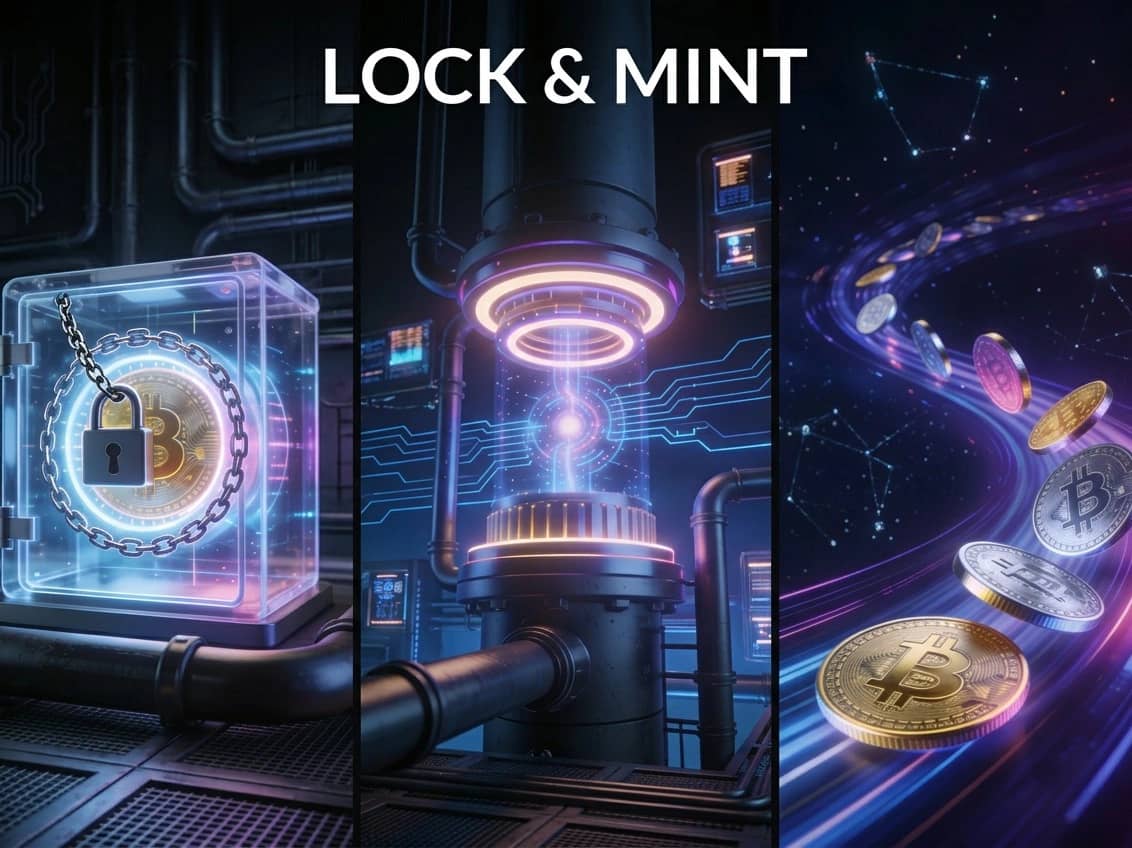
Lock-and-Mint is a cross-chain asset transfer mechanism in which original tokens on a source blockchain are locked under custody, while an equivalent amount of wrapped or synthetic tokens is minted on a destination blockchain.
The wrapped tokens function as claims on the locked collateral and can be burned to trigger an unlock of the original assets, enabling value to move across otherwise isolated blockchain environments while maintaining a one-to-one peg backed by verifiable collateral. [1] [2]
Background and Motivation
Blockchains are siloed systems that do not natively communicate with each other. Lock-and-Mint addresses this by representing a native asset from one chain on another chain, allowing the asset’s holder to access decentralized finance, governance, and other on-chain applications in the destination environment without relinquishing a collateralized link to the original token. The representation is enabled by locking the original asset and issuing a pegged token that mirrors its value and can circulate on the destination chain. [2] [1]
This mechanism is foundational for bridges seeking to maintain a straightforward collateral relationship and transparent backing of wrapped assets. It is employed in both custodial and decentralized bridge designs, with differences in how custody and verification are implemented.
In addition to enabling general-purpose DeFi participation, Lock-and-Mint has been cited for facilitating capital aggregation across chains for use cases such as decentralized sustainability initiatives, where assets must interoperate across multiple blockchain ecosystems. [2] [1]
Mechanism Overview
The mechanism proceeds through a four-step sequence that preserves a one-to-one collateral relationship between the locked asset and the minted representation:
- Lock: The user deposits the native asset into a custody mechanism on the source chain. Custody may be provided by a smart-contract vault, a multisignature (multisig) wallet, or a hybrid model that blends on-chain logic with off-chain controls. The result is that the original tokens are immobilized as collateral.
- Verify: Validators, relayers, or monitoring infrastructure observe the lock transaction and confirm sufficient finality or economic security before proceeding.
- Mint: After verification, an equivalent amount of wrapped tokens is minted on the destination chain under the control of the bridge’s mint authority, creating a claim against the locked collateral.
- Redeem/Unlock: If the user wants to recover the originals, the wrapped tokens are burned on the destination chain; upon verification, the original tokens are unlocked on the source chain and returned as specified. [1] [2]
This sequence ensures that the total circulating supply of wrapped tokens cannot exceed the locked collateral if the mint authority and reconciliation logic function correctly. The system’s safety depends on finality assumptions, custody security, and strict supply accounting spanning both chains. [1] [2]
Custody and Validation Models
Lock-and-Mint supports varied custody models. A purely on-chain smart-contract vault can immobilize assets using programmatic rules, while multisig custody distributes control among multiple signers. Hybrid approaches combine on-chain controls with off-chain operational processes to balance security, flexibility, and cost. The specific choice of custody mechanism affects trust assumptions and risk concentration, as single-key custody introduces higher counterparty risk than threshold or multisig control. [1] [2]
Validation is typically provided by watchers, relayers, or validator sets that attest to lock events and initiate minting on the destination chain after sufficient finality is observed. Protocols must calibrate how many confirmations or what economic finality threshold to require before minting; insufficient finality can expose minting to reorganization risk and potential double-spend–like scenarios. [1] [2]
Core Technical Invariants and Security Properties
Lock-and-Mint implementations target several invariants and properties that preserve solvency and peg integrity:
- Supply conservation: The aggregate supply of wrapped tokens must never exceed the collateral locked on the source chain. Any over-minting results in unbacked tokens and systemic risk.
- Restricted mint authority: Only a strictly controlled mint authority may create or destroy wrapped tokens; insecure admin functions, improper upgrade paths, or alternative mint routes are critical vulnerabilities.
- Custody security: Locked assets must be protected by robust custody mechanisms (e.g., multisig, threshold signatures) and conservative upgrade controls; single-signer custody elevates counterparty risk.
- Finality discipline: Destination-chain minting should wait for adequate source-chain finality to mitigate reorg and double-spend exposure.
- Continuous reconciliation: Automated and manual checks should reconcile locked collateral and wrapped-token supply across chains to detect discrepancies early. [1] [2]
These properties are mutually reinforcing: custody security is ineffective without strict mint authority controls, and supply conservation depends on both reconciliation and finality-aware verification. [1] [2]
Advantages and Trade-offs
Projects adopt Lock-and-Mint for several reasons:
- Capital efficiency: No pre-funded liquidity pool is required on the destination chain; capacity scales with locked collateral rather than market maker capital.
- Fixed 1:1 peg: Wrapped tokens target value parity with the underlying asset, avoiding AMM slippage when minting and redeeming are functioning properly.
- Transparent collateralization: If custody is on-chain or otherwise auditable, participants can verify that the wrapped supply is backed one-to-one by locked collateral. [1] [2]
The key trade-off is that Lock-and-Mint typically substitutes AMM pricing risk with custody and verification risk. While it reduces reliance on liquidity pools, it increases reliance on the bridge’s trust model, including custodians, validators, and monitoring infrastructure. [1] [2]
Risks, Limitations, and Trust Assumptions
Lock-and-Mint mechanisms involve explicit trust assumptions that vary by implementation:
- Counterparty and custodial risk: Users must trust custodians, validator sets, or governance controllers not to collude or mismanage keys. Compromise of custody can lead to loss of collateral.
- Centralization concerns: Many bridges rely on relatively small validator sets or centralized multisigs, concentrating risk.
- Contract and representation risk: Wrapped tokens represent a derivative claim on collateral, introducing contract risk in the wrapped-asset logic and mint/burn pathways.
- Redemption and peg risk: In major failures, users may be unable to redeem wrapped tokens for originals, impairing the peg and liquidity. [1] [2]
These risks amplify the importance of supply reconciliation and robust incident response, including time-locks or delays on large withdrawals to allow community review and emergency measures when discrepancies are detected. [1] [2]
Notable Incidents and Illustrative Failures
Bridge incidents have highlighted how Lock-and-Mint can fail when authority boundaries or verification logic break down. Frequently cited examples include a Wormhole exploit in which unauthorized minting of wrapped ETH occurred due to a signature verification flaw, with reported losses in the hundreds of millions of dollars, as well as large losses linked to other bridges such as Ronin and Nomad. The cited loss magnitudes for these incidents are approximate in the summarized materials and are used to illustrate systemic risks to custody and mint authority in Lock-and-Mint architectures. [1] [2]
These incidents underscore the necessity of external audits, conservative finality assumptions, and defense-in-depth on mint authority and custody design. [1] [2]
Comparison with Liquidity-Pool (AMM-Style) Bridges
Lock-and-Mint contrasts with liquidity-pool bridges that rely on pre-funded pools and automated market makers:
- Capital model: Lock-and-Mint scales with locked collateral and typically requires no destination-chain pre-funding; AMM bridges depend on pool depth and liquidity provider capital.
- Pricing: Lock-and-Mint aims for a fixed 1:1 peg to the underlying asset; AMM-based transfers are subject to pool-implied exchange rates and slippage, especially for large amounts.
- Transfer limits: Lock-and-Mint capacity is bounded by the amount of collateral locked; AMM transfers are bounded by pool liquidity and price impact.
- Trust and mechanics: Lock-and-Mint concentrates risk in custody and validator attestations; AMM bridges introduce LP risks and pool mechanics in addition to any bridging validators.
- Token outcome: Lock-and-Mint produces wrapped tokens that are explicit claims on collateral; AMM models typically deliver native or pool-sourced assets on the destination chain, not strictly wrapped claims. [1] [2]
These differences guide design selection based on desired user experience, liquidity requirements, and acceptable trust assumptions. [1] [2]
Operational and Security Best Practices
Projects implementing Lock-and-Mint typically apply a set of practices to reinforce peg integrity and reduce single points of failure:
- Enforce supply conservation in code and processes, ensuring that mint and burn events reconcile with lock and unlock events across chains.
- Use threshold signatures, MPC, or multisig custody instead of single-key control; consider shard separation of duties for operational resilience.
- Implement time-locks and delay mechanisms for large or sensitive withdrawals to allow review, alerts, and emergency actions if anomalies are detected.
- Require robust finality thresholds or economic security guarantees on the source chain prior to minting on the destination chain.
- Maintain continuous monitoring and automated reconciliation between locked collateral and wrapped-token supply, with alerting on any discrepancy.
- Conduct regular independent security audits covering lock contracts, mint authority logic, validator/relayer code, and upgrade pathways; apply conservative, time-locked upgradeability. [1] [2]
These practices address known failure modes observed in bridge incidents and align incentives toward solvency and timely detection of mismatches. [1] [2]
Use Cases and Capabilities
By enabling assets to move between chains in collateralized form, Lock-and-Mint expands where and how tokens can be used. Typical applications include participation in DeFi protocols, access to governance mechanisms, and integration into on-chain services on the destination network. The mechanism is also presented as a way to consolidate and deploy capital across heterogeneous chains for domain-specific initiatives, including large-scale decentralized sustainability efforts that depend on cross-chain coordination. [2] [1]
Because the wrapped token preserves a claim on the original asset, it can act as portable collateral or medium of exchange in ecosystems that otherwise do not natively support the original token’s standard or chain. This feature broadens liquidity venues while preserving a clear, auditable collateral relationship. [2] [1]
See something wrong?