AriChain
AriChain is a Layer 1 blockchain project that aims to support decentralized applications through EVM
概述
Arichain is a blockchain platform designed to operate as a decentralized, role-based network modeled on the structure of an ant colony, which functions without centralized control. It emphasizes coordinated interaction between participants to achieve collective goals, describing itself as a "SuperOrganism Network."
AriChain's current public positioning describes it as an intent-centric Layer 1 and an AI-Web3 interface. In this model, AI interprets a user's intent and proposes actions, while the chain executes deterministically and checks actions on-chain.[1] The website lists its roadmap in four phases: P1, Multi-VM Testnet Launch, including GAID beta and Agentized Contract; P2, intent rollout, including an Agent Pool, Risk Proof beta, and simulator; P3, Multi-VM Mainnet Launch; and P4, ecosystem expansion.[1]
To reduce entry barriers for users unfamiliar with blockchain, Arichain incorporates a DAPI-based smart contract processing system and offers compatibility with Linux and Windows interfaces. It also provides access to virtual machine environments from earlier blockchain generations to support decentralized application development while minimizing data redundancy and storage inefficiencies.[3][4]
历史
An earlier AriChain whitepaper described a Delegated Random Proof of Stake (DRPoS) design. Later GitBook architecture materials describe EVM, SVM, and domain-specific runtimes under a consensus layer labeled X-BFT, while a separate consensus details page describes a provisional PBFT-based multi-VM flow.[6][3][8] The public materials do not state how or when DRPoS was superseded, or whether the designs are equivalent.
On September 17, 2025, AriChain's official account named its planned multi-VM testnet Ariadne and said it was coming soon.[9] On September 19, 2025, the account described the AI-era intent stack as being prepared alongside the Ariadne Testnet.[10]
The website's roadmap lists a sequence of phases: multi-VM testnet, intent rollout, multi-VM mainnet, and ecosystem expansion.[1]
技术
DRPoS
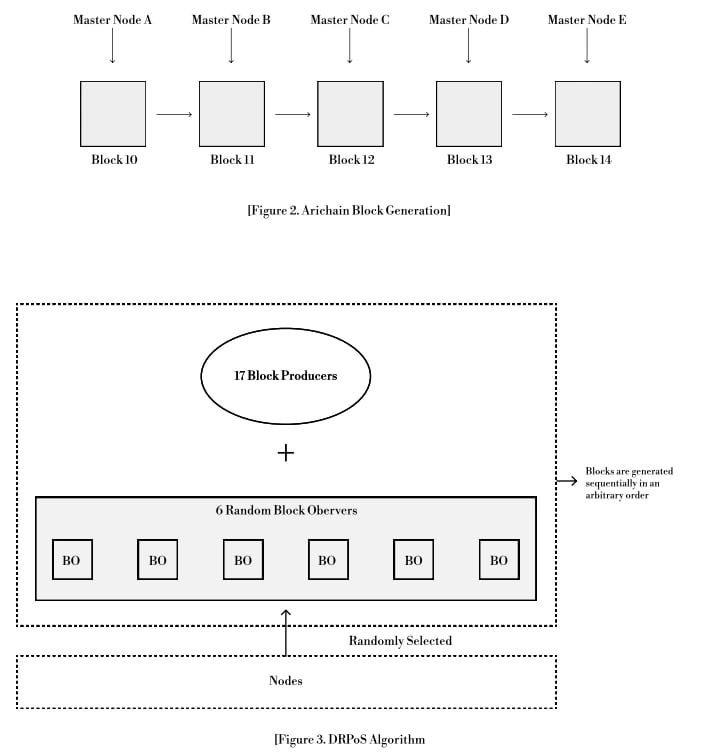
In its earlier whitepaper, AriChain describes Delegated Random Proof of Stake (DRPoS) as a consensus algorithm intended to improve decentralization, energy efficiency, and network security. The design addresses high energy usage and centralization risks associated with earlier consensus methods such as Proof of Work (PoW) and traditional Proof of Stake (PoS). These performance and security aims are claims made by the whitepaper, not independently established outcomes.[6]
The whitepaper's DRPoS design specifies 17 elected Block Producers (BPs) and six randomly selected Block Observers (BOs) drawn from general nodes. Token holders stake ARI to vote for BPs or participate as BOs. The BPs and BOs create blocks in a randomized or sequential order, while nodes support block and transaction validation during production rounds. The paper describes a three-second block interval and a 23-node round, taking 69 seconds to determine irreversibility. It does not specify the random-selection algorithm, voting threshold, or a complete observer verification or quorum procedure.[6]
The whitepaper describes rewards from transaction fees and annual ARI inflation for BPs, BOs, and delegators. BPs retain a commission, and a storage fund is intended to support long-term data storage on full nodes. In the paper's illustrative formula, 10% of annual inflation is directed to the storage fund, with the remainder allocated to producer/delegator and observer rewards.[6]
The earlier whitepaper presents DRPoS as a fourth-generation advancement that modifies and expands on the Delegated Proof of Stake (DPoS) model.[5][2] Later GitBook materials call the multi-VM consensus layer X-BFT and describe a provisional PBFT-based process; the public materials do not document an implementation migration from DRPoS to that design.[7][8][6]
Multi-VM Architecture
AriChain's GitBook describes a multi-dimensional Layer 1 with independent EVM, SVM, and domain-specific virtual machines operating under shared infrastructure and unified consensus. The materials describe shared security, staking, and governance across the VMs, and a proposed Global Account ID (GAID) for identity across them.[3]
The GitBook calls the multi-VM consensus layer X-BFT and describes unified block production, parallel validation, separate mempools, cross-VM routing, and an ARI fee market with VM-specific gas metering.[7] A separate consensus details page explicitly labels its account provisional. It describes validators receiving bundles from EVM and SVM mempools, executing transactions in parallel in their respective VM environments, reconciling cross-VM state using cryptographic proofs, and committing the combined state root after validator agreement. The page states a “2/3 + 1” validator agreement threshold.[8]
AI Intent Stack
The website describes an AI Planner that interprets a request and proposes a plan, with a Planner + Supervisor structure for planning and oversight. A Task Tensor represents execution as a graph of tasks. Agentized Contract manifests describe contract capabilities, while Risk Proof checks assess proposed actions; ARI-Assure provides post-execution checks.[1] These are website-described components and roadmap features, not necessarily deployed services.
代币经济学
The current GitBook describes ARI as intended for validator staking in the X-BFT layer and delegated staking, with a portion of staking rewards allocated to delegators. It also describes ARI as the unified multi-VM fee token and final settlement token, and as an asset for governance participation. Cross-VM gas abstraction is described as planned, and the token details may change as development progresses.[11] The token supply-and-distribution page currently lists its details as “TBD,” to be disclosed later.[12]
For historical context, an earlier whitepaper gives an example of a 500 million ARI total supply and 1.5% annual inflation; these are example parameters, not a confirmed final supply. Its illustrative reward formula directs 10% of annual inflation to the storage fund and allocates the remainder to producer/delegator and observer rewards.[6]