0% read
最后更新:
Ankr Network
The Ankr Network is a decentralized network of nodes designed to provide flexible and cost-efficient connections to blockchains. It’s built for Web3 developers and aims to make the global cloud infrastructure more accessible.[1][5]
Background
The Ankr Network was founded by Chandler Song[7] and Ryan Fang[8] in 2017 shortly after graduating from the University of California, Berkeley after being early participants in the Blockchain at Berkeley program. Chandler was working as an engineer at Amazon Web Services at the time where he met Stanley Wu,[9] the third co-founder. Together, they took on a mission to build the most decentralized and scalable Web3 infrastructure possible.[1]
After releasing the Ankr mainnet in 2019, the dev team behind the ANKR project launched a staking protocol, dubbed Stkr. Stkr allows users to stake Ethereum (ETH) in return for aETH, which represents the future gains on the deposited staking balance. That is how network participants are rewarded for staking through the Stkr protocol. Users can likewise deploy development nodes and build dApps on the network, or deploy staking nodes and enjoy the perks of becoming stakers on the ANKR Web3 platform.[3]
概述
Ankr is a comprehensive Web3 development hub offering a complete suite of tools for organizations to construct decentralized applications (dApps) and integrate them with high-performance connections to blockchain networks. In July 2026, Ankr reported serving more than 80 chains and processing more than one trillion RPC requests per month. Notable clients, including Microsoft, Tencent Cloud, Optimism, Polygon, Binance, and Messari, rely on Ankr's global node infrastructure for connections to major Web3 networks.[26]
Ankr has been used and is trusted by businesses like Stellar, Microsoft, Nansen, Binance, Messari, Avalanche, Wormhole, Bitfinex, 1inch, Tencent, SushiSwap, Polygon, Chiliz, etc.[2]

Ankr DePIN's Network
Ankr, a pioneer in Decentralized Physical Infrastructure Networks (DePIN) announced on March 14, 2024, that it was embarking on a significant expansion of its network through strategic collaborations with leading Ultra Sound Infrastructure providers. Ankr's commitment to enhancing performance and decentralization brings benefits such as increased node availability, access to high-performance archive nodes, and extended geographic coverage to bridge gaps in node resources.[23]
"As pioneers in the DePIN landscape, we're thrilled to broaden the availability of high-performance decentralized nodes through our Ultra Sound Infrastructure network." - Stanley Wu, Co-founder & CTO of Ankr[23]
The new partners include IoTex, Gateway, Storj, Clover, Tencent Cloud, Mind Heart Soul, and Ankr Labs. The ANKR token is an integral component of the Ultra Sound Infrastructure program and sees expanded utility as the exclusive payment method for accessing the highest tier of infrastructure, including archive nodes. This enhancement solidifies the ANKR token's critical role in Web3 operations, serving as a "gas" payment for multi-chain infrastructure and providing access to top-quality Web3 infrastructure.[23]
技术
Ankr operates as a globally distributed company to advance the next-generation decentralized internet. To achieve this, Ankr utilizes distributed ledger technology (DLT) to harness computing power, which is then utilized to aggregate data resources.[6]
These resources are subsequently deployed to developers and stakers through cost-effective data centers. This approach facilitates the easy creation and deployment of decentralized applications (dApps) and the staking of balances by developers and stakers. Ankr's staking mechanism is facilitated by the Stkr protocol, introduced in 2020, allowing for the staking of Ethereum (ETH) in exchange for aETH.[3]
The ANKR token serves as the native token of the network, providing various utilities such as payments, access to deployed applications, staking, and participation in governance through voting. Ankr's overarching aim is to broaden its support for additional blockchain protocols as part of its efforts in developing a more private and secure decentralized internet under the Web3 framework.[6]
ANKR offers three primary avenues for user participation: running nodes and staking, developing and deploying applications, and accessing enterprise solutions.[6]
Users can easily deploy nodes, earning passive income while supporting network operations for developers and enterprises seeking cost-effective Web3 access. Ankr provides developer APIs for deploying blockchain applications efficiently, serving as a cloud computing network tailored for enterprises and developers. Through the Stkr protocol, ANKR facilitates ETH 2.0 staking, enabling stakers to profit from their balances.[2]
The network comprises mining, data center, and computing nodes, distributing computational power efficiently to support development and staking protocols. Ankr's contributions strengthen the DeFi sector and the advancement of the decentralized web.[6]
产品
Ankr expanded its Web3 infrastructure products during 2025. Its year-end review reported support for 100 chains and 12 trillion RPC requests during the year. Web3 API additions included gRPC access for Premium users, while its rollup-as-a-service offerings added no-code deployments for Polkadot, Agglayer, Base, and ZK Stack, as well as Solana Permissioned Environments. The review also described choices for rollup stacks, data availability, and gas tokens.[27]
On August 18, 2026, Ankr launched Agent RPC, an interface based on the Model Context Protocol (MCP) for autonomous agents. It provides indexed chain-data tools across 29 networks, alongside account-management tools for actions such as managing accounts. Agent RPC also uses TORPC, Ankr’s open, token-optimized format for RPC interactions.[28]
Ankr Confidential RPC entered demo phase on its production network on October 22, 2026. It encrypts requests and responses end-to-end between the client and an attested Intel Trust Domain Extensions (TDX) node; the gateway routes and bills the traffic without being able to read its contents.[29]
Ankr launched x402 pay-per-request infrastructure on Monad mainnet on October 15, 2026. Autonomous agents can pay for each request in USDC without an account, signup, or API key. The service uses HTTP 402 to negotiate payment terms, verifies a signed USDC payment on Monad through a facilitator, and then returns data. Agents can access services through agent tools or JSON-RPC.[30]
On October 26, 2026, Ankr made Ethereum Fast Confirmation Rule (FCR) support available on Ethereum mainnet and Sepolia RPC. Ankr’s Ethereum RPC safe block tag follows FCR-backed blocks, typically one to two slots—about 12–24 seconds—behind the head, rather than waiting roughly 13 minutes for Ethereum finality. FCR is a faster confirmation threshold, not Ethereum finality. Its reliability depends on timely network-message delivery; prolonged network partitions or substantial validator misbehavior can result in an incorrect fast confirmation.[31]
How Ankr is Secured
Ankr ensures security through computational power, distributing blocks across the network to support the deployment of developer APIs, enterprise solutions, and staking protocols. Validator nodes are pivotal in maintaining security, randomly selected from a node pool. This selection process prioritizes nodes based on their service level and positive contributions rather than the amount staked, ensuring fairness for all stakers, regardless of balance size.[6]
ANKR Token
ANKR is the utility and governance token of Ankr. It is an ERC-20 and BEP-20 token that can be used in both the Ethereum and Binance Smart Chain ecosystems.[4]
ANKR can be used for staking, voting on governance proposals, and as a payment method for accessing services on the ANKR network, such as dApp and protocol deployment. It also serves as a reward for stakers and network participants.[4]
Ankr has a limited supply of 10 billion ANKR tokens, which means that no new coins should be minted once the total supply is exhausted unless changes are proposed and voted on by network participants.[4]
In July 2026, Ankr described a strategic change in which it aimed to capture part of partner RPC spending to buy ANKR and provision liquidity. It introduced Ankr Forge as a rewards and coordination platform for ANKR holders. A qualifying ANKR balance establishes eligibility, while partner, social, and on-chain missions earn Forge Points that determine users’ proportional shares of periodic Forge Drops. Ankr said the rewards would be funded by infrastructure deals and partner contributions rather than token emissions.[26][32]
On October 20, 2026, Ankr and Kite announced that Kite Agent Passport missions had been added to Forge Heat 2. The missions let participants explore agent identity and autonomous transactions and earn Forge Points.[33]
Neura
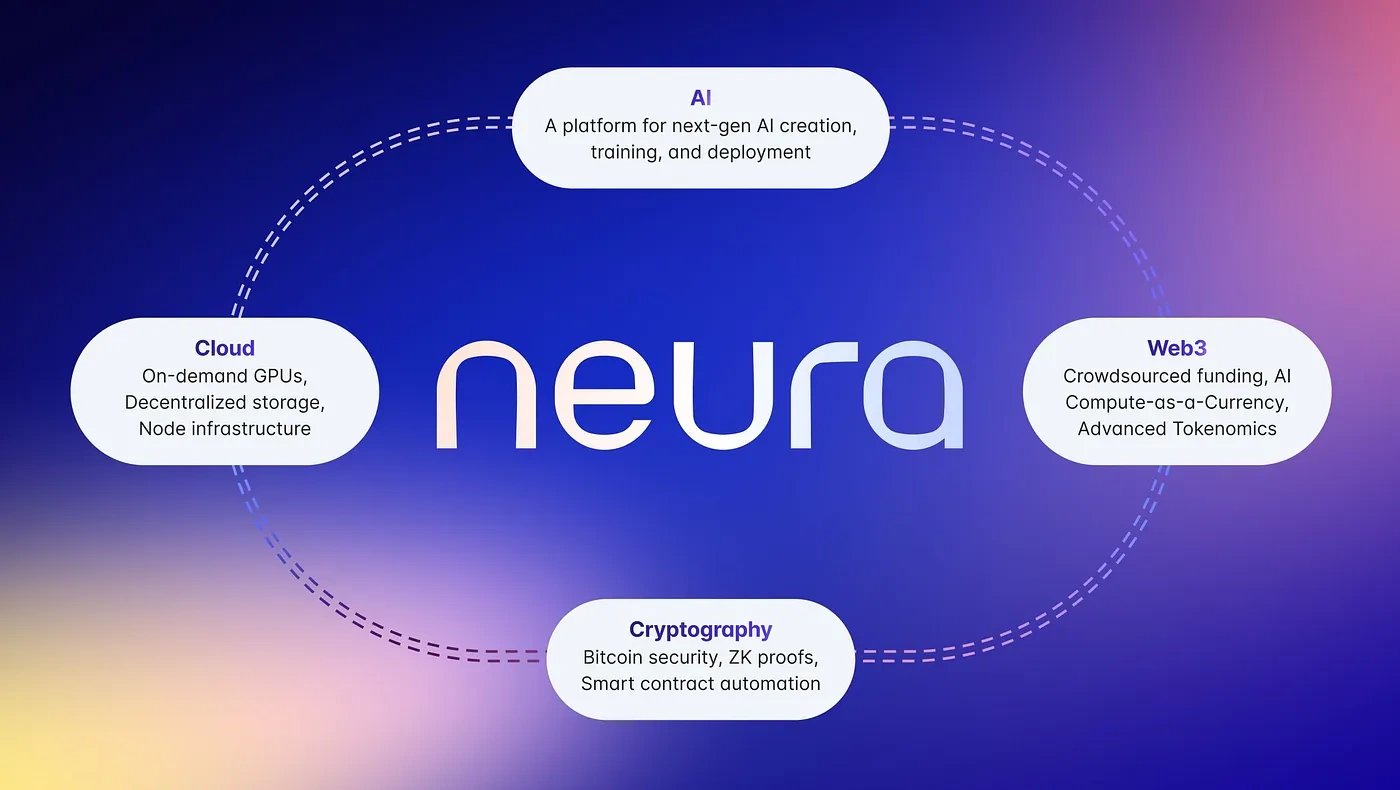
Released by Ankr on March 26, 2024, Neura is a blockchain that integrates AI, cloud computing, and Web3 technologies, creating a transformative era for digital innovation across all three industries.[11][12]
Neura was engineered to solve some pressing challenges AI developers face when bringing new projects to market. Neura is set to offer foundational infrastructure for AI startups, offering access to decentralized GPU resources, crypto-based crowdfunding, and on-chain AI operations. Neura provides a fusion of cloud computing, AI, and Web3 technologies to transform the way AI companies can deploy, train models, and operate on the blockchain.[12]
“Neura offers a superior operating system for the neural networks of AI models, supercharging them with trusted data, scalable access to GPU resources, smart contract automation, and new economic models more capable of handling by-the-second demands of future AI apps and payments. The convergence of Web3 and AI will be one of the most important events for both industries, and we are very excited to be leading the way" - Chandler Song, Ankr’s Co-Founder and CEO commented[11]
On October 23, 2026, Ankr ended RPC support for its Neura testnet endpoint and removed Neura from its documentation chain list.[29]
ANKR Token on Neura’s Ecosystem
The ANKR token plays a vital role in Neura's ecosystem, serving as a universal currency for accessing GPU resources, participating in IMOs, and acquiring AI services. It incentivizes GPU providers and compensates AI developers, nurturing an ecosystem of innovation and growth.[11]
Neura's launch underscores the ANKR token's indispensable role, highlighting its utility, demand, and contribution to broader growth and innovation strategies. By emphasizing ANKR's integral role and Neura's innovative economic models, Ankr aims to demonstrate the token's substantial value proposition to holders and ecosystem participants.[11]
合作伙伴
Ankr x Optimism
In June 2022, Ankr became a remote procedure call provider for Optimism — an open-source layer-2 scaling solution for Ethereum. The partnership allows decentralized application (DApp) developers from all parts of the world access to Optimism’s public and premium RPCs.“We love what Optimism is building for the future of Ethereum. Ankr is happy to do our part to provide a fast and reliable RPC service for their users,” - said Greg Gopman, chief marketing officer of Ankr.[20]
Ankr x SSV Network
In September 2022, Ankr strategically partnered with the SSV (Secret Shared Validator) team to integrate decentralized node operation technology into SSV's liquid staking product. Upon launch, there were two liquid staking solutions at Ankr. The classic Ethereum liquid staking product and the SSV trustless liquid staking solution.[19]
Ankr x Microsoft
In February 2023, Microsoft partnered with Ankr to provide a novel node hosting service on the Microsoft Azure Marketplace. The partnership also saw an integration of technology from both companies, pairing Ankr’s blockchain infrastructure with Microsoft’s cloud solutions. Per Ankr, the enterprise node deployment service offered low-latency blockchain connections for Web3 projects so developers could instead spend time scaling their applications.[18]
Chandler Song, co-founder and CEO of Ankr, commented on the development:
“The partnership, while an incredible milestone for Ankr, is also a key indicator of how far the decentralized web has come in integrating with the crucial players in every layer of web systems. The end result will be an era of extremely prolific building for blockchain-based applications from new Web3 projects as well as large enterprises entering the space.”[18]
In June 2023, Ankr announced the launch of its enterprise blockchain creator tool on Microsoft’s Azure Marketplace — “AppChains”. AppChains solution enables companies to launch a dedicated and customizable blockchain to power various Web3 strategies. Developers can deploy the Polygon Supernet on its first iteration, with more choices thereafter. According to Ankr, AppChains had been available for a year prior with use in launching application-specific blockchains to power their decentralized applications. However, Ankr’s developers witnessed strong demand from institutional clients for using AppChains in areas such as banking, central bank digital currencies, and gaming.[22]
“Making the AppChain solution available on Microsoft’s Azure Marketplace provides an easy path for businesses to find a vetted solution and go to market with use cases like the above. AppChains ensure fast and affordable transactions, seamless user experiences, regulatory compliance, and end-to-end engineering.”
Ankr x Tencent Cloud
On February 23, 2023, Ankr announced a partnership in the cloud provider industry with Tencent Cloud. Both parties signed an agreement to jointly develop a full suite of blockchain API services, provided by a globally distributed and decentralized network of Remote Procedure Call (RPC) nodes. The services cater to thousands of applications, games, virtual worlds, and companies needing connections to blockchain data while allowing any enterprise to launch a dedicated blockchain node cluster harnessing the Tencent Cloud in conjunction with Ankr’s globally distributed bare-metal servers.[21]
“Partnering with Tencent Cloud is a big step forward in upgrading [web3] - (https://iq.wiki/wiki/web3) infrastructure to handle adoption from some of the world’s largest organizations entering the space. Together we shall provide a gateway to blockchain data that is easier to access and more performant.” – Chandler Song, Co-Founder & CEO, Ankr[21]
Team Members
- Chandler Song - CEO[7]
- Ryan Fang - COO[8]
- Stanley Wu - CTO[9]
- Marco Robustelli - Marketing Advisor[10]
- Yuriy Momotenko - Backend Blockchain Engineer
- Fabio Wehb Ferrari - PR & Events Lea
Exploit
In December 2022, Ankr was hit by a multi-million dollar exploit on the aBNB token as confirmed on Twitter. The attack resulted in an immediate halt in trading the compromised token.[13]
"Our aBNB token has been exploited, and we are currently working with exchanges to immediately halt trading." - the team tweeted[14]
The attacker was purportedly able to mint 20 trillion Ankr Reward Bearing Staked BNB (aBNBc), a reward-bearing token for BNB staked on the protocol. According to a Twitter post from on-chain analysis firm Lookonchain, the exploiter used services such as Uniswap, Tornado Cash, and various bridges to swap and obfuscate the funds to gain around $5 million worth of USD Coin.[13]
A few weeks later, it was confirmed by the Ankr team that a former Ankr team member was behind the exploit. The ex-employee had conducted a “supply chain attack” by putting malicious code into a package of future updates to the team’s internal software. Once this software was updated, the malicious code created a security vulnerability that allowed the attacker to steal the team’s deployer key from the company’s server. Ankr alerted local authorities in an attempt to have the attacker brought to justice.[15]
The Ankr team said that it did not use a multisig account for ownership in the past but would do so from then on, stating:
“The exploit was possible partly because there was a single point of failure in our developer key. We will now implement multi-sig authentication for updates that will require signoff from all key custodians during time-restricted intervals, making a future attack of this type extremely difficult if not impossible. These features will improve security for the new ankrBNB contract and all Ankr tokens.”[15]
A group called “Victims of Ankr Exploit” claimed that its members lost over 13,000 BNB liquid staking coins (over $4 million worth at the time of writing) as a result of the exploit and were not adequately reimbursed by the Ankr company. According to a Jan. 19, 2023 statement from the group received by Cointelegraph, affected members alleged that they had only received half of the amount they lost. The group has called on Binance's former CEO Changpeng “CZ” Zhao to put pressure on Ankr to get the rest of the funds released.[16]
However, Ankr developed a reimbursement plan for the most impacted users. They fixed damage to Helio (aBNBc borrowing platform) by re-stabilizing HAY Price and continued purchasing HAY if the token remained unpegged until all funds were spent. They also airdropped BNB to all affected DeFi liquidity providers. In addition, Ankr reached an agreement to reimburse Wombat stkBNB LPs and planned to provide 100% coverage of the BNB Wombat LPs.[17]
ankrFLOW Incident (August 2026)
At about 06:18 UTC on August 31, 2026, a vulnerability in Ankr’s ankrFLOW liquid-staking Solidity contract allowed an attacker to create about 8.6 million unbacked ankrFLOW. The attacker used the tokens as collateral on MORE Markets and drained about 15.5 million WFLOW, valued at about $410,000 at spot prices; after slippage, the attacker realized roughly $246,000. Flow attributed the flaw to Ankr’s contract, not Flow EVM, the Flow protocol, or MORE Markets, and reported that no MORE Markets or ankrFLOW depositors lost funds.[34][35]
Ankr and MORE Markets paused affected contracts within hours. Flow Foundation said it would replace the drained WFLOW reserve and rebalance the affected pool. As of Flow’s September 1, 2026 statement, ankrFLOW staking and MORE Markets lending were to remain paused until Ankr deployed a corrective contract upgrade.[34]
Ethereum Bridge Exploit (November 2026)
On November 9, 2026, five unauthorized withdrawals from Ankr’s Ethereum cross-chain bridge transferred assets to one destination wallet. Reports estimated that the three priced assets totaled more than $303,000: about 82.91 ankrETH ($216,370), 515,206 ankrPOL ($56,372), and 7.98 million ANKR ($30,857). The withdrawals also included 5,372.25 aMATICb and 0.8196 aETHb, which were excluded from that estimate because prices were unavailable.[36][37]
According to security-firm analysis and on-chain records cited in reports, a legitimate 0.0044024803 ankrETH deposit originating on Optimism on November 3 had already been redeemed that day. On November 9, five withdrawal requests reused that source transaction while changing the recipient, token, and amount. Reports said the receipts passed the bridge’s trusted-signer signature checks. Available analysis had not established how the attacker obtained the signatures or whether a signing key was compromised.[37][38]
The Ethereum bridge contract was paused at about 09:51 UTC on November 9, after the five withdrawals. The pause contained further withdrawals but did not recover assets already drained. Reports dated November 10 said that no public recovery plan or root-cause finding had been announced.[37][38]
A November 14, 2026 report by an ankrETH holder said an on-chain transfer test had reverted with a paused-contract error and that Ankr support had confirmed unstaking was also frozen. This was the status reported on November 14.[39]
Reporting did not confirm compromise of Ankr RPC infrastructure or users’ personal wallets.[36]
发现错误了吗?