Theseus Network
Theseus Network is a Layer-1 blockchain designed for AI-native applications, with infrastructure focused on autonomous agents, verifiable inference, and on-chain AI execution. The network uses components such as the AI Virtual Machine (AIVM), Tensor Commits, and agent-specific accounts to enable AI workloads to be executed and verified within a decentralized environment. [1]
Overview
Theseus is a Layer-1 blockchain designed to support AI execution and autonomous agents as core network functions. Its architecture enables AI agents to exist as on-chain entities with their own cryptographic keys, balances, and persistent state, allowing them to operate independently rather than relying on externally controlled wallets or applications. AI inference is treated as a native blockchain operation, with each execution verified through cryptographic proofs or digital signatures before it can modify on-chain state. The platform is built on the Substrate framework, supports asynchronous execution across multiple blocks, and incorporates custom runtime components for AI coordination alongside standard blockchain functionality. Theseus is currently available in an alpha testing phase, where full-proof systems are being evaluated before broader production deployment.
The platform is built around three primary components: the AI Virtual Machine (AIVM), Tensor Commits, and a native USD-pegged gas unit called seus. AIVM provides a deterministic runtime for registering AI models, executing inference, enforcing agent policies, and managing autonomous behavior directly on-chain. Tensor Commits provide succinct cryptographic proofs that enable network participants to efficiently verify AI inference before state changes are finalized, reducing the need to trust individual operators. Agents can independently manage and spend native assets, pay for inference, receive fees, and interact with other agents without requiring continuous human authorization. Theseus also defines multiple operational models, ranging from human-managed agents to fully autonomous agents that maintain their own policies, balances, and execution history while responding automatically to on-chain events. [2]
Technology
Proof of Agenthood
Proof of Agenthood (PoA) is a signed credential system that allows third parties to verify the identity, ownership, capabilities, and inference verification history of an AI agent. Each credential is a portable JSON document linked to a specific agent registered on Theseus, containing information such as its controller, Agent Behavior Graph (ABG), declared capabilities, and recent verification status, all of which can be verified against public keys and revocation records. The system relies on Theseus infrastructure, including on-chain agent addresses, stored behavior definitions, capability declarations, and execution history, to provide verifiable information that cannot be changed without leaving an observable record. At the alpha stage, PoA credentials are controller-attested, meaning they confirm that an agent’s registered controller approved the credential, while future sovereign agent support would enable attestations without a human controller. PoA does not certify an agent’s quality or behavior; instead, it provides a verifiable record of who controls the agent, what it is authorized to do, and whether its underlying on-chain state remains consistent with the issued credential. [3]
AIVM
The AI Virtual Machine (AIVM) is Theseus's execution layer, providing a deterministic runtime for AI inference and autonomous agent operations within the blockchain. Implemented as a Substrate pallet, it queues model and agent requests, receives inference results from off-chain provers, and verifies them through constant-time cryptographic verification before allowing any state changes, ensuring that only validated outputs are accepted by consensus. AIVM supports asynchronous execution, specialized tensor-native opcodes for AI computations, deterministic processing using verifiable random functions, and a gas model that prices operations according to their computational workload. The runtime also includes sandboxed memory management, proof-generation interfaces, verified system-call boundaries, and state-anchoring mechanisms that support efficient validation and cross-chain verification. Compared with traditional blockchain virtual machines, AIVM is designed specifically for AI workloads by incorporating native support for tensor operations, inference verification, autonomous agent execution, and computational cost models based on floating-point operations rather than general-purpose instruction execution. [4]
Tensor Commits
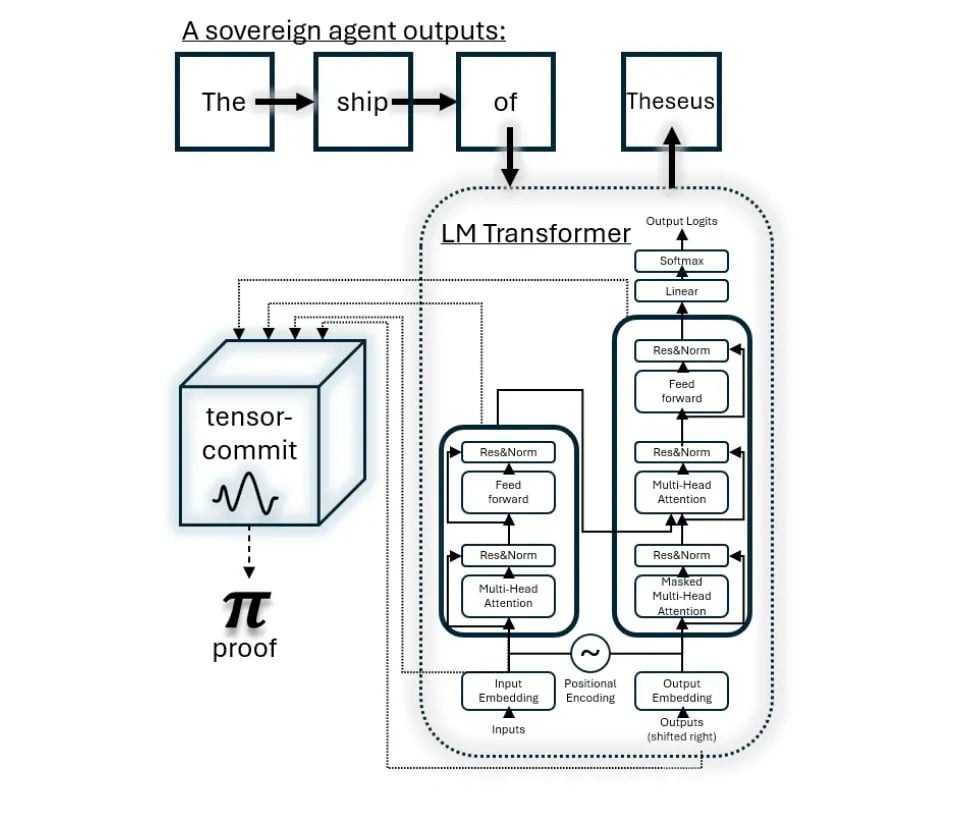
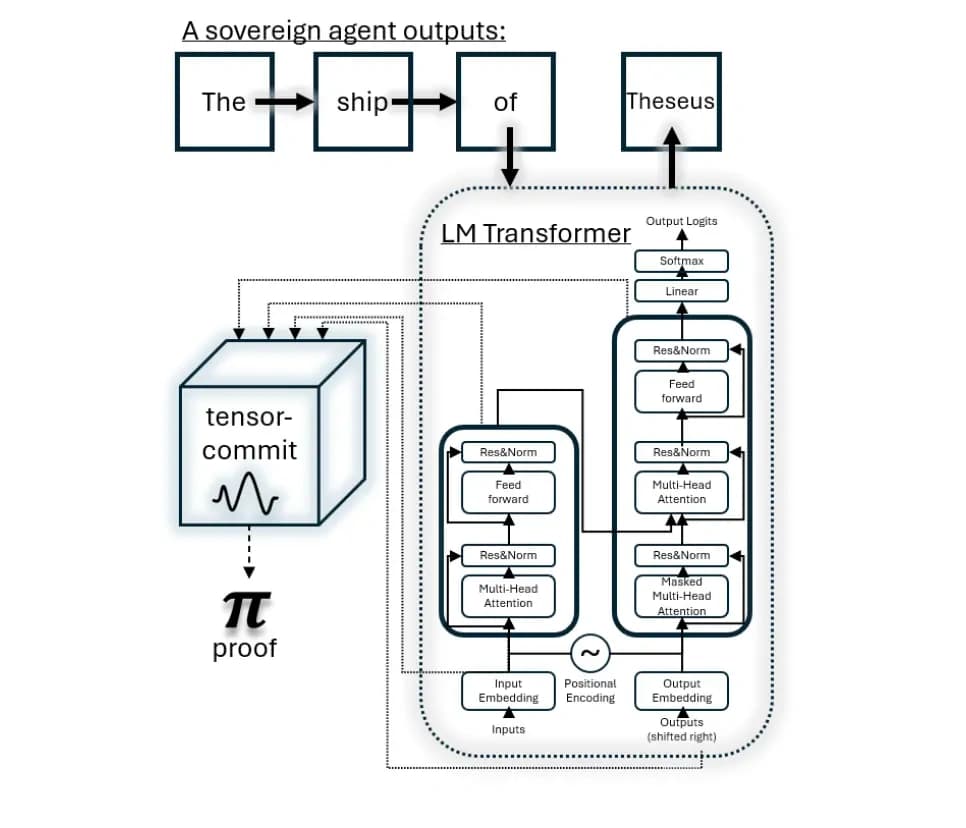
Tensor Commits is the cryptographic verification protocol that enables Theseus to validate AI inference without requiring validators to recompute entire models. The protocol uses tensor-based commitment schemes derived from KZG cryptography to generate compact proofs that verify large neural network computations with minimal computational overhead, while organizing commitments in hierarchical Terkel trees to efficiently represent model weights and intermediate computations. During execution, model weights are registered with an on-chain commitment, inference results are accompanied by cryptographic proofs, and validators independently verify each proof in milliseconds before consensus accepts any state changes. The protocol is designed to support production-scale AI models by providing low proof-generation overhead, efficient proof sizes, logarithmic verification complexity, and privacy-preserving verification that does not require validators to access model weights. Compared with full model re-execution or zero-knowledge machine learning approaches, Tensor Commits aim to reduce verification costs while maintaining scalable verification, hardware-independent validation, and efficient support for large neural network architectures. [5]
Agents
Theseus agents are created from a four-file workspace that compiles into an on-chain entity with its own keys, balance, state, and static Agent Behavior Graph (ABG). The workspace includes a configuration file, tool definitions, reusable skills, and execution logic that together define the agent’s capabilities and behavior. Agents operate through event-driven execution, waking on triggers such as schedules, blockchain events, or external calls, then processing tasks through their ABG until an inference or tool request requires verification. Their execution follows a queue, proof, and resume cycle, in which inference results are verified before the agent continues operating in a later block.
The agent framework separates static behavior from dynamic execution history, with the ABG defining permitted actions and the Agent Knowledge Graph (AKG) recording execution steps and observations. Agents can register on-chain accounts, hold their own balance, pay for inference and tool usage, and interact with other agents through controlled calls with limits on execution depth. Models are registered separately and referenced by agents, with model weights anchored through content-addressed storage for verification by provers. The system enables autonomous operation by allowing agents to manage their own resources and execute based on on-chain conditions without requiring human authorization for each action. [6]
Architecture
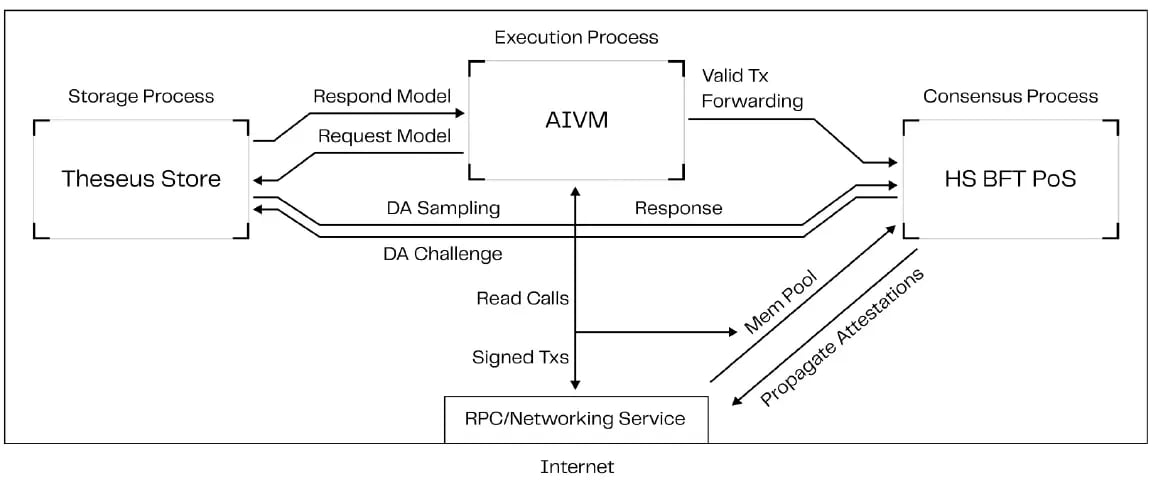
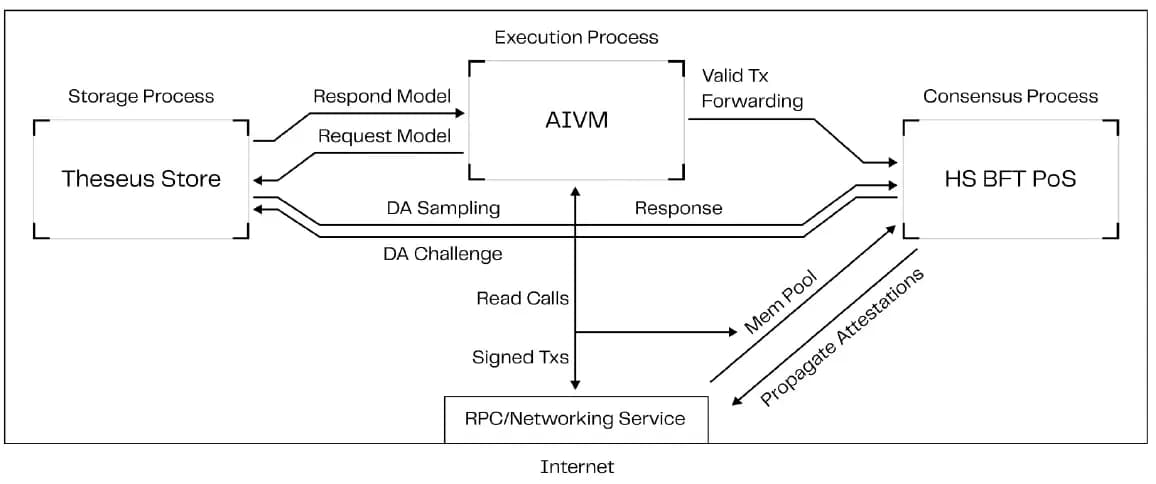
Theseus is built on a three-layer architecture that integrates execution, storage, and consensus to support AI workloads within a blockchain environment. Built on the Substrate framework, the network coordinates AI inference and autonomous agent execution, while computationally intensive processing is performed off-chain by specialized provers, who submit results along with cryptographic proofs for on-chain verification before any state changes occur. The execution layer is powered by the AI Virtual Machine (AIVM), which manages deterministic AI inference, agent scheduling, proof generation, and transaction processing. The availability layer, TheseusStore, stores model weights and agent context off-chain using content-addressed storage anchored by on-chain cryptographic roots to verify data integrity. The consensus layer employs Byzantine Fault Tolerant proof-of-stake, requiring validator agreement on inference proofs, model integrity, and data availability before blocks are finalized. Provers are selected through a verifiable random function based on stake and hardware capacity, and validators independently verify every submitted proof. This architecture separates AI computation from blockchain verification while ensuring that only cryptographically verified inference results and retrievable data are incorporated into the network's state. [7]