0% read
Last updated:
Cysic
Cysic (CYS) is a decentralized hardware acceleration layer designed to improve the performance and reduce the cost of generating Zero-Knowledge (ZK) proofs. The project aims to address the computational bottlenecks inherent in ZK technology by creating a specialized network of hardware, including GPUs and custom ASICs. Cysic positions itself as a foundational infrastructure layer for ZK-rollups, ZK-coprocessors, and other applications leveraging ZK cryptography, operating under a model it terms "ComputeFi," which seeks to financialize computational power. [1] [2]
Overview
Cysic's core mission is to create a full-stack, decentralized compute network that serves the growing demand for verifiable computation in Web3. The project identifies that computationally intensive tasks, particularly ZK proof generation, create significant time and energy costs that hinder the scalability of blockchain applications. Cysic proposes a solution in the form of a decentralized marketplace that connects compute providers (owners of specialized hardware) with compute requesters (such as ZK-rollup sequencers). By offloading these intensive tasks to its network, Cysic aims to accelerate proof generation by 10 to 1,000 times. [1] [3]
The project's vision, known as ComputeFi, treats computational resources as programmable, liquid, and yield-bearing assets. This framework intends to establish a market for on-chain compute liquidity, positioning computation as a fundamental pillar of Web3 infrastructure alongside decentralized finance (DeFi), storage, and bandwidth. [1]
Beyond ZK proof acceleration, Cysic has expanded its scope to include services for artificial intelligence (AI) and consumer-grade crypto mining. The infrastructure is designed to be multi-purpose, with a long-term goal of supporting various forms of digital computation on a single, unified network. [3] [2]
Technology and Architecture
Cysic's platform is built on a "hardware-software co-design" philosophy, combining a modular network architecture with a multi-stage hardware acceleration strategy. [2]
Network Architecture
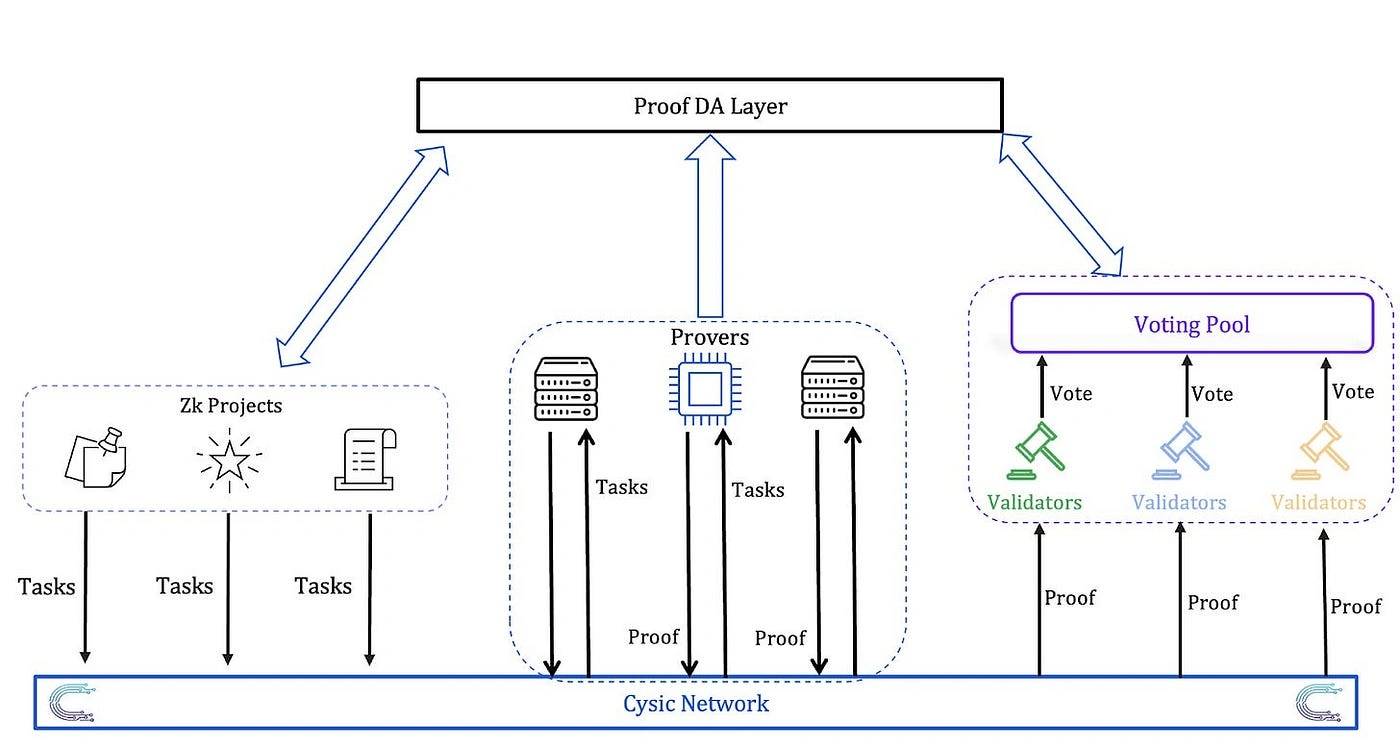
The Cysic Network is built using the Cosmos Chain Development Kit (CDK) and functions as a decentralized marketplace for computational tasks. It features a four-layer modular architecture and a modified consensus mechanism. [3] [2]
- Hardware Layer: The base layer comprising the physical computational resources contributed by network participants, including CPUs, GPUs, FPGAs, and ASICs.
- Consensus Layer: This layer uses a modified CometBFT consensus engine called Proof-of-Compute (PoC). In the PoC model, a validator's weight is determined by a combination of staked tokens and staked compute resources, ensuring that entities contributing to the network's computational power have a proportional say in its governance.
- Execution Layer: An EVM-compatible layer that handles the logic for task scheduling, workload routing, and settlement through smart contracts.
- Product Layer: The user-facing application interface that supports Cysic's various use cases, including the ZK proof market and AI inference services.
The architecture is designed to manage the lifecycle of a computational task, from a user's submission to its dispatch to a prover, verification of the result, and final settlement. This structure aims to provide reliability and optimized resource allocation across the distributed network. [4] [2]
Network Roles and Status
The network consists of two primary node types: [2]
- Prover Nodes: Responsible for executing computationally intensive tasks, such as generating ZK proofs for Ethereum mainnet blocks. Provers are required to stake 10 CYS as collateral.
- Verifier Nodes: Perform lightweight verification of the proofs generated by provers to ensure correctness and network security. To lower the barrier to entry, these nodes can run on standard hardware and require a stake of 0.5 CYS.
Phase III of the Cysic testnet, named "Ignition," was completed on September 18, 2025. According to project reports, the testnet attracted 1.36 million registered users, with over 260,000 nodes participating and processing 8 million transactions. As of October 15, 2025, the network reported approximately 42,000 active Prover nodes and over 100,000 Verifier nodes. [2]
Hardware Acceleration Strategy
Cysic employs a dual-track strategy for hardware acceleration, using both GPUs for immediate market needs and developing custom ASICs for long-term performance advantages. [5]
ASIC Development
Cysic's primary long-term competitive advantage is its focus on custom silicon. The ASIC development path is centered around several key innovations:
- Hypercube Intermediate Representation (IR): This is a proprietary optimization layer that restructures ZK circuits into high-dimensional, hypercube-style data flows. It is designed to make circuit logic align with the parallel processing capabilities of modern silicon, enabling more efficient memory access and maximizing parallelism. Cysic claims this IR allows for a 13x performance increase on a single chip. [5]
- Cysic C1 Chip: A zkVM-based ASIC that forms the basis of Cysic's hardware products. It features high internal memory bandwidth and is designed to be programmable for developers. The project has demonstrated the capacity to prove 131.31 million Keccak functions per second on its ZK-ASIC design. [5]
- Hardware Products: Two ASIC-based hardware products were planned for release in 2025:
- ZK Air: A small, portable plug-and-play ZK proof accelerator.
- ZK Pro: A high-performance hardware system built for large-scale ZK workloads. [5]
GPU Acceleration
To provide a more immediate and flexible solution, Cysic developed GPU-based acceleration tools:
- GPU Acceleration SDK: An in-house CUDA software development kit for GPU-accelerated ZK proving. It supports major proof systems, including Plonky2, Halo2, and Gnark. [5]
- ZKPoG (Zero-Knowledge Proof on GPU): A proving stack developed in collaboration with Tsinghua University that optimizes the entire ZK pipeline—from witness generation to final proof computation—on a single consumer-grade GPU. Project tests claim ZKPoG delivers up to a 52x faster performance compared to CPU-based proving. [5] [2]
Products and Services
In addition to the core Cysic Network, the project is developing a suite of products for ZK, AI, and mining. [3]
Cysic AI
Cysic AI is a service designed to provide infrastructure for AI models, structured in three tiers: [2]
- Serverless Inference: A pay-as-you-go service providing API access to large language models like Meta-Llama-3 and Phi-4.
- Agent Marketplace: A decentralized platform for AI Agent applications built on Solana, featuring an "Agent Swarm Framework" for collaborative tasks and payments in USDC.
- Verifiable AI: Cysic's core strategic offering, which uses ZK proofs and GPU acceleration to provide cryptographically verifiable AI inference. It integrates with frameworks like PyTorch and TensorFlow.
DogeBox 1 Miner
The DogeBox 1 is a consumer-grade Scrypt ASIC miner designed for home use. Its primary function is to mine Dogecoin (DOGE) and Litecoin (LTC). The device is compact (100x100x35mm) and operates with low power consumption (55W) and noise (<35dB). In addition to mining, the DogeBox 1 also verifies ZK proofs for DogeOS, a ZK-based Layer 2 for Dogecoin, creating an incentive loop where users can earn both DOGE mining rewards and CYS rewards for ZK verification. [2]
Tokenomics
Cysic's economic model utilizes a dual-token system and tokenized node licenses to facilitate its ComputeFi vision. The total supply of CYS is 10 billion tokens. [5] [2]
CYS and CGT Tokens
- $CYS (Network Token): The native, transferable utility token of the Cysic Network. Its primary uses are for paying transaction fees, staking by nodes, and rewarding compute providers and verifiers for their services. CYS can also be staked for governance rights.
- $CGT (Governance Token): A non-transferable token representing a long-term commitment to the network. It is minted at a 1:1 ratio by locking CYS tokens and is used for "Computing Governance." CGT serves as an admission bond for compute providers to disincentivize malicious behavior and has a longer unbonding period than CYS.
The network also initiated a CYS token airdrop and an NFT-to-CYS redemption program with a vesting schedule of 50% unlocked at the Token Generation Event (TGE) and the remaining 50% unlocked linearly over six months. [3]
Token Distribution
The allocation of the total CYS supply is as follows: [5]
- Ecosystem & Community: 50% (of which 5% is allocated for airdrops)
- Team: 15%
- Foundation: 15%
- Strategic Round Investors: 14%
- Seed Round Investors: 6%
Digital Compute Cube (Node NFTs)
Cysic introduced "Digital Compute Cube," a series of 29,000 NFTs that function as verifiable node licenses. These NFTs tokenize ownership and access rights to the network's high-performance compute assets. Holders are entitled to a fixed allocation of CYS tokens, real-time compute rewards, governance rights in protocol decisions, and priority access to tasks. These NFTs are tradable on marketplaces like the OKX NFT Marketplace. [2]
Team and Investors
Cysic was developed by a team with expertise in hardware engineering, cryptography, and blockchain applications. [4]
Key Team Members
- Xiong (Leo) Fan (Co-founder & CEO): Holds a Ph.D. from Cornell University. He was formerly an Assistant Professor of Computer Science at Rutgers University and a researcher at Algorand. His academic work focuses on cryptography and hardware acceleration. [4] [2]
- Ming Wu (Co-founder & CTO): A specialist in high-performance computing and integrated circuit design who leads Cysic's hardware development. [4]
- Bowen Huang (Co-founder & Head of Hardware): Holds a Master's degree from the University of Southern California and has prior hardware R&D experience at Intel and Meta. [4]
- Minghang Pan (Co-founder & Principal Scientist): A key member of the founding team. [5]
- Jacob Zhao (Chief Strategy Officer): The CSO for the project. [5]
Investors and Funding
Cysic has raised capital through multiple funding rounds from prominent venture capital firms. It secured a $6 million seed round led by Polychain Capital and later announced a $12 million Pre-A round in May 2024. [3] [4]
Key investors in the project include:
- Polychain Capital
- HashKey Capital
- OKX Ventures
- ABCDE
- Matrix Partners
- IDG Capital
- SNZ
- A&T Capital
- Web3.com Ventures
- BitDigital
- Find Satoshi Lab
- CoinSwitch
Angel investors include George Lambeth (early investor in Celestia and Arbitrum) and Ken Li (Co-founder of Eternis). [3] [2]
Ecosystem and Partnerships
Cysic has established partnerships and integrations across the ZK, L2, and AI ecosystems to provide hardware acceleration. An early key partnership was with Scroll, for which Cysic reported generating over 10 million proofs. [2]
Other notable partners and collaborations include:
- ZK-Rollups (L2): zkSync, Linea, Manta Network, Kroma, Kakarot zkEVM.
- Prover Networks & zkVMs: Succinct, Risc0, Nexus, Axiom.
- Layer 1 Blockchains: Aleo, Talus.
- ZK Coprocessors & Infrastructure: Herodotus, Polyhedra, Brevis.
- AI Ecosystem: Modulus Labs, Gensyn, Inference Labs.
- Oracles: Chainlink.
These partnerships typically involve Cysic serving as an upstream compute provider, integrating its hardware and software to accelerate proof generation for these protocols. [3] [2]
Market Position and Competition
Cysic operates in the specialized market of ZK Hardware as a Service (ZKaaS) and is a notable project in the Decentralized Physical Infrastructure Network (DePIN) sector. Its primary differentiator is its full-stack approach, which combines the development of custom hardware with a decentralized network protocol and a multi-purpose product layer for ZK and AI. [4] [3]
Competitors
Cysic's main competitors are other firms developing hardware and software for ZK proof acceleration.
- Ingonyama: Known for its open-source
ICICLEGPU acceleration SDK, which has gained significant adoption. - Irreducible (formerly Ulvetanna): Focuses on deep theoretical innovations in cryptography and zkASIC development.
- Fabric Cryptography: Building a general-purpose "Verifiable Processing Unit" (VPU) with a hardware-software co-design approach.
- Supranational: A company that also focuses on hardware acceleration for blockchain protocols.
While projects like Succinct and Axiom operate in the ZK space, they are also partners, with Cysic acting as an upstream compute supplier to their proof marketplaces. [5] [2]
See something wrong?