0% read
Last updated:
Scott Moore
Scott Moore is the co-founder of Gitcoin and the founder of Public Works. [1] [2] He is a prominent advocate for creating sustainable funding models for digital public goods, particularly open-source software, and has been instrumental in the popularization of the Quadratic Funding mechanism within the Ethereum ecosystem. [3] [4]

Education
Scott Moore attended the University of Toronto, where he earned a Bachelor's Degree in Mathematics and Political Science, studying from 2008 to 2013. [2] He later returned to the university to study Data Science from 2015 to 2016. [2] His academic background combining political science, mathematics, and machine learning has informed his work in developing new community coordination and funding mechanisms in the blockchain space. [5]
Career
Early Career and Entry into Crypto
Before his involvement in the crypto industry, Moore worked in machine learning. [5] During this time, he also organized several organizations in Toronto focused on open financial markets and software tools. [3] His journey into the Web3 space began in 2015 after he attended an Ethereum meetup in Toronto. This event sparked his interest in addressing the economic sustainability challenges faced by open-source software maintainers. [3]
In 2016, he worked on an early project called "Venture Equity Exchange," which was conceived as an exchange and system for creating Decentralized Autonomous Organizations (DAOs). The major "DAO Hack" event of that year significantly shifted his perspective. He concluded that it was more effective to build upon existing foundations and communities, like GitHub, rather than creating new platforms from scratch. This strategic pivot became a foundational philosophy for the creation of Gitcoin. [3]
Gitcoin
Moore joined the Gitcoin project full-time in May 2018. [6] His status as a co-founder was formally established through an agreement with the project's initiator, Kevin Owocki. The title was offered contingent on the completion of four years of full-time work, a condition Moore fulfilled in May 2022. This history was publicly documented in a Gitcoin governance forum post by Owocki to ensure clarity and avoid ambiguity about the founding team. [6]
During his tenure at Gitcoin, which lasted until 2023, Moore held roles including Co-founder and Developer Relations Lead. [7] He was a key figure in pioneering and implementing Gitcoin Grants, which utilizes Quadratic Funding to match community donations to projects, aiming for more democratic resource allocation. [1] Following their invention in 2018 by Vitalik Buterin, Zoe Hitzig, and Glen Weyl, Gitcoin became the first organization to widely implement and popularize the Quadratic Funding mechanism. [3]
Moore was also involved in Gitcoin's evolution from a centralized grants program to the decentralized Grants Stack, built on the Allo Protocol, which empowers communities to fund their own local public goods. [5] Through the funding methods he helped pioneer, Moore assisted in the collective distribution of over $500 million to various causes, including open-source software and climate change initiatives. [8] As an author on the Gitcoin blog, he wrote extensively on topics such as Decentralized Science (DeSci), public goods funding, and Decentralized Impact Organizations (DIOs). [9]
Public Works
In 2023, Moore founded Public Works, an open-source ecosystem fund and coordination organization. [2] [10] He serves as its Founder and General Partner. [8] The venture operates on the thesis that "public goods are community infrastructure and community infrastructure can be investible." [5]
Public Works focuses on providing pre-seed funding to core open-source infrastructure projects. It aims to offer an alternative path to the traditional venture capital model, which Moore has critiqued as being misaligned with the needs of open-source development. [4] The fund is associated with the concept of "Venture Mutualism," which explores more collective forms of investment. [4] While a separate entity from Gitcoin, a secondary goal of Public Works is to become sustainable and ultimately "gift actual value back" to the Gitcoin grants ecosystem. [5] Projects that have received support from Public Works include Gitcoin, Fuser, Metalabel, and Spline. [10]
Other Ventures and Advisory Roles
Throughout his career, Moore has been involved in numerous other projects and organizations. He co-founded the educational community Kernel, where he was active from 2020 to 2023. He also co-founded GitToken, a project that was later acquihired. [2] [7]
In 2024, Moore joined the boards of the ZKsync Foundation and the Ethereum Attestation Service. [2] His advisory roles include serving ENS Labs Ltd (since 2021), Mochi!, Gray Area (a non-profit cultural center in San Francisco), Metagov (an academic collective researching networked human coordination), and The Plurality Institute. [2] [10] [8] In the past, he served on grants advisory committees for ConsenSys and the Ethereum Community Fund. [7]
Additionally, Moore has been a delegate for OP Labs since 2022 and is a member of the Ethereum Ecosystem Support Group. [2] [7]
Angel Investments
Moore is an active angel investor in the Web3 space, with a portfolio of over 40 companies. His investments focus primarily on infrastructure, artificial intelligence (AI), and developer tooling. He has participated in numerous funding rounds as a non-lead investor. [7]
His portfolio includes investments in a wide range of projects, such as:
- Layer 1 & 2 Blockchains: Berachain, Movement, Intmax, Corn
- Infrastructure & Tooling: WalletConnect, Push Protocol, Syndicate, WeaveDB, KYVE, Argus
- DeFi & Staking: Kelp DAO, aPriori, LYS Labs, Catalyst
- AI: Prime Intellect, Gaia, PIN AI, OpenLedger, NovaNet
- Identity & DAOs: Clique, jokerace, Parcel
Moore's investment activity includes participation in significant funding rounds, such as Berachain's $100 million Series B round in April 2024, Movement's $38 million Series A in April 2024, and Kelp DAO's $9 million private round in May 2024. [7]
Interviews
Building Open-Source Public Goods with Gitcoin #01
This interview, published on the CoinGecko YouTube channel on July 18, 2021, features Scott Moore, co-founder and community lead of Gitcoin. The discussion presents Moore’s views on open-source software as a form of digital public good and outlines the mechanisms Gitcoin uses to support such projects.

Moore explains that Gitcoin was established to provide financial and coordination support for digital public goods, with an emphasis on open-source software used across Web3 and Web2 environments. He describes Gitcoin as a platform designed to facilitate community-based funding and participation, operating alongside existing institutional models rather than replacing them. Within this framework, Gitcoin offers bounties, grants, and the Kernel program, which Moore presents as distinct mechanisms for contributor onboarding, project support, and skill development.
A central topic of the interview is quadratic funding, which Moore describes as a matching mechanism intended to allocate funds based on the number of contributors rather than the size of individual donations. He attributes the conceptual foundation of this model to prior academic and community research, including work associated with Vitalik Buterin. According to Moore, Gitcoin applies this model to grant distribution in order to reflect aggregated community preferences, while acknowledging structural challenges related to participation and verification.
Moore also discusses the issue of identity within grant funding. He outlines Gitcoin’s use of multiple verification signals, such as GitHub accounts, ENS names, POAPs, and external identity tools, as methods employed to reduce Sybil attacks. He characterizes identity verification as an ongoing area of development, noting the need to address abuse risks while limiting intrusive data collection.
The interview further addresses Gitcoin’s governance structure following the introduction of the GTC token. Moore describes the token as a governance mechanism without inherent economic utility, distributed to contributors to enable participation in decision-making processes. He explains that governance stewards are selected from the community to review grants and oversee procedures, with active discussion around criteria for project eligibility, including the treatment of venture-backed or token-based initiatives.
In outlining future directions, Moore states that Gitcoin aims to function as a reusable protocol for funding digital public goods, rather than solely as a standalone platform. He references internal governance decisions, including the handling of the Akita token donation, as examples of how community-led processes are applied to resolve disputes and manage collective resources. [12]
Public Goods and Web3 Governance #02
In an interview published on June 21, 2022, on Rehash: A Web3 Podcast, Scott Moore, co-founder of Gitcoin, discusses public goods, funding mechanisms, and governance models in Web3, presenting his views on how these concepts intersect within decentralized ecosystems.
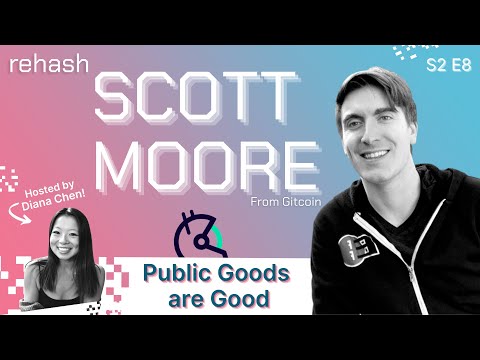
Moore describes his professional trajectory, including academic training in political science and mathematics and subsequent experience in finance and cryptocurrency. He connects this background to his interest in decentralized systems and outlines different interpretations of public goods. These include the classical economic definition and alternative framings that emphasize goods producing positive externalities across multiple communities through shared digital infrastructure.
The discussion examines open source software as a category of public good and addresses structural challenges related to its sustainability and funding. Moore introduces the terms regenerative finance and regenerative approaches, describing them as frameworks intended to link economic activity with environmental and social considerations through incentive design.
Quadratic funding is presented as a method for allocating resources based on aggregated participation signals, prioritizing the number of contributors rather than the magnitude of individual contributions. Moore also addresses quadratic voting, outlining its proposed role in decentralized autonomous organization governance and noting implementation constraints and trade-offs.
In the final portion of the interview, Moore comments on market downturns and frames them as periods associated with infrastructure development, coordination efforts, and community maintenance. He describes community organization and coordination as recurring elements in the long-term functioning of Web3 systems, particularly during periods of lower market activity. [13]
See something wrong?
Official Website:
Social Profiles: