Zachary Williamson
Zachary Williamson is a British software developer and technology entrepreneur whose career has focused on software engineering and blockchain technology. He is the co-founder and CEO of Aztec, where he has been involved since 2017 and previously served as co-founder and CTO, following an earlier role as a software developer at Carallon Ltd. [3]
Education
Williamson graduated from the University of Southampton with a Master’s in Particle Physics in 2010. He later earned his Ph.D. in Neutrino Physics from the University of Oxford in 2015. [2]
Career
Williamson began his career as a Software Developer at Carallon Ltd in London, where he worked from January 2015 to September 2017. In January 2017, he co-founded Aztec and became its CEO, a role he continues to hold. From November 2017 to January 2025, he additionally served as Co-Founder & CTO at Aztec, working on the company's technical development before transitioning his focus to the CEO role.
Williamson was also an EF9 Cohort Member at Entrepreneur First from October 2017 to January 2025 in London. His career has therefore centered primarily on software development and the creation and leadership of Aztec, with his responsibilities progressing from technical development to executive leadership. [2]
Interviews
Aztec Alpha
In an April 2026 interview at EthCC, Williamson discussed the launch of Aztec Alpha and its capabilities as a decentralized rollup network on Ethereum mainnet. He described the network as feature-complete but in an early stage, supporting private and encrypted transactions and smart contracts, and explained how decentralization and governance were intended to reduce reliance on centralized points of control while enabling confidential information to be used onchain. Williamson also discussed his transition from physics into cryptography, his work with cryptographic researchers, and the development of zero-knowledge proof systems including Plonk. He outlined potential applications for Aztec’s privacy infrastructure, including private stablecoins, governance, treasury management, real-world assets, and identity-related use cases. [4]
Presentations
Privacy and Identity
In an October 2025 presentation at TOKEN2049, Williamson discussed privacy as a core component of blockchain infrastructure. He explained how encryption and zero-knowledge proofs could enable users to verify identities and other information without disclosing sensitive data, while supporting decentralized applications and asset ownership. Williamson described Aztec as a decentralized Ethereum Layer 2 designed to process real-world data while preserving privacy and argued that the lack of privacy had limited blockchain’s ability to support digital cash, decentralized finance, and real-world assets. He discussed potential applications including the on-chain issuance and trading of bonds and mortgages, unified digital identities that interact with Web2 services, private smart contracts, and systems that verify ownership and links to real-world assets. The presentation concluded with his view that privacy infrastructure could expand on-chain liquidity and support broader applications of blockchain technology. [5]
Mainstream Web3
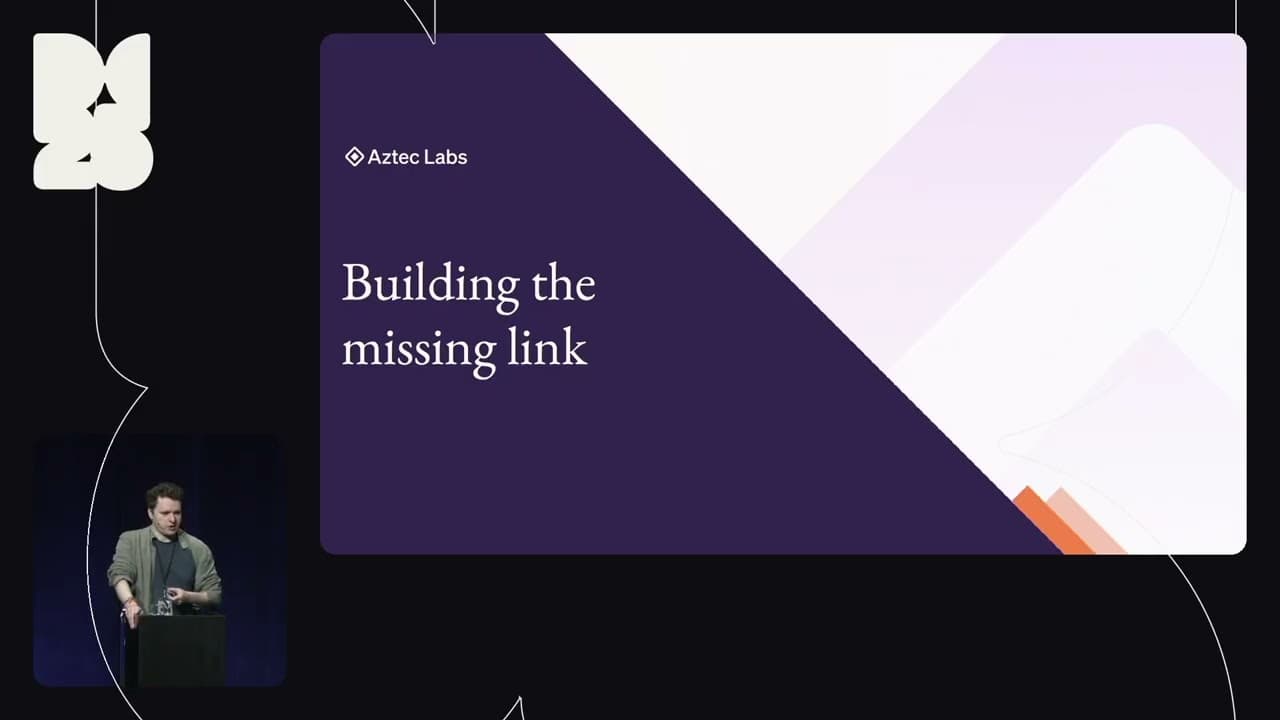
In a June 2025 keynote at DappCon Berlin, Williamson discussed privacy as a core component of blockchain infrastructure and its role in linking digital identities with real-world information. He explained how privacy technology could support encrypted attestations, account ownership verification, and digital sovereignty while enabling interactions between Web2 data and blockchain systems. Williamson argued that privacy-focused networks require changes to blockchain architecture, including transaction and state models, as well as cryptographic tools such as Noir for developing zero-knowledge applications. He outlined Aztec’s progress with its live testnet and decentralized network upgrades, including work on private transactions and account abstraction, alongside plans for mainnet deployment. He also discussed decentralized private-state discovery using side channels and encrypted communication, emphasizing the need to balance privacy, security, scalability, and usability for wallets and applications. [1]