0% read
Last updated:
10101.art
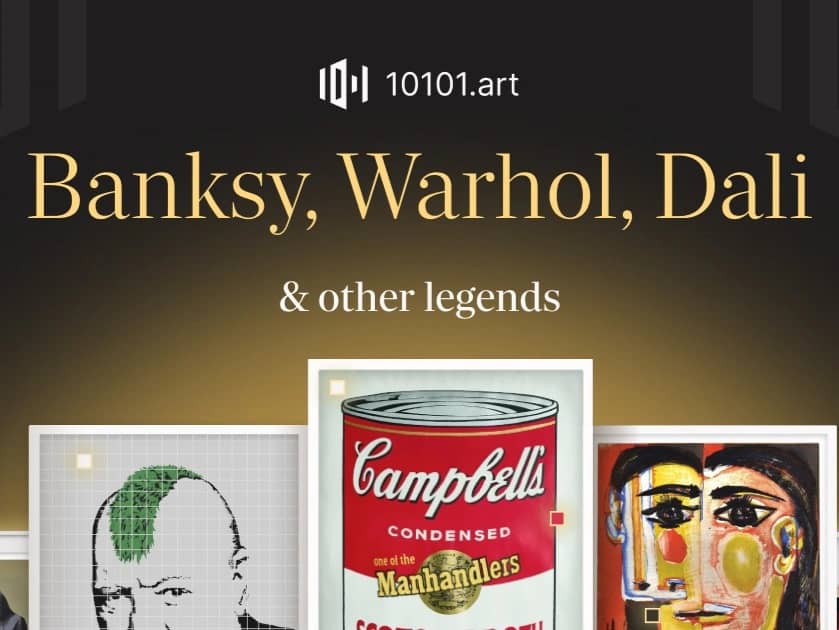
10101.art is a fine art RWA brand that links original works by Pablo Picasso, Banksy, Andy Warhol, Salvador Dalí and other blue chip artists to on chain ownership tokens. Each token is backed by an institution level physical artwork held in professional custody and is designed to let holders connect these pieces to their public identity in Web3 and beyond.[1]
Compare Cryptoassets
Select an asset to compare its price and other stats against 10101.art.
Overview
10101.art operates at the intersection of high end art and blockchain. The team acquires original works from established artists, places them in long term professional custody and then issues on-chain ownership tokens that encode legal rights to the underlying paintings or prints. The idea is to free artworks that would normally remain locked inside closed private collections and bring them back into public view through curated exhibitions, while at the same time allowing collectors to become recognized owners of these pieces via on chain structured ownership.[1]
The company presents ownership of art as an emotional and social experience. Holders are encouraged to see their pieces as part of their personal story and public image, not only as financial assets. Blockchain in this model is used as infrastructure: it records provenance, custody and ownership transfers in a transparent way, while the core value comes from the artworks themselves and how they underline the high status of the person who owns them.[1]
Products
The core product of 10101.art is the ownership token – an NFT that represents verifiable rights in a specific physical artwork held in custody. For each artwork the project issues a fixed series of tokens under a dedicated legal structure, allowing multiple collectors to stand behind the same piece while keeping provenance and rights clearly defined.
Around these tokens, 10101.art builds a set of digital and physical experiences:
- Marketplace listings where users can acquire and manage ownership tokens for specific artworks.
- Collector profiles that currently function as public facing pages where holders can show which Picasso, Banksy, Warhol or other works they stand behind and present their collection as part of their online identity.
- An AI powered artist chat that lets users “talk” to simulated versions of artists such as Picasso, discuss what kind of work fits them, and better understand why a particular piece matches their personality and story.
- Exclusive physical benefits for holders of selected artworks, including limited merchandise, high quality reproductions and curated gift boxes connected to specific pieces.
The team is also developing:
- An upgrade of collector profiles into a full social network for collectors – with feeds, follower mechanics and social tools that allow them to influence the ART & Blockchain space like influencers, compete with other collectors, build reputation around their taste and participate in shaping the narrative around art on chain.
- An upgrade of the marketplace into a full secondary market, where holders will be able not only to acquire new pieces, but also to list and trade their existing ownership tokens, set their own prices and launch auctions, in a format similar to how major art institutions handle sales.
- DAO mechanics that will allow token holders to vote on decisions around individual artworks – with each ownership token corresponding to one vote on questions such as where to exhibit a piece or which proposal for its future to support.
These products are designed to translate the real-world concept of a personal art collection into the digital realm.[1]
Ecosystem
The 10101.art ecosystem is built around several groups:
- Collectors - individuals who acquire and hold ownership tokens and use them to shape their on-chain and social identity.
- The 10101.art core team - responsible for sourcing art, legal structuring, custody, digitization and the operation of the marketplace and profiles.
- Physical partners - galleries, storage providers and event organizers who handle exhibition and long term care of the artworks, such as Monada Art Gallery in Dubai and partners like Emaar for large scale exhibitions.
- Blockchain infrastructure - the networks on which ownership tokens are issued and traded, providing transparent records of ownership and transfers.
These participants interact to facilitate the tokenization and ownership of fine art.[1]
Use Cases
Examples of how 10101.art is used include:
- Gaining access to ownership in high-value artworks that are usually locked in private storage, while still being able to see them exhibited in real life.
- Building a visible on-chain identity and reputation around holding pieces by artists like Picasso, Banksy, Warhol or Dalí.
- Verifying provenance and ownership history of specific artworks via public blockchain records.
- Taking part in a curated group of collectors around a shared portfolio of blue-chip art.
- Supporting the continued public display and professional care of important artworks by backing them through ownership tokens.
These use cases demonstrate the platform's aim to blend the cultural significance of art with the technological benefits of blockchain.[1]
Tokenomics
10101.art does not issue a native fungible utility or governance token. The main on-chain assets are the non-fungible ownership tokens for individual artworks. These tokens are specific to each piece and are not used as a general purpose currency.[1]
Confirmed Partnerships
According to public sources, 10101.art has collaborated with several partners in the art, real estate and event space, including:
- Monada Art Gallery: A gallery in Dubai that serves as a flagship physical partner.
- Emaar: A real estate development company that partnered for an exhibition in a major Dubai mall.
- Art For All: An event collaboration partner.
- NFT Paris: An event collaboration partner.
- Blockchain Life: An event collaboration partner.
- Art Dubai: An event collaboration partner.
These partnerships support both the physical exhibition of the collection and the promotion of 10101.art within the broader art and Web3 communities.[1]
See something wrong?