Paul Kohlhaas

Paul Kohlhaas

Paul Kohlhaas is the co‑founder and CEO of , a co‑founder and senior leader at Molecule, and a founding steward of VitaDAO. His work focuses on building platforms and governance models to fund and manage biomedical research through decentralized organizations and tokenized intellectual property structures. [1] [2]

Education

At the University of St.Gallen, Kohlhaas earned a Bachelor’s Degree in Economics & International Affairs (2012–2015). [3] [2]

In 2015 he completed Princeton University’s CS.251: and Technologies (Computer Science), an online course. [5] [3]

In 2014 he spent an exchange semester at the University of Cape Town, studying International Trade and Finance, Intermediate Microeconomics, and Comparative Politics. [3]

Career

Pre-crypto / Early Career

Thura Swiss Consulting and Capital Markets

Based in Yangon, Myanmar, Kohlhaas contributed to business development by acquiring a new client for a mid-sized consulting project, analysed and transcribed financial statements to IFRS for a Myanmar company seeking foreign capital and created a DCF valuation model for prospective private equity investors. He also led interviews with company directors and HR heads to assess Myanmar’s talent market and proposed staffing strategies for multinational entrants.

St. Gallen Model United Nations

Kohlhaas served as co-president of the St. Gallen Model United Nations during the 2014–2015 academic year.

Sovereignty Capital

As an investment analyst in Johannesburg, Kohlhaas focused on private equity deal sourcing in the South African technology and startup sector, preparing term sheets and valuations, assisting due diligence, supporting business development and market-entry strategies for logistics and security firms expanding across Africa, and working on nationwide leasing finance projects with Uber.

Blockchain & Crypto Career

Ethereum Community (Meetup Organiser)

While organizing community meetups in Cape Town, Kohlhaas grew a local group from 4 members to about 50 attendees (with over-subscription) within a month, secured venue sponsorship from Barclays Rise Cape Town, and began efforts to replicate the meetup structure in Johannesburg to broaden community engagement across South Africa.

Linum Labs

Kohlhaas founded Linum Labs, a software development studio focused on decentralized systems and applications. The studio developed in-house solutions and provided consulting, security audits, bespoke development and smart contract architecture services to clients exploring blockchain and decentralized technologies.

Trustlab Blockchain Innovation Studio

In Cape Town, Kohlhaas led business development at Trustlab and helped implement a UN-funded milestone identity project with UNICEF to pilot subsidy payments for children in townships.

ConsenSys

Globally focused on building the digital identity platform uPort, Kohlhaas led partnerships and integrations across uPort’s core use cases, connecting Web2 and applications for decentralized apps and enterprise clients across the US, Europe and Asia. He managed system integrations and partnerships with projects including Melonport, , and FOAM protocol, and led the uPort integration with the Swiss government of Zug for one of the first publicly issued citizenships on a blockchain identity platform.

ixo Foundation

Kohlhaas served as Vice President on the Board and an advisor at ixo from June 2017 to March 2021. In this role he contributed to governance and strategic direction for the ixo ecosystem, advising on blockchain-based impact measurement and verification systems and working with partners to grow adoption of decentralized identity and data attestations. [3]

Advanced Blockchain AG

As Vice Chairman of Advanced AG, Kohlhaas supported corporate governance and high-level business strategy between September 2017 and January 2019, helping align the company’s enterprise initiatives with emerging market opportunities.

Molecule

Kohlhaas co-founded Molecule and has been listed at different times as CEO, Chairman & Chief Architect, and Founder & Chairman, reflecting evolving responsibilities as the organization matured. Molecule describes itself as a decentralized biotech protocol and marketplace that connects academics and biotech companies with funding and supports community governance and ownership of research-related IP. [4] [5]

BIO Protocol (Bio.xyz)

By 2025, Kohlhaas as co-founder and CEO of BIO Protocol, an “AI-native” decentralized science platform for biotech funding and drug discovery. BIO Protocol has been presented as a spin-out and evolution of infrastructure intended to link bioDAOs, researchers, and on-chain capital into a shared “science finance” stack. [1] [6]

VitaDAO

Kohlhaas is a founding steward of VitaDAO, a decentralized organization focused on community-funded longevity and life-sciences research, where he contributed to the early governance and DeSci narrative linking patient communities, researchers, and funders. [2]

Interviews

Token Engineering in Pharmaceutical Research Models #01

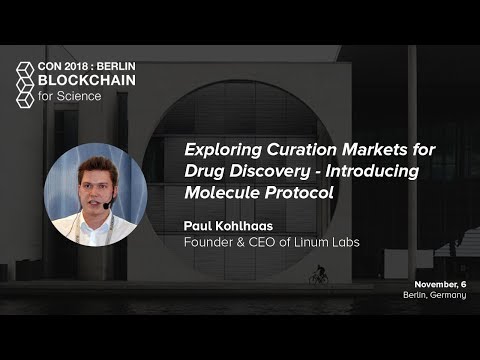
In an interview published on December 3, 2018, on the YouTube channel “BlockchainForScience,” Paul Kohlhaas discusses the application of token engineering and -economic mechanisms within the pharmaceutical sector.

The interview outlines his description of the existing patent system as a structure that grants exclusive rights over intellectual property, which can limit data sharing and collaboration between entities. He associates this structure with high development costs, extended timelines, and low success rates in drug development, as well as limited incentives to disclose unsuccessful research outcomes.

Kohlhaas describes the Molecule protocol as a framework intended to facilitate alternative coordination mechanisms for research and development. The model is based on infrastructure and incorporates mechanisms such as curation markets and token bonding curves. These mechanisms are presented as methods for allocating capital and signaling perceived value of intellectual property through market participation.

The discussion also includes the use of (NFTs) as representations of patents or chemical compounds. Within this framework, ownership of intellectual property may be structured through and associated legal entities, such as patent investment trusts. This structure allows for divisible participation and transferability of associated rights.

The interview further addresses the potential role of this model in enabling participation from multiple stakeholder groups, including researchers, investors, and other participants in the research process. It also notes the inclusion of governance structures and regulatory considerations required for implementation within existing legal systems.

Kohlhaas also references practical constraints, including technical design challenges, legal requirements, and the need for coordination with established industry participants. The discussion presents the model as one of several approaches being explored for organizing research funding and intellectual property management in scientific domains. [8] 

Decentralized Science and Research Infrastructure #02

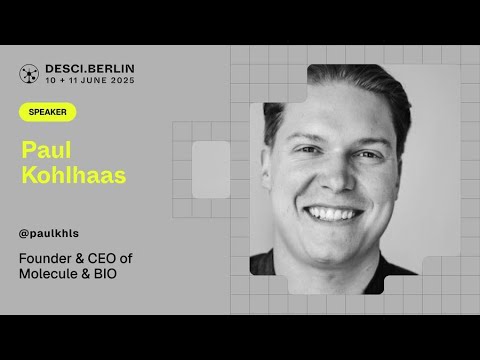
In a talk published on June 25, 2025, on the Molecule YouTube channel, Paul Kohlhaas discussed developments related to decentralized science (DeSci) and outlined his interpretation of its trajectory. He described the current scientific and biomedical research landscape as structured around established funding systems, patent frameworks, and institutional decision-making processes.

According to Kohlhaas, a large share of researchers’ time is allocated to funding acquisition rather than research activities. He presented this distribution as a structural characteristic of the existing system and drew a comparison to features observed in traditional financial systems, where institutional arrangements influence resource allocation.

Kohlhaas described decentralized science as a model that utilizes -based infrastructure and tools to support research funding, coordination, and governance. Within this framework, he referred to the concept of “permissionless science,” in which participation in research-related processes is not limited to centralized entities. He identified tokenized intellectual property and (DAOs) as mechanisms associated with this approach.

He also referenced the use of artificial intelligence systems in research workflows, including tools designed to generate and evaluate hypotheses and assist in data analysis. In his description, these systems operate alongside decentralized coordination models.

In summary, Kohlhaas characterized decentralized science as an approach that restructures how research activities, funding, and governance are organized, with reduced reliance on centralized institutions. [7]

参考文献

首页分类维基MC事件词汇表