Cooper Emmons
Cooper Emmons is an entrepreneur and business executive with a background in financial services, venture capital, business development, and digital asset markets. He is the Founder of Ibis and has held business and strategy roles at Injective Labs and Ratio Finance, alongside experience in brokerage and venture investment. [8]
Education
Emmons attended the University of Miami, where he earned a degree in Quantitative Economics and Econometrics, and the London School of Economics and Political Science, where he earned a degree in Finance. [2]
Career
In June 2020, Emmons joined Tradition in New York in a brokerage role, working with more than 25 inter-dealer broker desks across commodities, interest rate swaps, repurchase agreements, and derivatives. During this period, he also completed the Securities Industry Essentials (SIE) examination administered by FINRA. In July 2020, he co-founded SunGateGroup LLC in Miami, where he remained until November 2021. From September 2021 to November 2022, Emmons served as Head of Strategy at Ratio Finance. In November 2022, he joined Injective Labs in a business role, where he continues to work. In November 2025, Emmons became an Advisor to Pineapple. In October 2026, he founded Ibis, an onchain credit platform that connects institutional capital providers with businesses seeking financing. He serves as the company's Founder. [3]
Interviews
Injective Labs
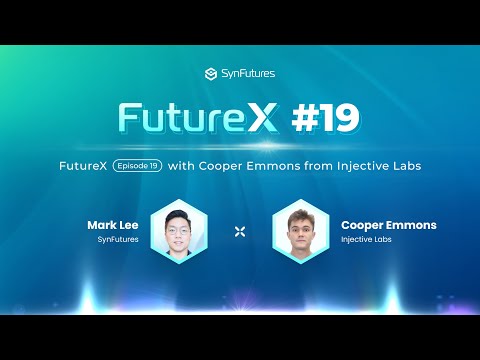
In a January 2024 interview on the FutureX podcast, Emmons discussed his finance background and his transition into the cryptocurrency industry after encountering Uniswap's automated market maker. He described his subsequent work in the Solana ecosystem and at Injective Labs, where he focused on business development and institutional adoption. The conversation covered Injective's finance-focused blockchain architecture, including its governance model, dedicated block space, transaction finality, and modular infrastructure for developing exchanges and other financial applications. Emmons also discussed partnerships with Google Cloud and Ondo, efforts to attract institutional market makers through compliant infrastructure and direct support, and the expansion of Injective's ecosystem. Other topics included plans for EVM and SVM environments, cross-chain composability, developer support, liquidity and funding initiatives, and the importance of developing practical applications to encourage broader cryptocurrency adoption. [4]
Presentations
Future of Finance
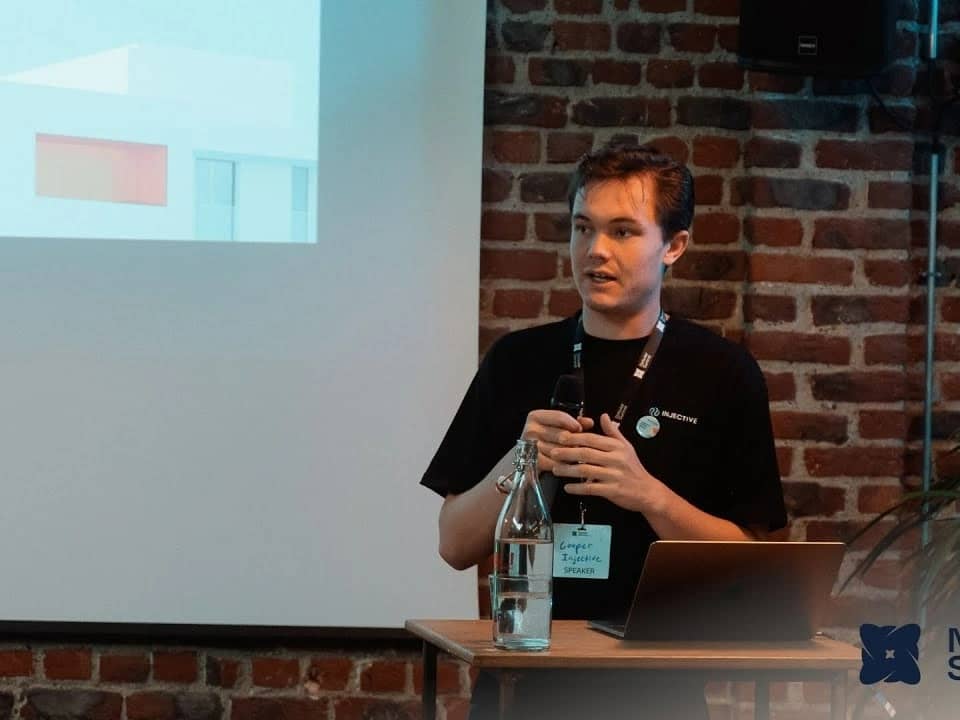
In a July 2024 presentation at the Nebular Summit, Cooper Emmons outlined Injective's blockchain infrastructure and its focus on financial applications. He discussed its onchain order book, batch auctions designed to reduce front-running, fast transaction processing, gas abstraction, liquidity provided by institutional market makers, and modular tools for application development. He also described growth in network activity, including transactions, trading volume, staking, active wallets, and developer participation. Other topics included Injective's support for DeFi, real-world assets, NFTs, gaming, trading, and lending, as well as onchain markets for commodities and foreign currencies and a permissioned module for compliant markets. [5]

Panel
On-Chain Global Markets
In an October 2025 panel at TOKEN2049, Cooper Emmons participated alongside Ming Zhao of Atomic Vaults and David Lu of Drift, with Samantha Yap of YAP Global as moderator, to discuss the adoption of real-world assets (RWAs) onchain. The discussion covered demand for tokenized bonds, private credit, U.S. equities, and other traditional assets, as well as challenges involving liquidity, settlement, collateral risk, and regulatory requirements. Panelists examined how perpetual products could provide exposure to traditional assets without requiring delivery of the underlying securities and discussed market activity in financial centers such as the United States, Hong Kong, and Singapore. Other topics included the need for simpler user experiences, stronger trust, more effective connections to traditional markets for hedging, and financial products designed for tokenization. The panel also considered the timeline for broader adoption, with differing views on whether the market could achieve significant scale within two to three years given regulatory and infrastructure constraints. [6]