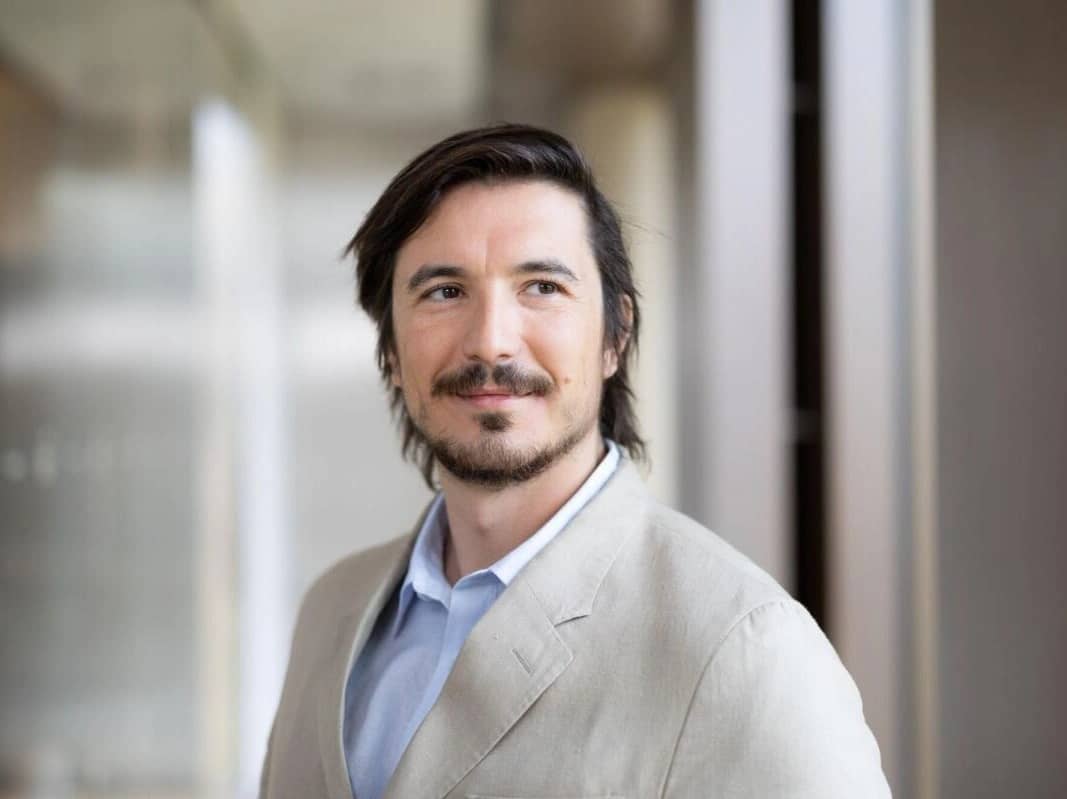
Vlad Tenev
Vladimir "Vlad" Tenev (born February 13, 1987) is a Bulgarian-American entrepreneur who is the co-founder, Chairman, Chief Executive Officer, and President of Robinhood Markets, the brokerage he launched in 2013 with Baiju Bhatt to "democratize finance for all."[1][2] Robinhood popularized commission-free stock trading through a mobile-first application and grew into a broad financial-services company offering retail brokerage, cryptocurrency, advisory, digital banking, and private-markets access.[3][1] Tenev is also the co-founder and Executive Chairman of Harmonic, an artificial-intelligence company he started in 2023 to build advanced mathematical reasoning systems; Harmonic raised a $75 million Series A led by Sequoia Capital, a $100 million Series B that valued it at $875 million, and a $120 million Series C in November 2025 at a $1.45 billion valuation, and in March 2026 it unveiled Aristotle Agent, described by the company as an autonomous mathematician capable of tackling complex formal-logic problems for up to 24 hours without human intervention.[1][8]

早年生活与教育
Tenev was born in Varna, Bulgaria, on February 13, 1987.[4] His father, described as a professor of economics in Bulgaria, went to the United States to study after the fall of communism, and his wife and young son followed him.[2] Tenev immigrated to the United States in the early 1990s at around five years old; the family initially settled in Newark, Delaware, sharing housing with another Bulgarian family while his father pursued a PhD, later moving to College Park, Maryland, for his father's doctoral program.[4] Both of his parents would later work for the World Bank.[4][5]
The family lived through economic scarcity and cultural adjustment while maintaining its Bulgarian heritage, and Tenev has repeatedly linked those conditions to his later interest in finance.[4] He has recalled that his grandfather traded salary and pension checks for copper cookware during Bulgaria's hyperinflation and has said, "I remember always thinking about finances, being aware of them, and recognizing that if you were in control of your finances, that's a superpower."[4] He has also described his parents' visa status as "fragile," saying they "had taken this huge risk leaving Bulgaria and their support system—leaving just in time, with no money, right before the economy collapsed."[4]
Tenev taught himself programming in the University of Maryland computer lab where his father worked late nights, and he attended Thomas Jefferson High School for Science and Technology in Fairfax County, Virginia.[4] He enrolled at Stanford University to study mathematics, graduating in 2008, and met his future business partner Baiju Bhatt during a summer physics program there.[4] He holds a B.S. in Mathematics from Stanford and an M.S. in Mathematics from the University of California, Los Angeles (UCLA), where he began a PhD before leaving academia to pursue business ventures.[1][6] Following the collapse of Lehman Brothers, Bhatt convinced Tenev to drop out and start a trading firm; Tenev later described the period after Lehman's failure as "a very, very interesting time for the industry."[2] He holds FINRA Series 3, Series 7, and Series 63 licenses.[1]
Early Ventures
Before Robinhood, Tenev and Bhatt founded two finance companies in New York City.[7] The first, Celeris, was founded in 2010 and focused on high-frequency trading.[6][2] About a year later, in 2011, the pair pivoted into Chronos Research, a company that sold low-latency software tools banks and hedge funds could use to build automated trading strategies.[2][6] Index Ventures recalled that Chronos grew to a few million dollars in revenue.[6]
In 2011, in the aftermath of the Great Financial Crisis and during the Occupy Wall Street protests, the founders were inspired to build a consumer product that made investing easy, cheap, and convenient with a mobile-first design.[2] The company was briefly called CashCat before the founders settled on the name Robinhood; Tenev tweeted about the CashCat name in April 2021.[3] Tenev has explained the eventual name in an interview with TechCrunch: "We understand the connotation of taking something from the rich and giving it to the poor. Robinhood is liberating information that's locked up with professionals and giving it to the people."[2]
Robinhood
Founding and Launch
Tenev and Bhatt founded Robinhood in 2013, assembling a team of mostly engineers who had worked with them at their earlier ventures.[2] The company raised a $3 million seed round led by Index Ventures with Andreessen Horowitz participating, and in 2014 raised a $13 million Series A that included Ribbit Capital along with individual backers Howard Lindzon, Dave Morin, Aaron Levie, Jared Leto, Nas, and Snoop Dogg.[6] The company also participated in the Y Combinator accelerator.[4] After roughly a year of regulatory scrutiny, Robinhood was approved by the U.S. Securities and Exchange Commission (SEC) and became a member of the Financial Industry Regulatory Authority (FINRA), clearing it to operate.[2]
For more than a year the Robinhood website served as a waiting list, and by the time the app launched it already had 500,000 people waiting.[2][6] The company launched on the App Store—in December 2014 according to some early reporting, and in March 2015 as the first mobile-first brokerage in the United States.[6][2] The app used a social-media-like design of effects and gestures to encourage continuous interaction, initially targeted millennials, and required no minimum deposit at registration.[2] Robinhood's iPhone and Apple Watch apps won an Apple Design Award in 2015.[6]
Business Model and Growth
Robinhood offered commission-free trading, financing itself through payment for order flow (PFOF), the practice of routing customer orders to market makers who pay for that order flow and profit by shaving fractions off spreads.[2][3] The company expanded its product set steadily, adding options trading in 2017, cryptocurrency trading in 2018, and fractional-share trading in 2019.[2]
The company's early funding rounds tracked rapid growth in valuation: a $110 million Series C led by DST Global in 2017 at a $1.3 billion valuation, followed by a $363 million Series D in 2018 at a $5.6 billion valuation as the platform passed four million users.[6] Its broader investor base came to include Index Ventures, Andreessen Horowitz, Ribbit Capital, NEA, DST Global, Thrive Capital, Greenoaks, Iconiq, CapitalG, Sequoia, and Kleiner Perkins.[6] Robinhood had 9.8 million users in 2020, and its leadership structure changed that year when Bhatt stepped down as co-CEO to become Chief Creative Officer, making Tenev the sole CEO.[2] Bhatt stepped away from day-to-day management in March 2024 while remaining on the board, later focusing on Aetherflux, a space-based solar-energy company.[6] Robinhood completed its initial public offering on the Nasdaq exchange in July 2021 at a $32 billion valuation, at which point it had over 22 million users; it trades under the ticker HOOD.[5][2][3]
Tenev holds significant voting control of the company. As of an April 7, 2025 disclosure basis, he held 24.2% of Robinhood's voting power; the company's dual-class structure gives Class A shares one vote and Class B shares ten votes each, and Tenev and Bhatt were linked by a Founders' Voting Agreement and irrevocable proxy arrangements.[6] Forbes reports he owns more than 6% of Robinhood Markets.[5] Robinhood joined the S&P 500 in September 2025.[6] The company reported $4.5 billion in full-year revenue and $1.9 billion in net income for fiscal 2025, and by May 2026 it had 27.7 million funded customers and $377 billion in total platform assets.[6] The company serves roughly 28 million customers across 38 countries.[3]
Robinhood's 2024 annual report placed total net revenue at $2.951 billion, made up of $1.647 billion of transaction-based revenue (56%), $1.109 billion of net interest revenue (38%), and $195 million of other revenue (7%); of the transaction-based revenue, $1.563 billion came from routing user orders to market makers.[6] In February 2026 Shiv Verma formally became Robinhood's Chief Financial Officer, and in June 2026 the company announced a roughly 10% workforce reduction—about 290 people—even as Tenev told employees the business had never been stronger.[6][3]
The GameStop Trading Restrictions
In January 2021, Robinhood became central to the "meme-stock" era when retail trading, largely on its platform, drove a short squeeze in GameStop and other heavily shorted stocks.[3] On January 28, 2021, Robinhood restricted buying in the affected names, a decision the company attributed to the National Securities Clearing Corporation (NSCC) raising deposit requirements during extreme market volatility.[6][3] The restrictions triggered accusations that the platform had sided with institutions against its own users, placed Tenev under intense scrutiny, and led to congressional hearings and fines.[3][2] The events forced the company to strengthen its risk-management practices. During the second quarter of 2021, 62% of Robinhood's crypto revenue came from Dogecoin.[3]
Product Expansion and Robinhood Chain
Under Tenev, Robinhood broadened well beyond stock trading. Its Gold subscription, priced at $5 per month or $50 per year, offers a 3.35% annual percentage yield on eligible brokerage cash along with an IRA match, research tools, and margin features; Gold generated $109 million in 2024 and reached $50 million for the first quarter of 2026, when subscribers numbered 4.3 million.[6] Robinhood Banking, rolled out to Gold subscribers, had over 20,000 customers depositing roughly $300 million by January 31, 2026, and crossed $2 billion in deposits with 125,000 funded customers by the first quarter of 2026.[6] Robinhood Strategies, an advisory product, grew from over 200,000 funded customers and $1.3 billion in assets under management at the end of 2025 to over 285,000 customers and $1.6 billion by the first quarter of 2026, when retirement assets under custody reached $27.4 billion, its Cortex Digests tool had been used by nearly one million customers, and a Robinhood Social beta launched.[6] The company's prediction-markets platform processed more than 12 billion contracts in 2025, including a record 8.5 billion in the fourth quarter; on an earnings call Tenev noted that NBA contracts overtook NFL contracts and cited the Winter Olympics, the FIFA World Cup, and March Madness as catalysts for expected activity.[3]
On July 1, 2026, Tenev unveiled Robinhood Chain at a livestreamed event billed as "The World is Flat" from the Old Royal Naval College in London, which the company described as its most ambitious global expansion and product vision to date.[3] Robinhood Chain is an Ethereum layer-2 network built on Arbitrum's Orbit stack; it uses ether for gas, runs roughly 100-millisecond block times, and settles to the Ethereum mainnet.[3] Its flagship product, Stock Tokens, are on-chain instruments tracking equities such as Nvidia, Apple, and Alphabet that trade around the clock and can be used in decentralized finance (DeFi); the launch stack incorporated Chainlink for oracle pricing, BitGo for custody, Uniswap for liquidity, Morpho for lending, and Lighter for perpetual futures inside Robinhood Wallet.[3] Stock Tokens are structured as tokenized debt securities, conferring no shareholder rights or legal ownership of the underlying shares, and are unavailable to U.S. persons.[3]
Robinhood markets the chain as AI-native and is rolling out Agentic Accounts, which let eligible users connect AI models to Robinhood's data and tools through a Trading MCP so that agents can analyze markets and construct strategies while humans retain control of capital; unlike Stock Tokens and wallet perpetuals, Agentic Accounts are being rolled out in the United States.[3] The emergence of these agentic trading features has prompted discussion among market participants and policymakers about appropriate guardrails, supervision, and disclosure standards for AI-assisted investing tools. The agent platform Bankr integrated Robinhood Chain so users can trade tokenized stocks and memecoins by text command on X or Telegram.[3] Days after the launch, Tenev posted on X that while the chain is being built to be the best platform for real-world assets, "it works great for memes too," and he followed the account of CASHCAT, a community memecoin launched on the chain that was unaffiliated with the company.[3]
Robinhood's crypto business contracted in early 2026: crypto transaction revenue fell 47% year over year to $134 million in the first quarter, and native-app crypto trading volume dropped 48% to $24 billion, while total quarterly revenue was $1.07 billion and platform assets rose 39% to $307 billion.[3] In filings covering early July 2026, Tenev sold 375,000 HOOD shares at weighted-average prices ranging from roughly $112.22 to $118.14, for a total in the region of $43.6 million, after which he continued to hold more than 48.2 million Class B shares; chief legal officer Daniel Gallagher sold shares on July 6, 2026 for approximately $1.1 million, and Robinhood Ventures Fund I also sold in the same window.[3]
Regulatory and Legal Matters
Robinhood has faced a series of regulatory actions during Tenev's tenure. In December 2020, the SEC charged Robinhood Financial with misleading customers about payment for order flow and best-execution issues, and the company agreed to pay a $65 million civil penalty.[6] In 2021, FINRA imposed about $57 million in fines plus roughly $12.6 million in restitution—nearly $70 million in total, which FINRA called the largest financial penalty in its history—citing systemic supervisory failures, misleading communications, outages, and inappropriate options approvals.[6]
The pace of enforcement continued into 2025. In January 2025, Robinhood's broker-dealer subsidiaries settled with the SEC for a total of $45 million over issues including Regulation SHO, blue sheets, anti-money laundering, identity-theft protection, cybersecurity vulnerabilities, off-channel communications, and recordkeeping.[6] In March 2025, FINRA ordered Robinhood Financial to pay $3.75 million in restitution and fined Robinhood Financial and Robinhood Securities a combined $26 million over anti-money laundering, supervision, and disclosure violations.[6] Separately, Robinhood Crypto paid $3.9 million in August 2024 to settle a California Attorney General matter over disclosures and delivery of customer crypto assets covering 2018 to 2022.[6] The SEC issued Robinhood Crypto a Wells Notice in 2024, but in February 2025 the company announced that the SEC's Enforcement Division had closed its investigation without taking enforcement action.[6] As Robinhood introduces more complex offerings, including AI-assisted and agentic trading tools, regulators and the firm have both emphasized the importance of controls, testing, and customer disclosures around automated decision-making.