Last updated:
Gwei
Gwei is a denomination of Ether in Ethereum blockchain, used to denote gas for transactions, equivalent to one quintillion Wei or one-billionth of one ETH.
Updated · 3 min read
Loading the full wiki…
Last updated:
Gwei is a denomination of Ether in Ethereum blockchain, used to denote gas for transactions, equivalent to one quintillion Wei or one-billionth of one ETH.
Updated · 3 min read
Loading the full wiki…
Last updated:
Gwei is a denomination of Ether in Ethereum blockchain, used to denote gas for transactions, equivalent to one quintillion Wei or one-billionth of one ETH.
Updated · 3 min read
Gwei is a denomination of Ether (ETH), the native currency of the Ethereum blockchain.
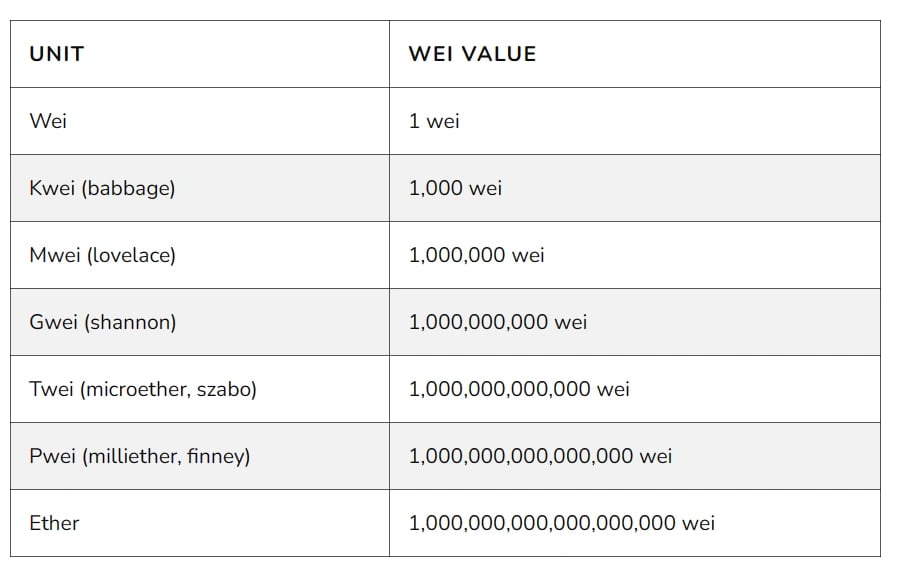
One Gwei is one billion wei, or 0.000000001 ETH. Gwei is commonly used to quote Ethereum gas prices because these small amounts are easier to read. [9][5][1][4][5]
In this wiki
Info
ETH documenatation
Gas is the unit used to measure computational work on the Ethereum network. Gas fees compensate validators for the execution resources required to process transactions. The fee is calculated by multiplying the gas used by the per-unit gas price. Under Ethereum’s EIP-1559 fee model, that price consists of a protocol-set base fee and an optional priority fee, or tip. The base fee is burned, while the tip is paid to the validator. A higher tip can improve a transaction’s inclusion priority, but its total cost also depends on the amount of gas used. Network demand and congestion can change gas prices.[5][9]
In Ethereum network slang, Gwei is also sometimes referred to as Shannon, after American mathematician and computer scientist Claude E. Shannon, who is credited with laying the foundation for information theory.[6][7][8]
Wei (Wei) - Dai Wei formulated the concepts of all modern cryptocurrencies, and is best known as the creator of the predecessor to Bitcoin, B-money.
Kwei (Babbage) - is named after Charles Babbage (1791-1871), an English mathematician and mechanical engineer who is considered the father of the computer. Babbage’s designs for his analytical engine, a mechanic computer, would go on to inspire modern computer scientists. Modern recreations of his designs have been successful in proving his idea would have worked if it was feasible to build.
Mwei (Lovelace) - is named after Ada Lovelace (1815-1852), a brilliant mathematician and daughter of the poet Lord Byron, collaborated with Babbage. She wrote what many consider the first computer program which would have derived Bernoulli numbers had the engine ever been built. She also had the idea of applying punchcards from weaving looms to input a sequence of instructions into Babbage’s analytical engine.
Gwei (Shannon) - is named after Claude Shannon (1916-2001), an American mathematician and electrical engineer known as “the father of information theory.” Shannon also designed early digital circuits which could solve Boolean algebra. His work laid the groundwork for the digital computers and networks we use today.
Twei (Szabo) - is named after Nick Szabo, a computer scientist, legal scholar, and cryptographer known for his pioneering research in digital contracts and digital currency. Szabo designed bit gold, a decentralized digital currency also said to have influenced Satoshi Nakamoto’s design of Bitcoin. Szabo proposed and coined the term “smart contracts.
Pwei (Finney) - is named after Hal Finney (1956-2014), a cryptographic activist, developer for the PGP Corporation, creator of reusable proof of work, and early Bitcoin contributor. Finney was allegedly the first recipient of a Bitcoin transaction, sent from Satoshi Nakamoto himself.
Ether (Buterin) - is named after Vitalik Buterin the creator of Ethereum.[2][3]
IQ.wiki is written by its community. Suggest an edit and an editor will review it.