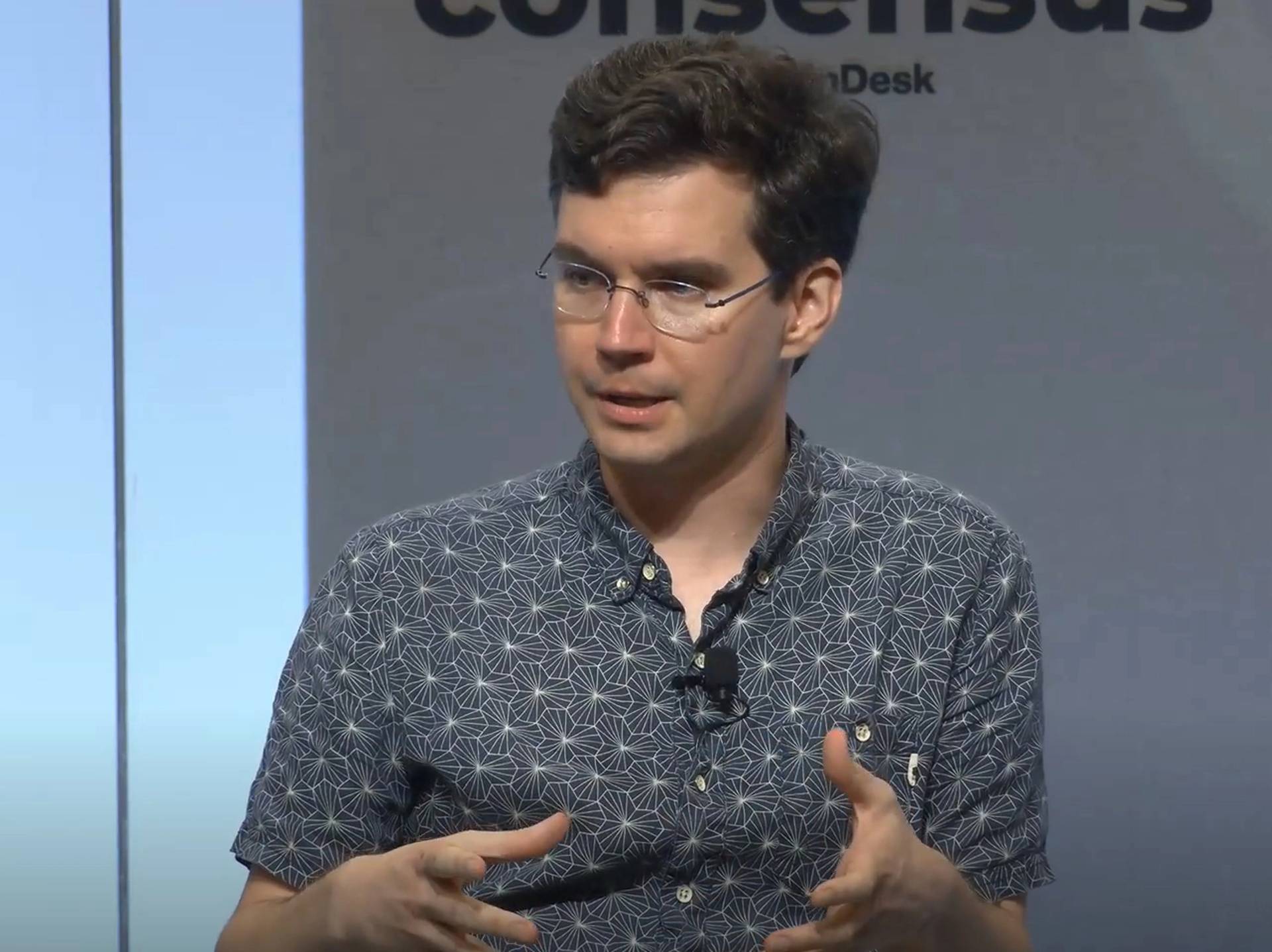
Austin Federa
Austin Federa is a co-founder of DoubleZero, a decentralized physical infrastructure (DePIN) project. He was formerly the Head of Strategy at the Solana Foundation, where he led the foundation's strategic efforts and supported the development of the Solana ecosystem. He has held multiple roles in blockchain, product marketing, and communications, including positions at Solana Labs, Bison Trails (acquired by Coinbase), and Republic Crypto.[5][1]
Education
Federa earned a Bachelor's degree from Lawrence University, where he studied Political Science, Environmental Science, and Economics, completing his studies in 2013. He also attended Sarah Lawrence College for one academic year from 2010 to 2011.[1][6]
Career
Austin Federa began his career working in digital content and communications. His early experience includes serving as Digital Content Director at KBIA 91.3 FM, an NPR member station, where he worked on the station’s website and digital strategy. He later moved to Superpedestrian as Social/Digital & Community Manager, overseeing social media activities and digital marketing projects.[6]
In 2015, Federa became Social Media Editor at The Boston Globe, managing content distribution across the company’s social media platforms. In 2018, he transitioned to the blockchain sector by joining Republic as Director of Marketing, where he was involved in the development of marketing strategies for Republic’s crypto platform.
In 2020, Federa took on the role of Senior Product Marketing Manager at Bison Trails, a blockchain infrastructure provider. After Bison Trails was acquired by Coinbase, he joined Solana Labs in 2021 as Head of Communications. By late 2022, he moved to the Solana Foundation to become Head of Strategy. Federa remained a prominent public figure for the ecosystem until December 2024, when he departed to co-found DoubleZero.[5][1]
Throughout his career, Federa has been involved in various aspects of blockchain, contributing to the development and communication of decentralized technologies.[3][4]
DoubleZero
In December 2024, Federa announced his departure from the Solana Foundation to co-found DoubleZero with Mateo Ward and Andrew McConnell. The company is a decentralized physical infrastructure (DePIN) project focused on building a high-performance network layer for blockchains, which has been described as "crypto's version of Flash Boys." By March 2025, the project reportedly secured a $400 million valuation from crypto VCs. The mainnet and a native token were launched in the latter half of 2025.[5][7][8]
Technology and Architecture
DoubleZero addresses the bottleneck created by the public internet, where critical transaction data competes with general web traffic, limiting the speed of high-throughput blockchains. The project's protocol enables multiple independent entities to contribute their private fiber optic networks, including unused "dark fiber," to create a single, decentralized, high-performance mesh network. This allows blockchains to scale and increase speed without centralizing by reducing their node count.[7][6][5]
The infrastructure is based on a "two-ring architecture" designed to deliver both speed and security. The "Defense Ring" acts as a "common shield" to protect validators from spam and invalid transaction data before it reaches them, utilizing shared hardware like FPGAs. The "Networking Ring" leverages dedicated fiber connections to accelerate block propagation and communication between nodes. The public internet serves as a fallback path to ensure censorship resistance and uptime.[8][7][5]
DoubleZero operates as a separate protocol with its own ledger system, described by Federa as an "accounting database," rather than being built directly on a blockchain like Solana. To enforce network rules, it uses an incentive model with rewards and a proof-of-stake (PoS) slashing mechanism.[7][5]
Goals and Adoption
The initial focus for DoubleZero was the Solana blockchain, chosen for its high transaction throughput and corresponding need for a faster communication layer. By August 2025, the testnet was supporting approximately 12.5% of all staked SOL, subsidized in part by a 3 million SOL stake pool launched by the project. The company's long-term goal is to enable the Solana network to sustain 100,000 to 1 million transactions per second (TPS). Beyond Solana, the infrastructure is designed to support other use cases requiring high-performance data transit, such as Content Delivery Networks (CDNs), gaming, and Large Language Models (LLMs).[7][8][5]
Interviews
Crypto Market Insights with Austin Federa #01
On March 20, 2024, Austin Federa appeared in an interview on CNBC Television, where he shared his insights on the current dynamics of the crypto market. During the conversation, Federa highlighted several key developments shaping the industry, focusing on utility, developer engagement, and the evolving role of altcoins.
According to Federa, altcoins are receiving increased attention as Bitcoin and Ethereum continue to dominate the market rally. He emphasized that the differentiation in blockchain capabilities is driving more developers to explore new opportunities and build applications across various platforms. This growing interest reflects the expanding use cases and the need for more advanced technical solutions within the ecosystem.
One of the critical points discussed was the rise of Layer 2 (L2) solutions. In Federa’s view, these solutions play a crucial role in improving scalability and performance for decentralized applications. By enhancing transaction efficiency, L2s make it more feasible for consumer-facing applications to thrive, which in turn, accelerates broader adoption.
Federa also pointed to innovative projects like Drip House, which are leading the way in the NFT space. These projects focus on artist discovery and content creation, showcasing the potential of blockchain technology to create new models for engagement and creative monetization.
Another key topic was Ethereum’s recent upgrades, which have significantly reduced transaction fees. Federa explained that this reduction benefits both developers and users, lowering the cost barrier and making decentralized applications more accessible.
He also highlighted Solana's unique approach, noting that the network’s single global state enhances trust and efficiency between applications, in contrast to the fragmented ecosystems found in other blockchains. This design, according to Federa, allows for a more unified and seamless user experience.
Lastly, the interview touched on the renewed interest from venture capital in the Solana ecosystem. Federa observed that many investors are actively seeking opportunities within Solana, indicating growing confidence in the network’s potential and reflecting broader optimism regarding the market's recovery.[2]
The Solana Thesis
In an interview published on the Kryptoplanet[Official] YouTube channel on April 8, 2024, Austin Federa, Head of Strategy at the Solana Foundation, discussed "The Solana Thesis" during his talk at BUIDL Asia 2024. According to Federa, Solana’s vision is focused on positioning itself as a high-performance, decentralized blockchain, with the central idea of creating a single Global State machine to enable enhanced interoperability and scalability among applications.
Federa explained that Solana’s core principles—fast finality and low transaction fees—are critical to its user experience, particularly in areas like DeFi and NFTs. By optimizing network architecture and leveraging advanced hardware, Solana maintains low transaction costs, which, according to him, is key for promoting broader adoption.
He further emphasized the concept of program reusability, which simplifies the development process, allowing developers to deploy applications with reduced overhead. This approach, in his view, not only saves costs but also accelerates the speed at which projects can launch.
Federa also noted Solana’s capacity to grow in line with hardware advancements, ensuring that as technology evolves, the network can process more transactions, lowering costs and improving accessibility.
Additionally, developer optionality was a focal point, with Federa highlighting that Solana’s flexibility in programming languages and tools gives developers the freedom to choose the most suitable options for their projects, driving innovation.
He also discussed the token extensions framework, which allows for creating permissioned systems within a decentralized network, a feature he believes could attract traditional finance players to the blockchain space.
Finally, Federa emphasized atomic composability, which ensures that multiple applications can interact seamlessly in real-time, reducing the risk of transaction failures and enhancing trust in the network’s reliability for complex operations.[[https://www.youtube.com/watch?v=uvofiBqyurc]\[\[BUIDL Asia 2024] The Solana Thesis by Austin Federa]]