0% read
Last updated:
Brennan Watt
Brennan Watt is a software engineer and executive who serves as the chief executive officer of Anza, a company that builds core infrastructure software for the Solana blockchain. He assumed the role at the start of 2026, having previously worked on large-scale, high-performance systems and led engineering organizations before moving into blockchain infrastructure.[1] [3]
Career
Watt has described his professional background as a career spent "building large-scale, high-performance systems and leading engineering organizations."[1] A podcast appearance characterizing his trajectory frames his path as moving from being a storage engineer to building Solana infrastructure, reflecting a transition from systems engineering into blockchain protocol development.[2]
In a blog post published on January 15, 2026, Watt announced that he had "stepped into the CEO role at Anza" beginning in 2026.[1] He has stated that he leads the company "alongside an exceptional team of engineers, researchers, and operators" and works closely with core developers and the wider Solana ecosystem to deliver production-ready protocol improvements.[1]
Work at Anza
Anza develops and ships software intended to let Solana continue scaling without compromising on performance, decentralization, or security.[1] Watt has reported that in the year before he became CEO the company "hardened the Agave validator, expanded adversarial testing, and experienced zero down time."[1] According to Watt, Anza shipped the first block limit increases while keeping slot times — the interval in which a validator produces a block — under 400 milliseconds, which he said unlocked throughput levels not previously seen on Solana's mainnet.[1] He also reported the deployment of new and improved schedulers and a reduction in gossip network overhead, referring to the peer-to-peer communication layer validators use to share information.[1]
Alpenglow
A central element of Watt's roadmap is Alpenglow, which he describes as Anza's "long-term consensus solution."[1] He has stated that Alpenglow provides tighter timing enforcement than TowerBFT — Solana's existing consensus mechanism — and uses BLS cryptographic primitives (a signature scheme that allows many signatures to be aggregated efficiently) to reduce finalization latency, the time it takes for a transaction to become irreversible, while preserving the safety guarantees of the network.[1] Watt reported that Alpenglow's core had been running on test clusters for several months as of early 2026.[1] In his 2026 roadmap, he described a target of moving Alpenglow from development clusters toward mainnet in the third quarter of 2026, with stress-testing network-fault and equivocation scenarios, hardening the rewards and incentives mechanisms, and tightening performance and end-to-end latency budgets as the key focus areas for that push.[1]
Multiple Concurrent Proposers
Watt announced Multiple Concurrent Proposers (MCP) as a protocol change Anza is developing to address how transactions are ordered.[1] He explained that MCP "brings ordering in-protocol by enforcing it in the replay stage" and derives censorship resistance from having multiple proposers rather than a single one, which he framed as breaking the "single leader monopoly" that normally decides transaction order in a given slot.[1] He said predictable ordering would unlock execution-control possibilities for applications built on Solana.[1] In his 2026 roadmap, Watt said that Anza planned to ship an initial version of MCP during 2026, focused on enforcing transaction ordering within a batch in-protocol.[1]
Performance and Throughput Initiatives
Watt groups a set of performance changes under the umbrella term IBRL, standing for "Increase Bandwidth, Reduce Latency," which he describes as work aimed at removing hard ceilings in Solana's software and kernel paths.[1] The IBRL initiatives he listed for 2026 include rolling out XDP shred transmission by default to increase the bandwidth of Turbine, Solana's block-propagation protocol; raising block limits to 100 million compute units, the metric that measures the computational cost of transactions in a block; enabling direct mapping to reduce memory-copy costs inside the Solana Virtual Machine (SVM), the execution environment for on-chain programs; and reducing slot times below 400 milliseconds.[1] Watt stated that these changes remove multiple independent bottlenecks across networking, execution, memory, and time.[1]
He has also said Anza is raising transaction-sending limits in Agave so the client better reflects modern hardware and software capabilities, allowing greater transaction ingress for all users, with throttling applied based on stake weight only during periods of global congestion.[1]
Operator and Developer Experience
Watt has emphasized improvements for the validators who operate the network. He described Block Revenue Distribution (SIMD-0123) as a change to how block rewards and fees are accounted for and distributed, intended to increase transparency and reduce operational ambiguity.[1] He said it would allow users to participate in block rewards directly and let validators automatically redirect a percentage of their rewards to designated partners such as infrastructure providers.[1] He also described "Scheduler Bindings" as creating a clean separation between transaction-scheduling logic and packing mechanics, calling it "intentional groundwork ahead of MCP" and a lower-risk sandbox for operator experimentation.[1]
For developers, Watt listed several 2026 initiatives: Rent Reduction to lower long-term storage costs on the network; Larger Transaction Sizes to permit more expressive transactions and reduce multi-step patterns that lack atomicity guarantees; and "Optimized Onchain Programs," which specifically targets cutting costs when interacting with the Associated Token Account (ATA) program by moving to a version he refers to as p-ATA.[1] He characterized 2026 overall as a year about "setting the foundation for the next phase of scaling."[1]
Interviews
Anza Protocol Developments #01
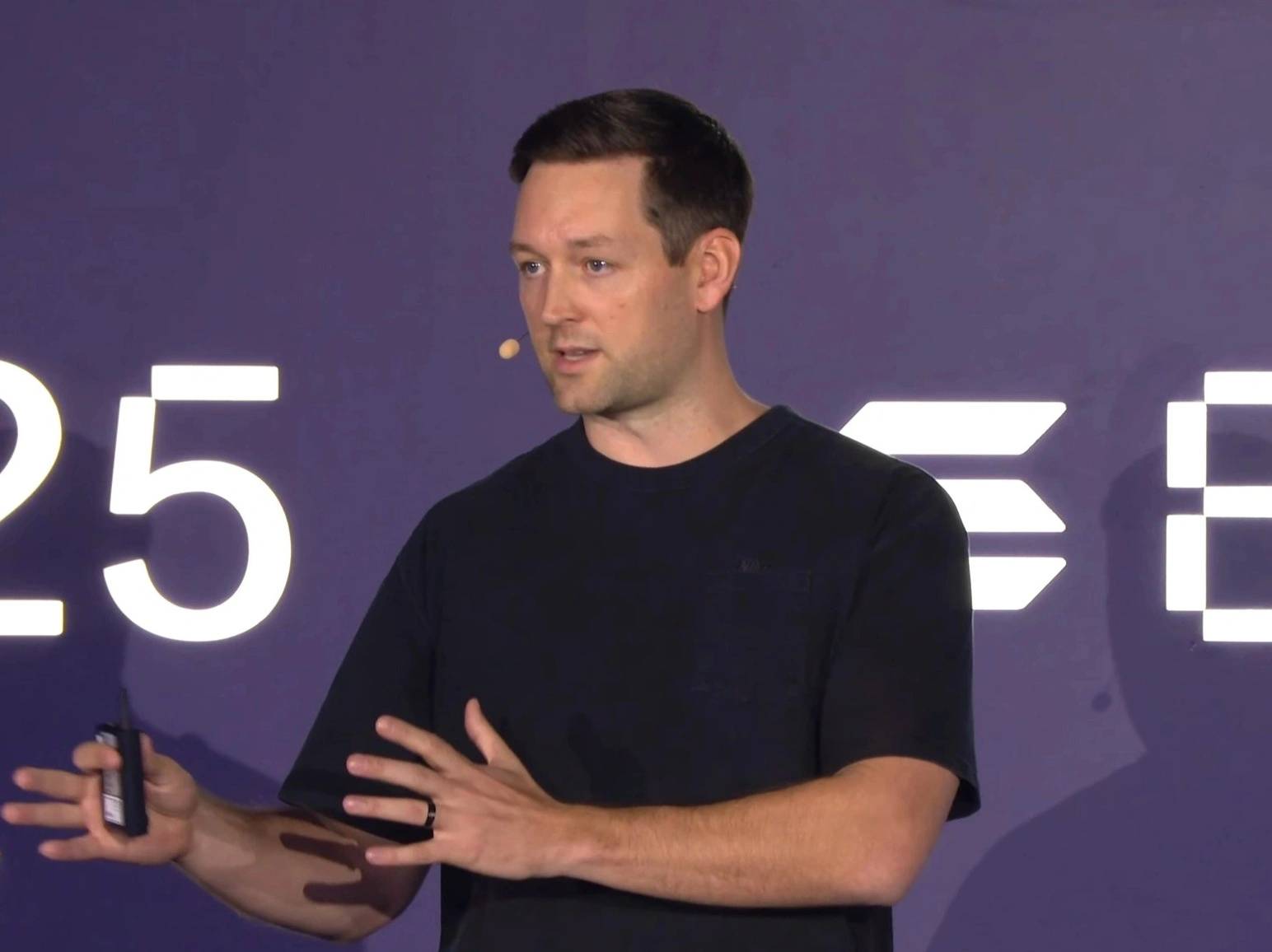
On December 12, 2025, Brennan Watt of Anza discussed developments in the Solana protocol during a presentation published on the Solana YouTube channel. He described the network as having maintained continuous operation while processing approximately 200 billion transactions. Watt attributed part of this operational performance to stress testing conducted by Anza's Invalidator team, which subjects the public testnet to network-level and transaction-level attack scenarios.

Watt described changes to Solana's resource limits and transaction processing during 2025. According to his presentation, mainnet throughput increased by approximately 25% following an increase in the block compute-unit limit from 48 million to 60 million. He also discussed XDP, a network-processing mechanism that allows applications to interact with network hardware from user space, reducing some of the processing associated with the conventional kernel network path. The presentation identified this change as an enabler for a possible future increase to 100 million compute units per block.
The presentation also covered Alpine Glow, a consensus engine under development as a replacement for Tower. Watt stated that Alpine Glow was designed to reduce transaction finality times to approximately 150 milliseconds and to provide additional mechanisms for handling validators that fall behind the network. At the time of the presentation, testing was being conducted on a geographically distributed cluster. Watt also discussed multiple concurrent proposers, a design in which validators can assume different roles in block production, as part of proposed changes to Solana's transaction-processing architecture.
Other changes discussed by Watt included a reduction in the cost of storing state, an increase in the maximum transaction size to 4 KB, modifications intended to reduce validator disk usage, and faster restart procedures. He also described SIMD-123, which would modify the distribution of validator revenue among stakers and infrastructure providers. Watt concluded by describing Anza's development process as release-oriented rather than organized around a fixed roadmap. [4]
Agave Engineering and Scaling #02
On May 19, 2025, the Solana YouTube channel published a presentation by Brennan Watt, Vice President of Core Engineering at Anza, concerning the development and operation of Agave, a validator client used by the Solana network. Watt described recent changes to the client and discussed measures related to transaction processing, block production, compute capacity, and network data propagation.

Watt reported that block skip rates had fallen below 0.5%, referring to instances in which a validator was able to produce a block but did not do so. He also stated that many transactions were reaching confirmation within a single slot, with most of the transactions represented in the presentation being confirmed in less than one second. He attributed these changes to improvements in the transaction and block processing pipelines.
The presentation also addressed compute-unit capacity. Watt stated that blocks were frequently reaching the network's compute-unit limit, indicating that transaction demand could exceed the available block space at times. He described an increase from 50 million to 60 million compute units as an upcoming change and identified 100 million compute units as a further target for 2025.
Watt discussed several areas of engineering work within Agave, including reductions in memory allocations, optimization of code executed along frequently used processing paths, and adjustments to hashing methods and data structures. He described these changes as a collection of smaller optimizations intended to improve execution efficiency rather than as a single architectural modification.
Another topic was Solana's block retransmission system. Watt explained that Turbine distributes block data from the leader to validators through a tree-based structure and discussed the development of Rotor as an extension of this approach. He stated that the proposed changes would increase the number of nodes receiving data directly and reduce the number of layers through which block data must propagate. The presentation also addressed the network traffic generated by block retransmission and the changes required to accommodate higher compute-unit limits.
Watt also discussed the scheduling of transactions for block execution. He referred to successive changes involving local fee markets and different scheduler implementations, with the objective of coordinating transaction selection and execution with the available computing resources.
In discussing network operation, Watt identified validator availability, client resilience, and transaction fees during periods of high demand as areas of engineering consideration. He described Anza's development process as centered on incremental releases and continued iteration rather than a fixed long-term roadmap. [5]
See something wrong?