Cournot Protocol is an AI-native oracle protocol that interprets real-world events and provides verifiable, evidence-backed results for prediction markets and onchain applications.
Cournot Protocol is an AI-native oracle protocol that interprets real-world events and provides verifiable, evidence-backed results for prediction markets and onchain applications.
Updated · 10 min read
Cournot Protocol is developing an AI-powered oracle network that uses cryptographic verification and automated reasoning to resolve complex real-world events and deliver verified information to blockchain applications. Its infrastructure includes structured data feeds, semantic oracles, AI-based event resolution, and autonomous agents for continuous monitoring and settlement. [1]
Cournot Protocol is developing an AI-based oracle system designed to resolve prediction markets, smart contracts, and other on-chain applications involving complex or unstructured real-world events.
Cournot Protocol's Price Feeds provide conventional oracle services that deliver structured data to blockchain applications, including cryptocurrency and equity prices, weather information, sports results, foreign exchange rates, and commodity benchmarks.
The protocol uses structured data feeds as a foundational layer, while addressing their limitations when applications require information beyond predefined data points.
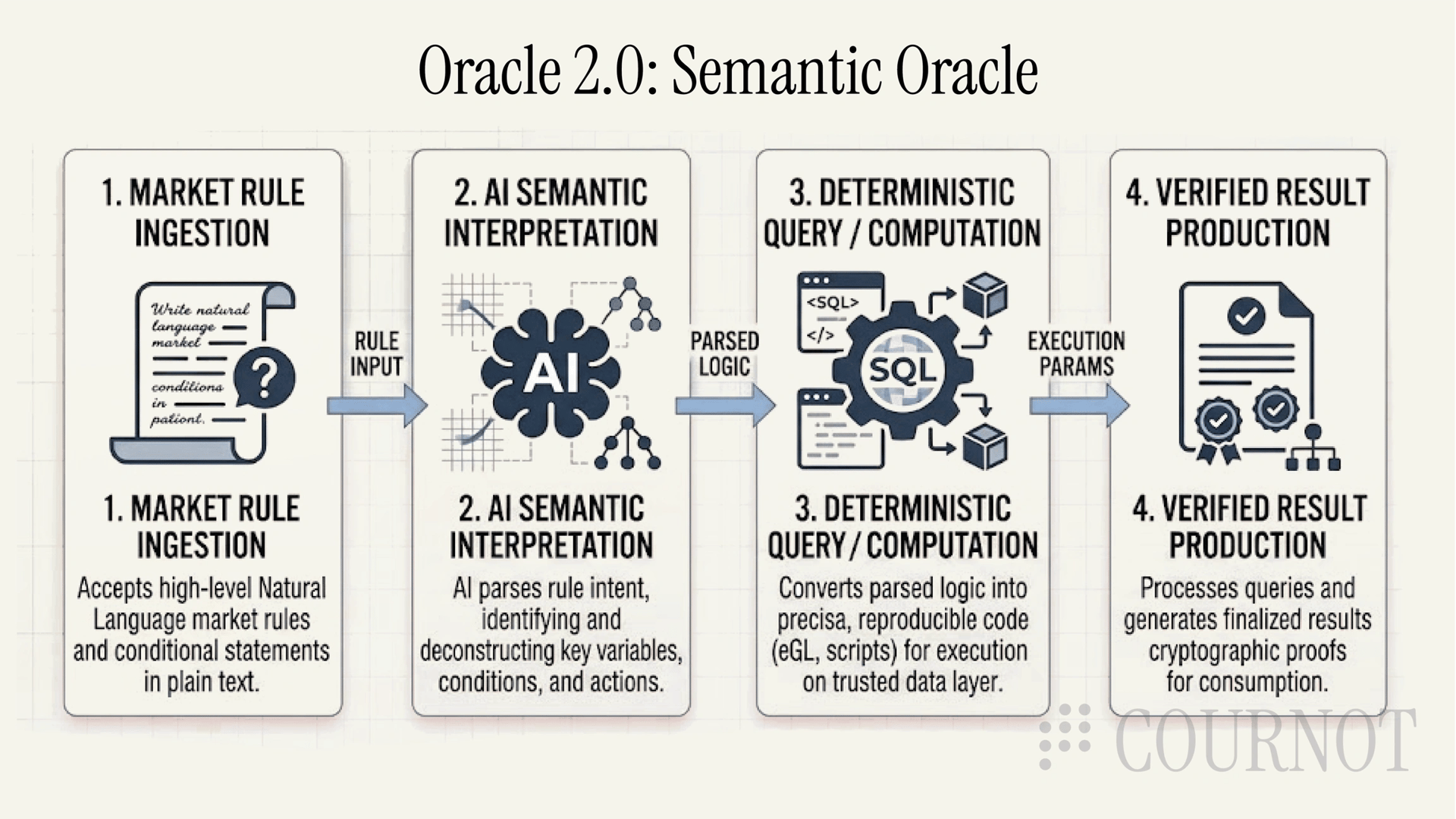
Cournot Protocol's Resolution Oracle is a semantic oracle layer that aggregates data from multiple oracle networks and primary sources, cross-checks inconsistencies, and uses AI to translate natural-language requests into deterministic queries and calculations.
The COURT token is the network token of Cournot Protocol and serves as collateral for operators participating in different roles across its resolution pipeline.
COURT has a total supply of 1B tokens and has the following allocation pools:
Cournot Protocol is developing an AI-based oracle system designed to resolve prediction markets, smart contracts, and other on-chain applications involving complex or unstructured real-world events. It addresses limitations in existing oracle systems, including the cost, delays, and scalability constraints of human-based resolution, as well as the difficulty of verifying AI-generated conclusions from unstructured information. The protocol focuses on events involving business milestones, policy conditions, supply chain disruptions, regional impacts, and other outcomes that require contextual interpretation and clearly defined settlement criteria. Cournot introduces Proof of Reasoning (PoR), a framework intended to make AI-based event resolution verifiable by linking conclusions to source authenticity, reasoning processes, and deterministic outputs. The system incorporates both semantic definitions of the events being evaluated and evidence requirements for determining outcomes, aiming to make resolutions auditable and reduce ambiguity and disputes. Its approach is intended to support automated resolution of complex real-world events across prediction markets, smart contracts, and AI-driven applications. [2]
Products
Price Feeds
Cournot Protocol's Price Feeds provide conventional oracle services that deliver structured data to blockchain applications, including cryptocurrency and equity prices, weather information, sports results, foreign exchange rates, and commodity benchmarks. These feeds support applications such as DeFi lending, derivatives, stablecoins, automated trading, gaming, parametric insurance, sports markets, and real-world asset applications. For gaming, the system also supports verifiable random functions (VRF), while insurance and sports applications can use structured data from external sources to determine predefined conditions or outcomes.
The protocol uses structured data feeds as a foundational layer, while addressing their limitations when applications require information beyond predefined data points. Traditional feeds generally require separate integrations for each data requirement, making them less adaptable to applications involving numerous or dynamically defined questions. Cournot combines standard feeds with additional semantic and AI-based capabilities to support the resolution of more complex events, such as market conditions involving disputed sporting events, specific match occurrences, or settlement rules that are not captured by conventional data APIs. [6]
Resolution Oracle
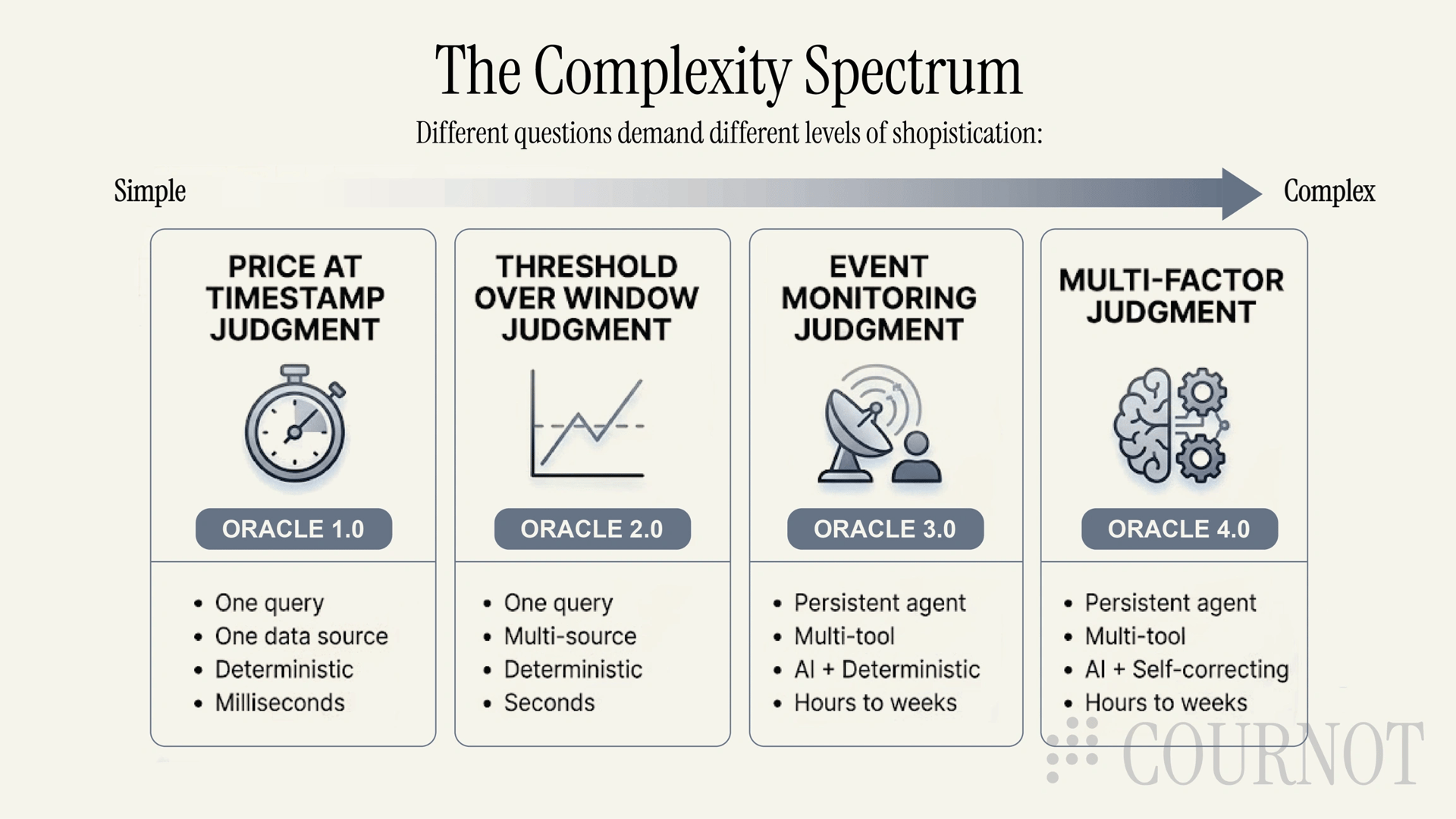
Cournot Protocol's Resolution Oracle is a semantic oracle layer that aggregates data from multiple oracle networks and primary sources, cross-checks inconsistencies, and uses AI to translate natural-language requests into deterministic queries and calculations. Rather than requiring a separate feed for each data requirement, it allows applications to query the same underlying datasets for different calculations, including TWAP, VWAP, price thresholds, time-based conditions, and multi-exchange composite prices. AI interprets the query, while deterministic code performs the calculation, supporting more complex data requirements across DeFi, structured prediction markets, commodities, traditional financial markets, and risk management.
The semantic layer also extends to pricing real-world and alternative assets, including collectibles, real estate, and luxury goods, where valuations may depend on fragmented marketplaces, asset condition, location, authenticity, and transaction history. The system can aggregate sales data, normalize differences between assets, filter outliers, and calculate composite valuations from multiple sources. By combining independent data providers and applying cross-validation, Cournot aims to reduce reliance on individual feeds and support more adaptable data queries without requiring new oracle integrations for each use case. [7]
Intelligence Oracle
Cournot Protocol's Intelligence Oracle is designed to resolve unstructured real-world events that cannot be determined through conventional data feeds or deterministic queries alone. It monitors unstructured sources, collects evidence with cryptographic provenance, cross-checks information across multiple sources, and applies semantic reasoning and domain-specific processes to produce verifiable judgments. Use cases include assessing regulatory approvals, corporate announcements, political events, subjective prediction market conditions, and supply chain disruptions. The Intelligence Oracle is described as Cournot's core product and is live in production as the Cournot Resolution Oracle, serving platforms such as 42space.
The system incorporates audit and dispute mechanisms to make AI-based resolution processes more accountable, addressing limitations associated with human consensus oracles, conventional data feeds, and AI computation systems that do not verify semantic reasoning. Cournot's architecture includes a reasoning-verification framework that uses Merkle traces and SOP (standard operating procedure) audits to track and verify the resolution process. The protocol is designed to support automated resolution of large volumes of complex and long-tail events, with reported resolution times of minutes in production and sub-second processing through its TEE fast path. [3]
Proof of Reasoning
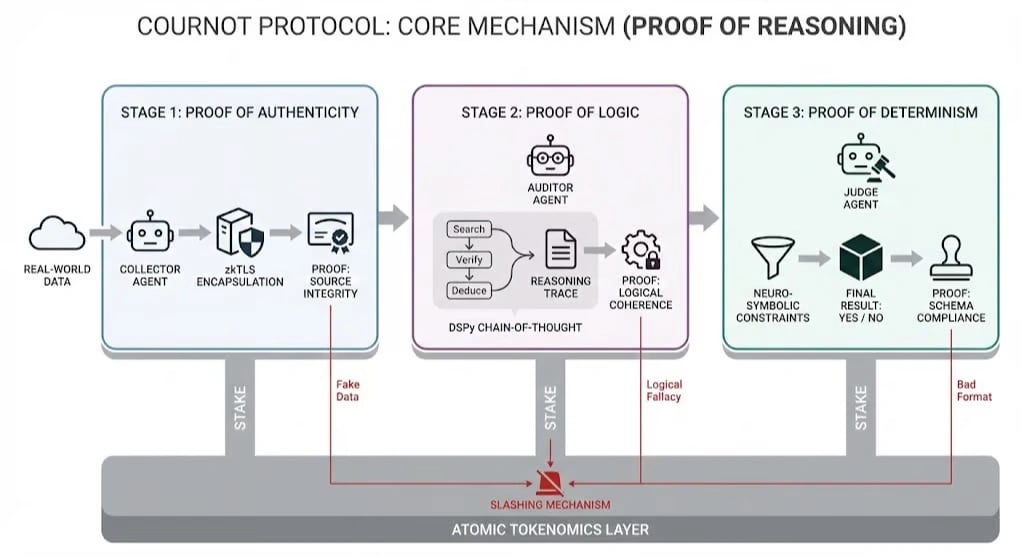
Proof of Reasoning (PoR) is Cournot Protocol's framework for making AI-based oracle resolution auditable by structuring the process into a role-based standard operating procedure (SOP) that generates a cryptographic evidence trail from data collection to final verdict. The system divides resolution into three stages: the Collector retrieves evidence from authorized sources and verifies its authenticity and freshness using cryptographic receipts and zkTLS; the Auditor evaluates the verified evidence against predefined rules and produces a Merkle-structured reasoning trace; and the Judge converts the resulting analysis into a deterministic, machine-readable verdict. Each stage has defined responsibilities and accountability requirements, with operators staking tokens against their performance.
PoR uses PromptSpec, a semantic specification that defines the question, scope, valid outcomes, and logical constraints, alongside evidence requirements governing permitted sources, retrieval methods, freshness, and conflict resolution. The reasoning process is represented through a Merkle tree, with its root anchored on-chain to support verification without storing the full trace on-chain. Cournot also separates evidence verification from reasoning verification by freezing the semantic specification, authenticated evidence, verdict schema, reasoning policy, model weights, and execution environment, creating a reproducible reasoning target for verification through mechanisms including optimistic machine learning (opML). [8]
opML
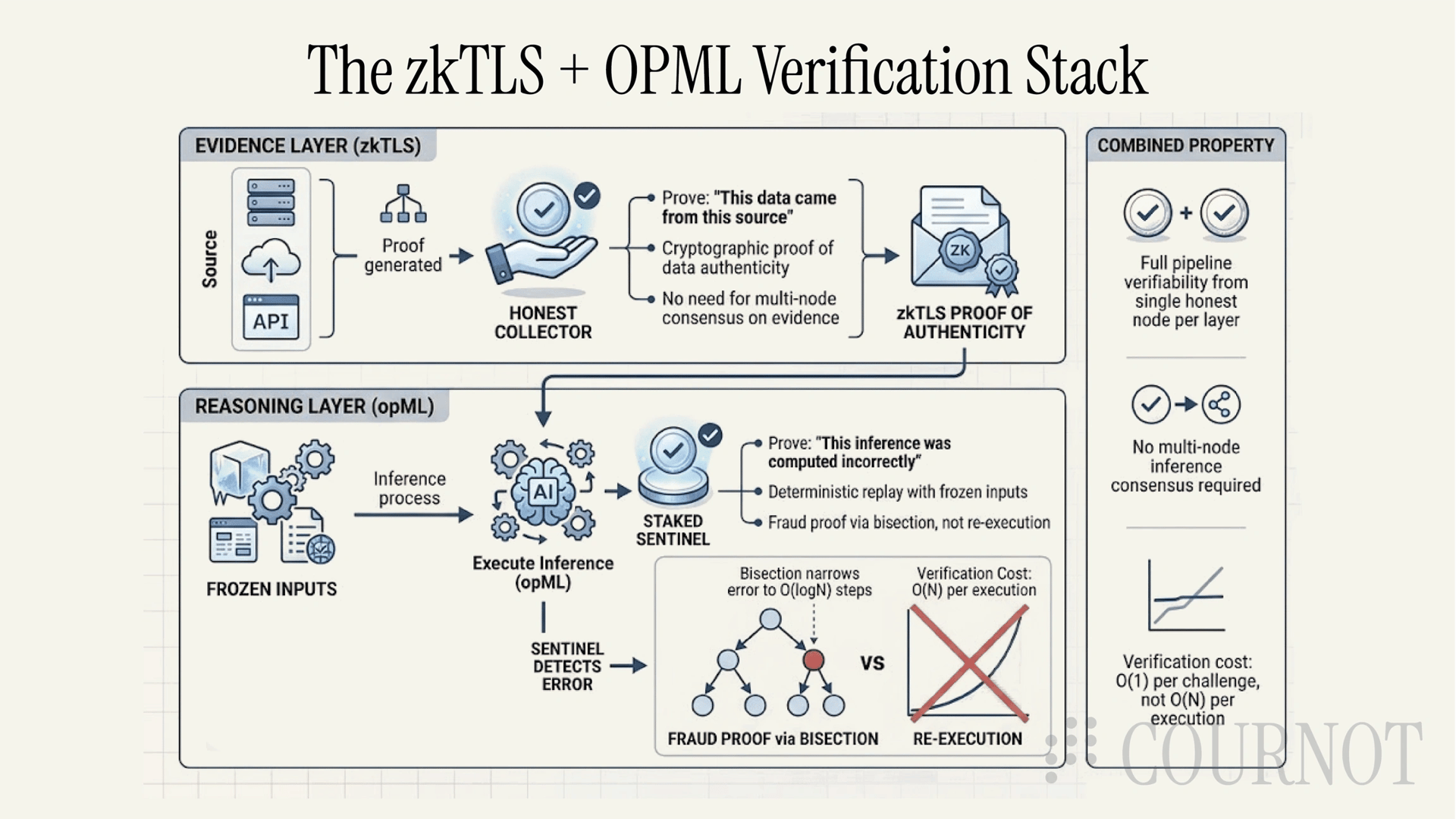
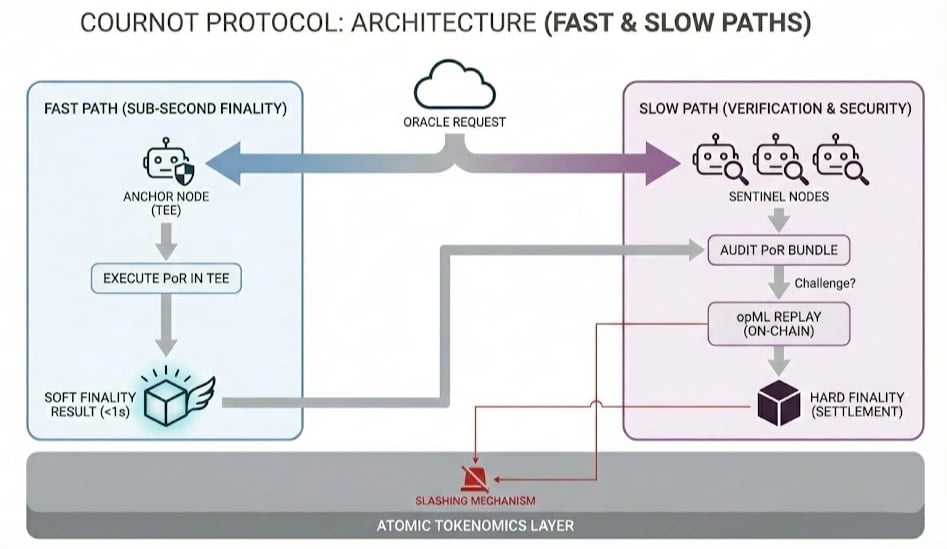
Cournot Protocol uses optimistic machine learning (opML) to make AI inference verifiable without requiring every network participant to independently run the same model. The system assumes that an inference result is correct unless a participant challenges it, allowing a single honest node to identify and prove an incorrect result. In Cournot's implementation, an Anchor Node executes the inference within a trusted execution environment (TEE) and publishes the result alongside the frozen inputs, including the PromptSpec, evidence bundle, model hash, and execution parameters. During a designated challenge period, a Sentinel Node can dispute the result, triggering a deterministic replay using the same inputs, model weights, and controlled execution environment. An interactive bisection protocol then narrows the disagreement to the specific computation step that differs, which can be verified on-chain. Combined with zkTLS, opML is intended to provide verification across the data collection and AI reasoning process, allowing one honest node to challenge the pipeline without requiring multiple nodes to repeat the full inference. This approach aims to reduce verification costs and make AI-based oracle resolution more economically scalable than systems that rely on independent execution by multiple nodes. [9]
Agentic Oracle
Cournot Protocol's Agentic Oracle, referred to as Oracle 4.0, is designed to extend AI-based oracle capabilities from one-time event resolution to continuous monitoring, reasoning, and autonomous action. Rather than waiting for a query, it uses persistent agents to monitor relevant data sources, interpret emerging evidence, select appropriate tools, adjust their approach when necessary, and determine when sufficient evidence exists to produce a verdict. Depending on the complexity of a question, agents can monitor sources such as regulatory filings, company announcements, social media, news services, on-chain activity, and market data over extended periods. Simple queries can follow Oracle 2.0's deterministic processing path, while more complex questions are assigned to agents capable of managing multi-step investigations.
The agents operate within human-defined boundaries, including PromptSpecs, data requirements, permitted tools, confidence thresholds, and verdict schemas. This allows them to make operational decisions about how and when to gather information while retaining predefined rules for what constitutes a valid outcome. Built using the OpenClaw framework and Proof of Reasoning (PoR) infrastructure, the Agentic Oracle is intended to provide a persistent intelligence layer that can monitor real-world developments and initiate resolution processes when relevant events occur. Its event-driven architecture is designed to reduce delays associated with scheduled oracle queries or manual settlement by activating the verification process as soon as trigger conditions are detected.
Oracle 4.0 is also designed to support applications beyond prediction markets, including trading intelligence, real-world asset verification, risk monitoring, insurance automation, credit surveillance, and coordination between autonomous AI agents. For disputes, agents can gather additional evidence, conduct adversarial reviews of reasoning traces, and use optimistic machine learning (opML) to identify and verify disputed computation steps. This combines persistent monitoring and autonomous reasoning with cryptographic evidence and verification mechanisms intended to make decisions auditable. The development of Oracle 4.0 remains an engineering challenge, particularly in ensuring that agents can reason reliably over extended periods, adapt to uncertainty, and maintain verifiability throughout multi-step processes. [4]
Architecture
Dual-Layer
Cournot Protocol's Fast and Slow Path architecture combines rapid execution with decentralized verification. The Fast Path is currently in production and operated by Cournot, while the open verification layer is planned for introduction after the token launch. Anchor Nodes execute AI inference within Trusted Execution Environments (TEEs) and generate Proof of Reasoning (PoR) results. Structured queries can achieve sub-second settlement, while unstructured events currently take a median of under eight minutes to resolve due to evidence collection requirements. The Anchor Node then signs the verdict, reasoning root, and PromptSpec hash, making the result available for use.
The Slow Path uses permissionless Sentinel Nodes to verify results through zkTLS evidence checks, opML reasoning challenges, and deterministic output validation. A single honest Sentinel can identify invalid evidence or flawed reasoning and initiate a challenge without requiring a network-wide consensus or multiple nodes to repeat the inference. Using Merkle-structured reasoning traces and opML's bisection protocol, disputes can be narrowed to a specific computation step and verified on-chain rather than requiring the entire inference to be repeated. This approach is intended to reduce verification costs while maintaining decentralized security through cryptographic proofs and economic incentives, including stake slashing. [10]
Confidential Truth
Cournot Protocol's Confidential Truth framework is designed to verify information without exposing the underlying sensitive data. This approach addresses applications such as corporate transactions, supply chain monitoring, and financial verification, where the evidence required to resolve an event may contain private information that cannot be published on a blockchain. The system uses zero-knowledge TLS (zkTLS) to allow users to generate proofs locally in their browsers, confirming that information came from an authorized website through a secure TLS session and meets specified conditions. Collector Nodes verify these proofs without accessing the original content, allowing private information, including personal and financial data, to remain on the user's device.
To protect information during AI processing, Cournot also uses Trusted Execution Environments (TEEs) for Fast Path inference. Hardware-based confidential computing technologies, including Intel TDX and NVIDIA H100 Confidential Computing, encrypt model weights and input data in memory to prevent server operators from directly inspecting the reasoning process. Remote attestation provides cryptographic evidence that the approved Cournot software is running within the protected environment and processing the specified input. Together, zkTLS and TEE-based computing are intended to enable private data verification and AI reasoning without exposing sensitive evidence to the oracle operator or other parties. [11]
COURT
The COURT token is the network token of Cournot Protocol and serves as collateral for operators participating in different roles across its resolution pipeline. Rather than relying on a single staking pool or token-weighted voting to determine outcomes, COURT bonds are assigned to individual roles, with penalties applied when participants commit objectively verifiable violations. The token also provides access to network roles, participation in governance over operational parameters, and an optional payment method for Cournot services. Customers who stake COURT can receive service benefits such as higher rate limits, included call credits, and discounted pricing across the protocol's products, although staking does not generate yield or provide claims on revenue. Users can access Cournot services without holding COURT and can pay using supported settlement assets. The token is not designed to represent ownership, debt, dividends, or a claim on the protocol's profits, and it does not determine the truth of events, which is established through cryptographic verification and open challenges. [12]
Tokenomics
COURT has a total supply of 1B tokens and has the following allocation pools: [13]