0% read
Last updated:
Initia
Initia is a modular blockchain ecosystem that combines a Layer 1 network with application-specific Layer 2 rollups, known as Minitias, through an integrated infrastructure framework. Its architecture supports multiple virtual machines, shared security, cross-chain interoperability, and liquidity coordination through the Cosmos SDK and Celestia data availability layer. [3]
Overview
Initia is a modular blockchain platform that supports interconnected, application-specific Layer 2 rollups, known as Minitias, through an integrated Layer 1 and Layer 2 architecture. Its Interwoven Stack combines the underlying blockchain, rollup infrastructure, data availability, interoperability, and communication layers to reduce the technical and operational burden of launching independent application chains. Built around the Cosmos SDK and Celestia's data availability infrastructure, Initia uses the OPinit Stack, a virtual machine-agnostic optimistic rollup framework that supports different execution environments, including EVM, MoveVM, and WasmVM.
The platform provides Minitias with shared infrastructure and services, including bridging, cross-chain messaging, native USDC and CCTP access, oracle integrations, fiat payment rails, and developer tools. Its interoperability layer lets applications exchange assets and information across Minitias, regardless of their virtual machine environments. Initia also implements Omnitia Shared Security, integrating Celestia light nodes into Initia's Layer 1 validator infrastructure to verify rollup data and support fraud-proof mechanisms without requiring validators to download the complete data for every Minitia. This architecture allows application-specific chains to operate independently while sharing common infrastructure for data availability, security, and communication. [4]
Architecture
Initia L1
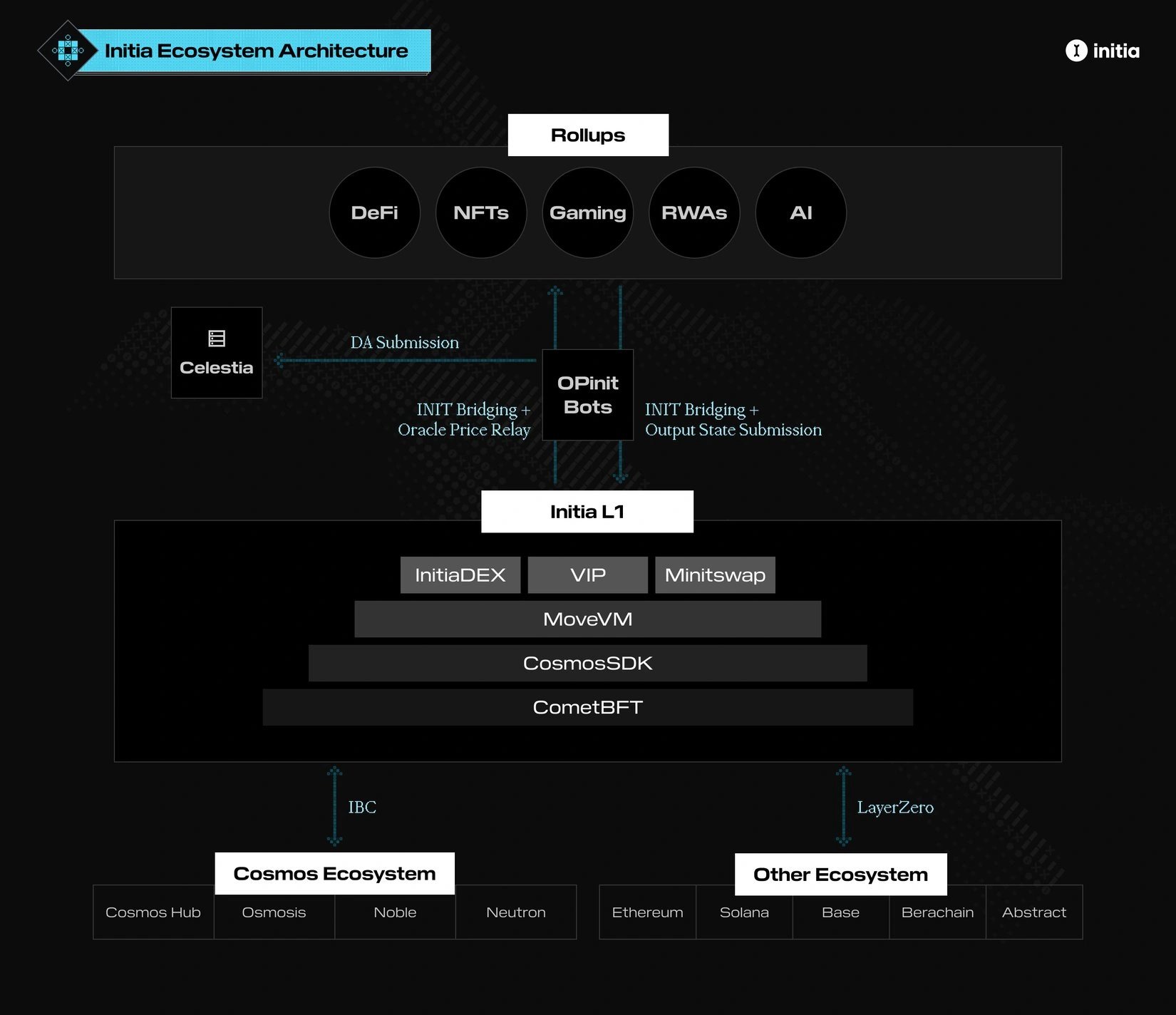
Initia L1 is a Layer 1 blockchain built using the Cosmos SDK that serves as the central coordination layer for Initia's interconnected rollups. It provides shared infrastructure for network security, governance, liquidity, and interoperability, allowing rollups to interact with one another and the broader blockchain ecosystem. Rollups use Initia L1 for services such as token bridging, state commitments, and fraud proofs, while InitiaDEX functions as a central liquidity hub for token swaps, liquidity provision, and cross-rollup transfers. The Layer 1 also coordinates ecosystem incentive mechanisms, including the Vested Interest Program (VIP) and Enshrined Liquidity. [1] [6]
Interwoven Rollups
Interwoven Rollups are Layer 2 application-specific blockchains built using Initia's Interwoven Stack. They let developers customize rollups for their applications, including selecting a virtual machine (EVM, Move, or Wasm), configuring gas tokens and transaction fee structures, and implementing custom transaction-ordering mechanisms. Initia provides three primary rollup environments: MiniEVM, which supports Solidity and other EVM-compatible smart contracts while integrating with the Cosmos ecosystem through custom precompiles, a unified ERC-20 interface for different token types, and IBC compatibility; MiniMove, which uses an Aptos-based implementation of MoveVM adapted to work with the Cosmos SDK and Initia ecosystem; and MiniWasm, which integrates CosmWasm for deploying and interacting with CosmWasm smart contracts. Together, these environments allow applications to use different execution frameworks while maintaining access to Initia's shared infrastructure and interoperability layer. [1] [7]
Interwoven Stack
The Interwoven Stack is Initia's integrated infrastructure framework for developing, deploying, and operating application-specific Layer 2 rollups. It combines the components and services required to launch a rollup, including a multi-virtual-machine rollup framework, wallets, explorers, bridges, oracles, and fiat on-ramps. The Stack also enables interoperability between individual rollups, Initia L1, and external blockchain ecosystems, along with integrated security mechanisms. By consolidating these infrastructure components into a single framework, the Interwoven Stack reduces the need for developers to independently source, build, and integrate separate services when launching and maintaining rollups. [1] [5]
OPinit Framework
The OPinit Framework is Initia's optimistic rollup infrastructure, consisting of three main components: the OPinit Bridge, Executor, and Challenger. The OPinit Bridge facilitates token transfers, including INIT and other assets, between Initia L1 and its Layer 2 rollups through two Cosmos SDK modules: OPhost, which operates on Initia L1 and manages bridge configurations and rollup state proposals, and OPchild, which is integrated into Interwoven Rollups and handles operator management, bridge messages, and oracle updates. The Executor operates the bridge, submits rollup transaction outputs to Initia L1, publishes transaction batches to Celestia's data availability layer, and relays oracle price data when configured. The Challenger operates separately from the Executor, monitoring submitted state proposals and disputing invalid outputs to help maintain the integrity of rollup state transitions. Together, these components coordinate asset transfers, transaction processing, data availability, and state verification between Initia's Layer 1 and Layer 2 networks. [11]
Features
VIP
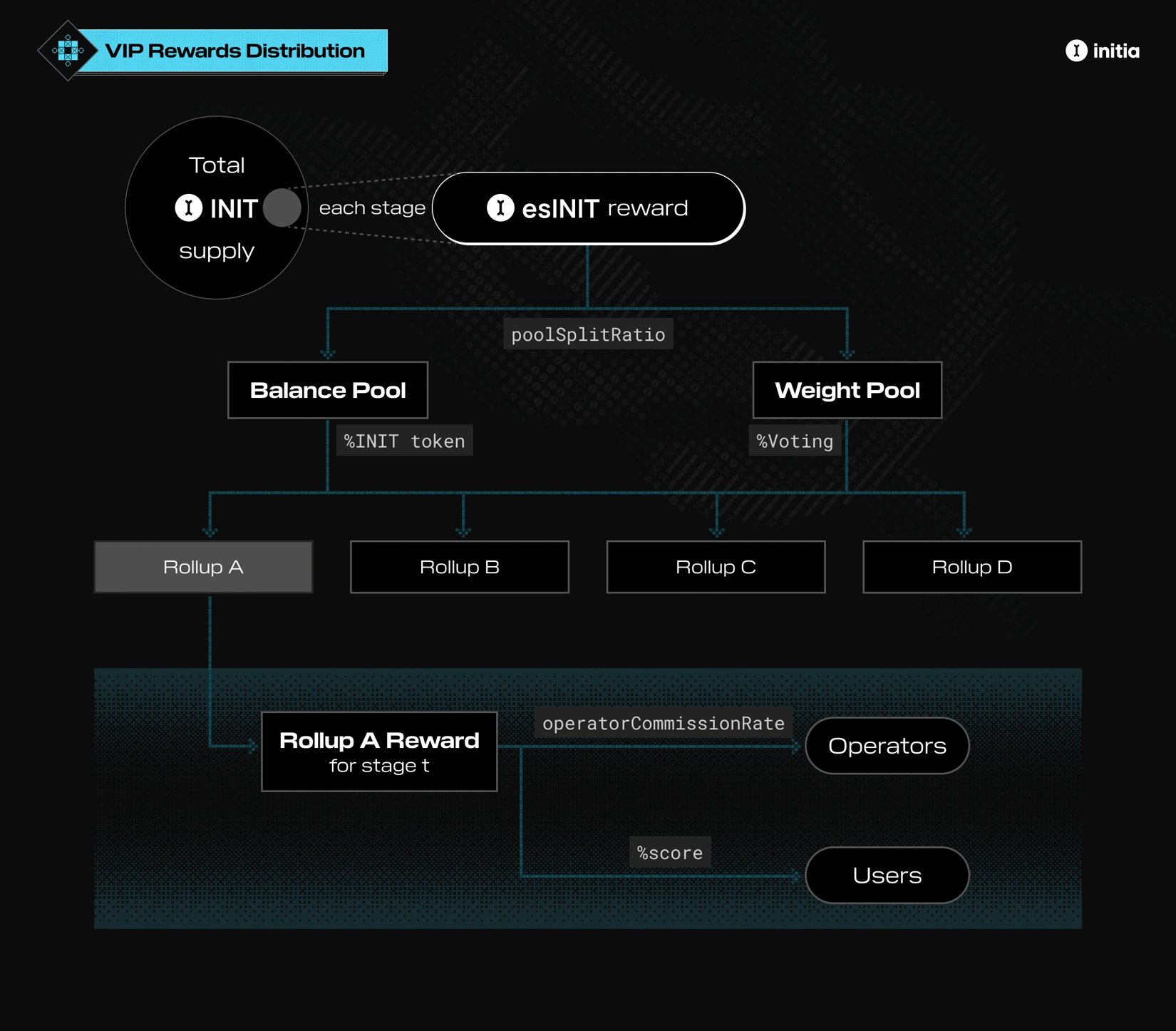
The Vested Interest Program (VIP) is an incentive mechanism that aligns the economic interests of Initia's Layer 1, Interwoven Rollups, application developers, users, and INIT token holders. It distributes rewards based on economic activity and contributions within the ecosystem, addressing how incentives are allocated across applications and rollups. Under the program, rollups receive reward allocations for developing applications and introducing new uses for INIT, while users can earn INIT tokens by completing activities or meeting participation criteria established by individual Layer 2 networks. A portion of the rewards is also allocated directly to rollups, incentivizing development and encouraging longer-term participation across the ecosystem. [15] [16]
InitiaDEX
InitiaDEX is a decentralized exchange built on Initia L1 that serves as the central liquidity hub for the Interwoven Rollup ecosystem. It supports Balancer-style weighted pools for assets with different market characteristics and StableSwap pools for assets with closely correlated prices. The exchange facilitates trading, liquidity provision, and token swaps between assets across the Initia ecosystem, including cross-rollup transactions. It also incorporates Enshrined Liquidity, which allows governance-approved liquidity pool positions to be used as staking assets for Initia L1. [12]
Enshrined Liquidity
Enshrined Liquidity is an Initia mechanism that allows governance-approved liquidity positions on InitiaDEX to be used as staking assets with Initia L1 validators, alongside the native INIT token. It is designed to address liquidity fragmentation, capital inefficiency, and the trade-off between blockchain security and available trading liquidity in traditional Proof of Stake systems. By allowing eligible INIT-token liquidity positions to contribute to network staking, the mechanism enables participants to earn both validator staking rewards and trading fees from the same position. This approach combines liquidity provision with network security while reducing the need to divide capital between separate staking and liquidity positions. [12]
Minitswap
Minitswap is a decentralized exchange developed by Initia to facilitate faster withdrawals and asset transfers between Initia L1 and its Layer 2 rollups, known as Minitias. It addresses the withdrawal delays associated with optimistic rollups, which typically require a seven-day challenge period before assets can be withdrawn through the native OPinit Bridge. Minitswap works alongside the Inter-Blockchain Communication (IBC) protocol, allowing users to transfer rollup-specific versions of INIT back to Initia L1 and exchange them for the original INIT without waiting for the challenge period to expire. Its architecture uses a virtual omnipool design centered on a single INIT liquidity pool, supporting swaps between INIT and different IbcOpINIT tokens from multiple Minitias and reducing liquidity fragmentation. To manage the security and liquidity risks associated with these transactions, Minitswap uses whitelisted trading pairs and withdrawal rate limits, along with mechanisms such as Peg Keeper Swaps, Internal Rebalancing, and Direct Swaps to manage liquidity and improve capital efficiency. [8] [9] [10] [13] [14]
INIT
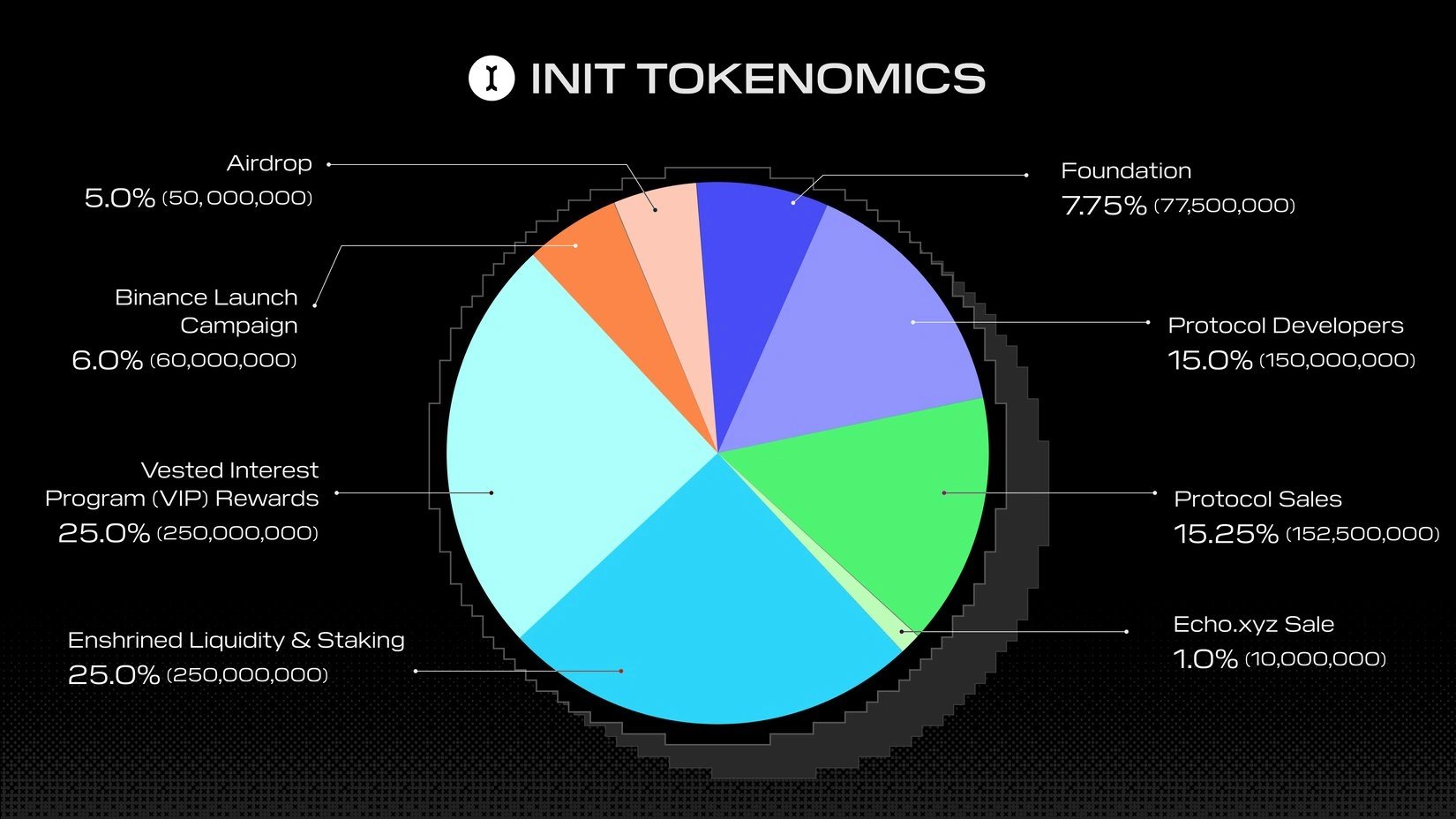
INIT is Initia's native token. It has a total supply of 1B tokens and has the following allocation: [17]
- Vested Interest Program Rewards: 25%
- Enshrined Liquidity & Staking: 25%
- Protocol Sales: 15.25%
- Protocol Developers: 15%
- Foundation: 7.75%
- Binance Launch Campaign: 6%
- Airdrop: 5%
- Echo.xyz Sale: 1%
Partnerships
- Binance Labs
- Delphi Ventures
- Hack VC
- Nascent
- A_Capital
- Big Brain Holdings
- Figment Capital
- Theory Ventures
See something wrong?
Official Website:
Social Profiles:
Founders:
Blockchains: