0% read
Last updated:
Jasper Zhang
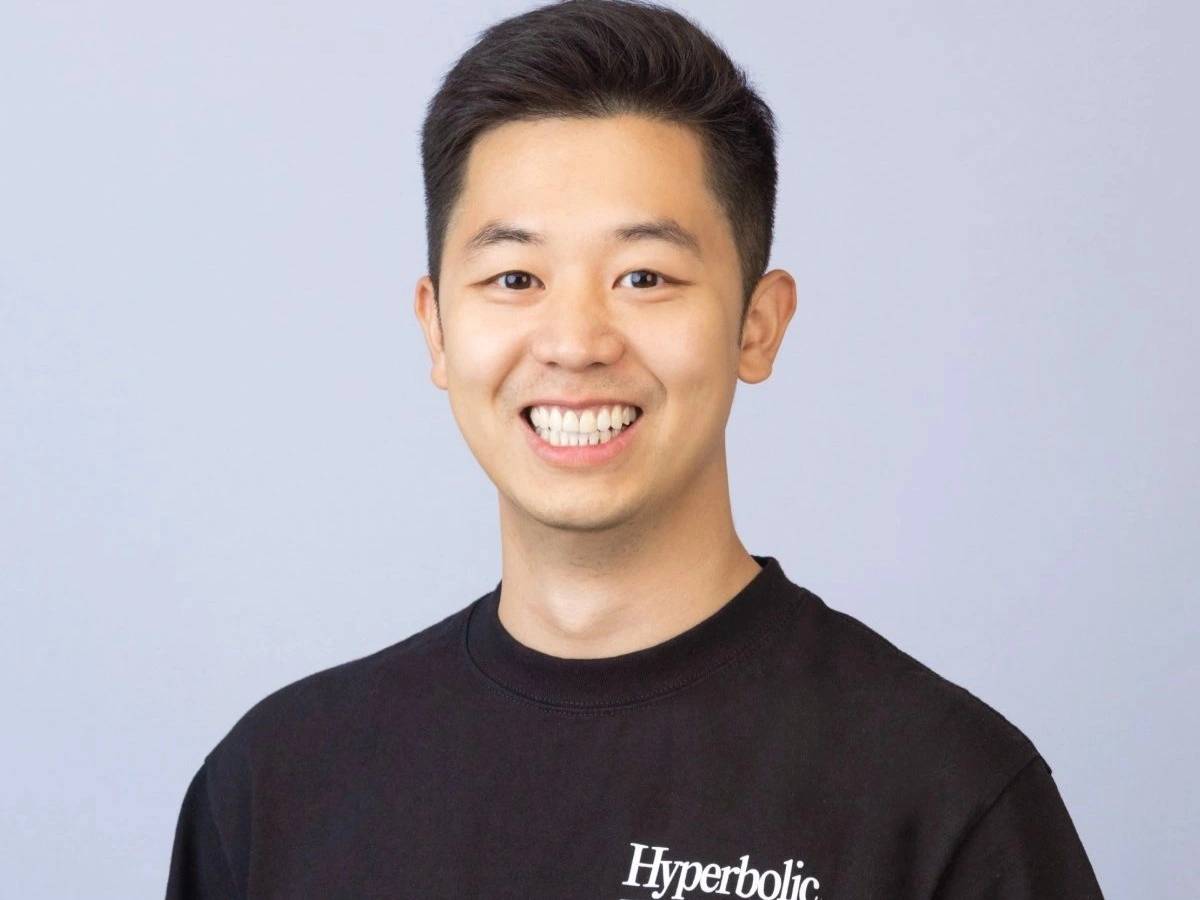
Jasper Zhang (also known as Yue Zhang) is the co-founder and chief executive officer of Hyperbolic, a company developing decentralized infrastructure for artificial intelligence. He has a background in mathematics, quantitative research, and blockchain infrastructure, with prior professional experience at Citadel Securities and Ava Labs. [1]
Education
Zhang demonstrated an early aptitude for mathematics, participating in and winning competitive math competitions from a young age. He earned a Bachelor's degree in Mathematics from Peking University in 2018. Following his undergraduate studies, he pursued doctoral research at the University of California, Berkeley. In 2020, after two years of study, he completed his Ph.D. in Mathematics. His doctoral work focused on three-dimensional topology and hyperbolic manifolds. [2]
Career
Zhang developed an early interest in mathematics and participated in competitive math competitions from a young age. During his secondary education, he won gold medals at the Chinese Mathematical Olympiad and the All-Russian Mathematical Olympiad. He later placed first in the Chinese Mathematics Competition for College Students and earned two gold medals at the Alibaba Global Mathematics Competition during his doctoral studies. Zhang pursued higher education in mathematics at the University of California, Berkeley, where he earned a Ph.D. in the field. His doctoral research focused on three-dimensional topology, including hyperbolic manifolds. Following his doctorate, he worked as a quantitative researcher at Citadel Securities, applying mathematical and statistical methods to financial markets.
After his work in quantitative finance, Zhang transitioned into blockchain research. He served as a senior blockchain researcher at Ava Labs, where his work focused on the performance, reliability, and security of consensus protocols and distributed systems. Drawing on his background in mathematics, quantitative research, and blockchain infrastructure, Zhang later co-founded Hyperbolic, where he serves as chief executive officer. His work at Hyperbolic centers on developing infrastructure intended to improve access to computational resources for artificial intelligence, with an emphasis on decentralized compute, inference, and verification systems. [3]
Interviews
Hyperbolic’s Vision
In an April 2025 interview on Venture with Grace Gong, Zhang discussed his background in mathematics, including a Ph.D. from the University of California, Berkeley, and his early professional experience applying AI techniques in quantitative finance and research roles. He explained that Hyperbolic is focused on addressing structural barriers to AI development by improving access to GPU compute, describing the AI cloud as a remotely hosted infrastructure that allows developers to use AI services without owning hardware. Zhang outlined Hyperbolic’s model of aggregating underutilized GPUs from data centers worldwide into a marketplace where developers can rent compute resources at market-driven rates, with the platform operating as an intermediary rather than a traditional data center operator. He noted that growing demand for AI workloads is increasing pressure on GPU supply and argued that more flexible access models can support experimentation, deployment, and fine-tuning of specialized AI models as companies scale. Zhang also discussed how developers typically move from early testing through iterative model refinement on the platform, emphasizing the role of accessible infrastructure in enabling broader participation in AI development. [6]

On-chain AI
In a December 2024 appearance on the Show Me The Crypto podcast, Zhang discussed the rapid development of artificial intelligence and the role blockchain technology may play in supporting decentralized AI systems. He outlined his academic background in mathematics and early interest in blockchain, then described Hyperbolic’s objective of building a decentralized GPU network to improve access to computing resources for AI developers. The conversation covered the use of blockchain to coordinate AI agents and build trust in autonomous systems, as well as the structure of a GPU marketplace designed to lower costs and reduce barriers to entry. Zhang also shared views on longer-term trends in AI and crypto adoption, highlighting expectations around increased practical use cases and the need for greater coordination between AI and Web3 communities. [8]

Presentations
No More Data Centers
In an August 2025 presentation at the AI Engineer’s World Fair, Zhang discussed projected growth in demand for data centers and GPUs, noting that capacity requirements are expected to increase substantially over the coming years amid high infrastructure costs, grid constraints, and environmental considerations. He highlighted inefficiencies in current markets, where many GPUs remain underutilized for much of the time, and outlined a marketplace-based approach that aggregates capacity across multiple data centers to match supply and demand better. Zhang described how this model enables more flexible access to compute resources, allowing users to scale usage up or down without long-term commitments while improving overall utilization of existing hardware. He also addressed sustainability concerns, arguing that optimizing current GPU usage is more viable than relying solely on new data center construction, and concluded with a technical overview of Hyperbolic’s software stack, including a system for coordinating GPU access and management across participating providers. [4]

Affordable AI Cloud
In a March 2025 presentation during Hyperbolic’s AI After Hours event, Zhang outlined the company’s origins, structure, and technical direction. He explained that Hyperbolic was founded in late 2022 with a focus on improving access to compute resources for AI development, highlighting the problem of widespread underutilization of existing hardware. Zhang described the company’s approach to decentralized computing, including a system that enables contributed machines to operate as nodes in a distributed network and a compilation service that runs AI models across different hardware architectures. He also discussed mechanisms for maintaining trust and privacy in decentralized environments, such as sampling-based verification and data protection strategies. He addressed longer-term ideas around AI agents, platform scalability, and integration with crypto-based payments and infrastructure. [5]

Open Source AI
At TOKEN2049 Singapore in September 2024, Zhang presented a keynote outlining Hyperbolic’s approach to open-source and decentralized AI infrastructure. He discussed his academic background in mathematics and the company’s founding in 2022, then framed AI as an increasingly foundational technology across multiple industries. Zhang identified limitations in centralized computing and described the development of a decentralized operating layer that aggregates GPUs globally, along with service layers designed to support multiple machine learning frameworks and hardware environments. He introduced verification and security mechanisms, including a sampling-based approach and the use of trusted execution environments to address reliability and privacy concerns in decentralized computation. The talk concluded with a forward-looking discussion of how AI ecosystems may evolve from infrastructure to applications and economic coordination, emphasizing participation across infrastructure, data, and model development to support open AI systems. [7]

See something wrong?
Official Website:
Social Profiles: