0% read
Last updated:
Project Ensemble
Project Ensemble is a financial technology initiative led by the Hong Kong Monetary Authority (HKMA) designed to explore and develop Hong Kong's asset tokenization ecosystem. The project aims to build a new financial market infrastructure (FMI) to facilitate seamless interbank settlement of tokenized assets and deposits, primarily through the use of a wholesale Central Bank Digital Currency (wCBDC) and tokenized commercial bank money.
Overview
Project Ensemble was initiated to support the growth of Hong Kong's digital asset market by enhancing the efficiency, transparency, and liquidity of financial transactions. The central goal is to create a robust infrastructure that can handle the end-to-end process of asset tokenization, from issuance to settlement. The project's framework is built upon two core concepts: a wholesale CBDC (wCBDC) to serve as a risk-free settlement asset for interbank transactions, and tokenized deposits, which are digital representations of commercial bank deposits used as a medium for settling transactions involving tokenized real-world assets (RWAs).[1]
The HKMA positions Project Ensemble primarily as a wholesale market infrastructure, with tokenized deposits as the initial focus and, over time, tokenised central bank money such as e‑HKD to support 24/7 settlement of tokenised transactions.[6]
The HKMA has structured the project in progressive phases, beginning with a controlled experimental environment, or sandbox, before advancing to live pilots with real-value transactions. This staged approach allows the HKMA and industry participants to test technology, establish standards, and refine regulatory frameworks in a contained setting before broader implementation. Key objectives include enabling atomic settlement, where the transfer of a tokenized asset and its payment occur simultaneously, thereby eliminating settlement risk.
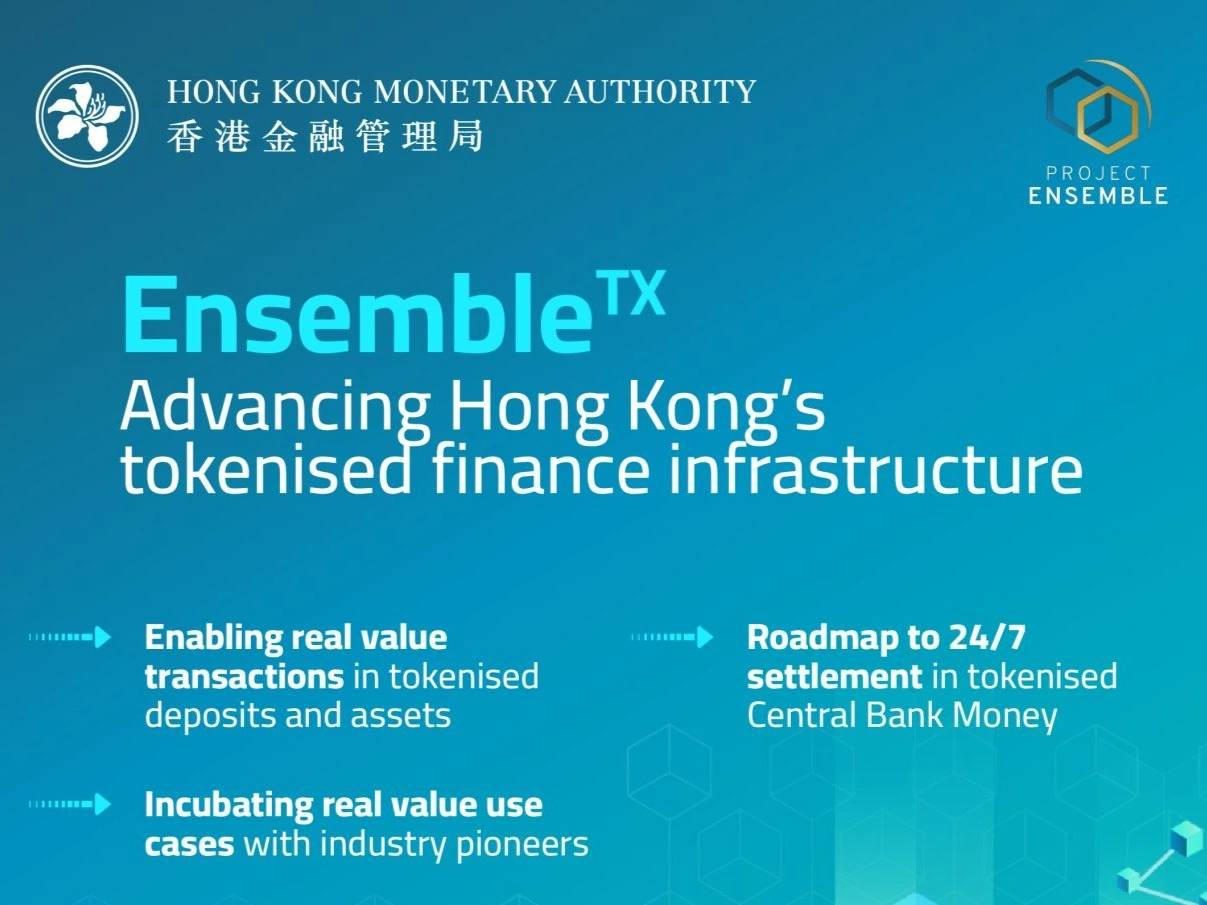
The project also explores the programmability of digital assets to streamline complex financial processes.[1] Ensemble TX, the live pilot phase announced in November 2025, is planned to operate throughout 2026 as a real-value testbed for these wholesale tokenisation use cases.[7][8]
Strategically, Project Ensemble aims to connect Hong Kong’s digital finance advancements with the real economy, reinforcing its status as a global financial hub and a compliant gateway between mainland China and international capital markets. A significant component of this strategy involves extending the project's scope to cross-border applications, such as trade finance, to address long-standing inefficiencies and risks in international commerce.[2]
The initiative forms part of the HKMA’s broader Fintech 2030 agenda and its digital money strategy, under which the authority is exploring both wholesale and retail CBDC, tokenised deposits, and other forms of digital money in an integrated policy framework.[6]
History and Development
Launch and Sandbox Phase
Project Ensemble was officially launched in March 2024 as part of the second phase of the HKMA's broader e-HKD pilot program.[1] On August 28, 2024, the HKMA introduced the Project Ensemble Sandbox, a controlled environment designed for industry participants to experiment with and test tokenization use cases. This initial phase operated on a proof-of-concept basis, utilizing experimental tokenized deposits for settling digital asset transactions without the exchange of real value.[3][4]
The sandbox was created to allow banks, asset managers, and technology firms to test the end-to-end lifecycle of tokenized products, from issuance and trading to settlement. The initial round of experiments focused on four primary themes: fixed income and investment funds, liquidity management, green and sustainable finance, and trade and supply chain finance.
The sandbox architecture enabled participating firms to connect their proprietary tokenization platforms to a central infrastructure, allowing for tests of interoperability and settlement workflows. This collaborative effort was intended to pave the way for a more innovative financial ecosystem in Hong Kong.[1][3]
Ensemble TX Pilot Phase
On November 13, 2025, Project Ensemble advanced from its experimental stage to a live pilot phase with the launch of "Ensemble TX." This transition marked a significant milestone, as the project moved from proof-of-concept to facilitating real-value transactions in a controlled environment.[4][5] Eddie Yue, Chief Executive of the HKMA, described this step as the point "where innovation meets implementation."
The Ensemble TX pilot is scheduled to operate throughout 2026. The initial use cases for the pilot focus on enabling participants to use tokenized deposits for transactions in tokenized money market funds and for managing liquidity and treasury needs in real time. Unlike the sandbox phase, the pilot involves the transfer of actual monetary value, bringing the project's concepts into practical application for participating financial institutions.[4][5]
In the 2026–27 Budget and subsequent HKMA speeches, the government confirmed resources for keeping Ensemble TX in operation in 2026, with priorities that include onboarding additional banks, incubating a wider set of tokenisation use cases, and developing local standards that support interoperability with tokenised markets in other jurisdictions.[9][7][8]
Technical Architecture
Core Components
Project Ensemble's architecture is built around several key technological components designed to create a modern and efficient financial market infrastructure.
- Wholesale Central Bank Digital Currency (wCBDC): The wCBDC is envisioned as the core settlement asset within the project's ecosystem. It offers a risk-free, final, and instantaneous means of settlement for interbank transactions involving tokenized assets. It functions as the "atomic" settlement leg in Delivery-versus-Payment (DvP) transactions, ensuring that the transfer of a tokenized asset occurs only if the corresponding wCBDC payment is made simultaneously, thus eliminating settlement risk.[3][1] In HKMA’s digital money strategy, this wholesale tokenised central bank money is expected to sit alongside e‑HKD and other CBDC initiatives as part of a unified Fintech 2030 roadmap.[6]
- Tokenized Deposits: These are tokenized representations of commercial bank deposits held on a distributed ledger. In the initial and pilot phases of Project Ensemble, tokenized deposits serve as the primary settlement asset for transactions involving various tokenized RWAs. This allows for the integration of tokenization within the existing commercial banking framework and reflects the HKMA’s priority of testing wholesale use cases in which banks issue and redeem tokenised deposits on a 24/7 basis.[5][7]
- Atomic Settlement: A key feature of the architecture, atomic settlement (or Delivery-versus-Payment) ensures that the exchange of a tokenized asset for a payment asset (like a tokenized deposit or wCBDC) is simultaneous and indivisible. This mechanism is crucial for mitigating counterparty and settlement risks in digital asset transactions.[1]
Settlement Mechanism
The settlement mechanism for Project Ensemble is designed to evolve over time as the technology and infrastructure mature.
- Initial Pilot Phase (Ensemble TX): In its current stage, interbank settlement of tokenized deposit transactions within the Ensemble TX pilot is conducted through Hong Kong's existing HKD Real Time Gross Settlement (RTGS) system. This approach allows the project to leverage established and trusted financial infrastructure while testing new tokenization use cases with real value.[4][5] Ensemble TX is used in 2026 as a live pilot to explore how tokenised deposits can interoperate with existing payment rails and prepare for migration to tokenised central bank money.[7][8]
- Future Development: The HKMA plans to progressively upgrade the pilot environment to support 24/7 settlement using a wCBDC, which is also referred to as tokenised Central Bank Money (CeBM). In the HKMA’s roadmap, this tokenised CeBM may be implemented through e‑HKD or another form of wholesale CBDC and is expected to become a continuously available settlement layer for large‑value wholesale transactions. This future state is intended to provide a more robust and continuously available settlement layer, which is considered a critical infrastructure component for supporting the scalability and growth of Hong Kong’s tokenization market.[6][8]
Key Initiatives and Use Cases
Asset Tokenization in the Sandbox
The Project Ensemble Sandbox has been used to test a variety of innovative use cases for asset tokenization, demonstrating the practical applications of the underlying technology. As part of documenting these experiments, the HKMA has indicated plans to publish an Ensemble Use Case Report and develop an Ensemble Taxonomy, in collaboration with the Project Ensemble Architecture Community, to summarise sandbox and pilot findings and provide standardised definitions for tokenisation concepts and transaction types.[7]
- A notable case involved the tokenization of a green bond, showcasing the potential for real-value tokenization in sustainable finance.[3]
- Ant Digital Technologies, in collaboration with energy firm Longshine Technology, digitized over 9,000 of Longshine's electric vehicle (EV) charging piles as Real-World Assets (RWAs). This tokenization enabled Longshine to secure its first cross-border financing for RWAs in Hong Kong, highlighting how the project can enhance financing efficiency for green infrastructure.[1]
- HashKey Group, a digital asset services firm, utilized the sandbox to test the full lifecycle of tokenized RWAs. Assets under test included carbon credits, other green assets, and money market funds, demonstrating the platform's versatility across different asset classes.[1]
Cross-Border Trade Finance Platform
On March 2, 2026, the HKMA announced the signing of a Memorandum of Understanding (MoU) to develop a shared, blockchain-based platform for cross-border trade finance. This initiative, operating under the Project Ensemble framework, represents a significant expansion into real-world, international applications.[2]
The platform is a collaborative effort between the HKMA, the Shanghai Data Bureau, and the National Technology Innovation Center for Blockchain in mainland China. Its primary objectives are to streamline complex trade finance processes, reduce fraud associated with paper-based systems in cargo finance, and deepen the integration of Hong Kong with mainland China's supply chains. The platform will utilize blockchain as a shared, immutable ledger and will leverage electronic bills of lading (eBLs) to replace traditional paper documents for the transfer of cargo titles. It is also designed to connect with existing infrastructure, such as Hong Kong’s Commercial Data Interchange (CDI) and the CargoX platform, to facilitate secure data sharing.[2]
Participants and Collaboration
Project Ensemble is a highly collaborative initiative involving regulatory bodies, private sector firms, and international partners.
Leadership and Regulation
- Hong Kong Monetary Authority (HKMA): The HKMA is the lead organization that initiated, spearheads, and oversees the project, including managing the Sandbox and pilot phases.[3]
- Securities and Futures Commission (SFC): The SFC is a key regulatory partner, working closely with the HKMA to co-develop regulatory standards for tokenized products. The SFC is an official member of the Project Ensemble Architecture Community and co-leads initiatives related to the asset management industry.[4]
- Project Ensemble Architecture Community: This is a group composed of private sector firms, including major banks, that actively participate in the sandbox, contribute to standard-setting, and collaborate on experiments.[3]
Industry Participants
The Project Ensemble Sandbox has attracted a wide range of participants from banking, technology, and asset management sectors. Notable participants include:
- Banking and Technology: Bank of China, HSBC, Hang Seng Bank, Standard Chartered Bank, Ant Digital, HashKey, and Microsoft.
- Asset Management: BlackRock, CSOP Asset Management, Franklin Templeton, and China Asset Management. This diverse group of participants ensures that the project's development is informed by a broad spectrum of industry expertise and practical business needs.[1]
International Partnerships
As the project evolves, it has begun to incorporate international collaboration. The most significant example is the Cross-Border Trade Finance Platform, a partnership with mainland Chinese authorities:
- Shanghai Data Bureau: A key government entity from Shanghai responsible for data management.
- National Technology Innovation Center for Blockchain: A mainland Chinese organization contributing blockchain expertise. This partnership demonstrates the project's ambition to extend its financial infrastructure beyond Hong Kong's borders.[2]
See something wrong?
Official Website:
Social Profiles: