Last updated:
Raydium
Raydium (RAY) is an on-chain order book AMM on Solana, sharing liquidity with Serum DEX, enabling permissionless cryptocurrency trading.
Updated · 10 min read
Loading the full wiki…
Last updated:
Raydium (RAY) is an on-chain order book AMM on Solana, sharing liquidity with Serum DEX, enabling permissionless cryptocurrency trading.
Updated · 10 min read
Loading the full wiki…
Last updated:
Raydium (RAY) is an on-chain order book AMM on Solana, sharing liquidity with Serum DEX, enabling permissionless cryptocurrency trading.
Updated · 10 min read
Raydium is a decentralized exchange and liquidity protocol built on the Solana blockchain, providing infrastructure for token swaps, liquidity pools, and token launches. Its products include automated market makers, concentrated liquidity pools, perpetual futures, and bonding-curve-based launches through LaunchLab. [1]
1 Apr 2021
AcceleRaytor Launch
1 Feb 2021
Date Launched
In this wiki
Swap Raydium
Raydium documentation introducing its Solana DeFi products.
Raydium documentation on its original constant-product AMM.
Raydium documentation on its standard constant-product AMM.
Raydium documentation on its concentrated-liquidity AMM.
Raydium is a decentralized exchange (DEX) and liquidity protocol built on Solana that provides permissionless, non-custodial infrastructure for token swaps, liquidity provision, and token launches. Launched in 2021, it initially combined automated market maker (AMM) pools with integration into the OpenBook orderbook, although that integration has since been deactivated. Its product suite includes AMM v4, which uses a constant-product pricing model; CPMM, a more cost-efficient constant-product market maker with native Token-2022 support; and CLMM, which lets liquidity providers concentrate capital within selected price ranges.
Raydium also provides token launch infrastructure through LaunchLab, where projects issue tokens using bonding curves before automatically migrating accumulated liquidity into CPMM pools once predetermined graduation thresholds are reached. Its ecosystem supports liquidity providers earning trading fees, token projects establishing markets, and traders accessing decentralized spot markets. Raydium's liquidity is also integrated into external applications, including Jupiter and various Solana wallets and DeFi protocols, which access its pools through public APIs and onchain infrastructure. The platform additionally provides access to perpetual futures through its interface, with trading infrastructure supplied by Orderly Network rather than Raydium's own onchain programs. [2]
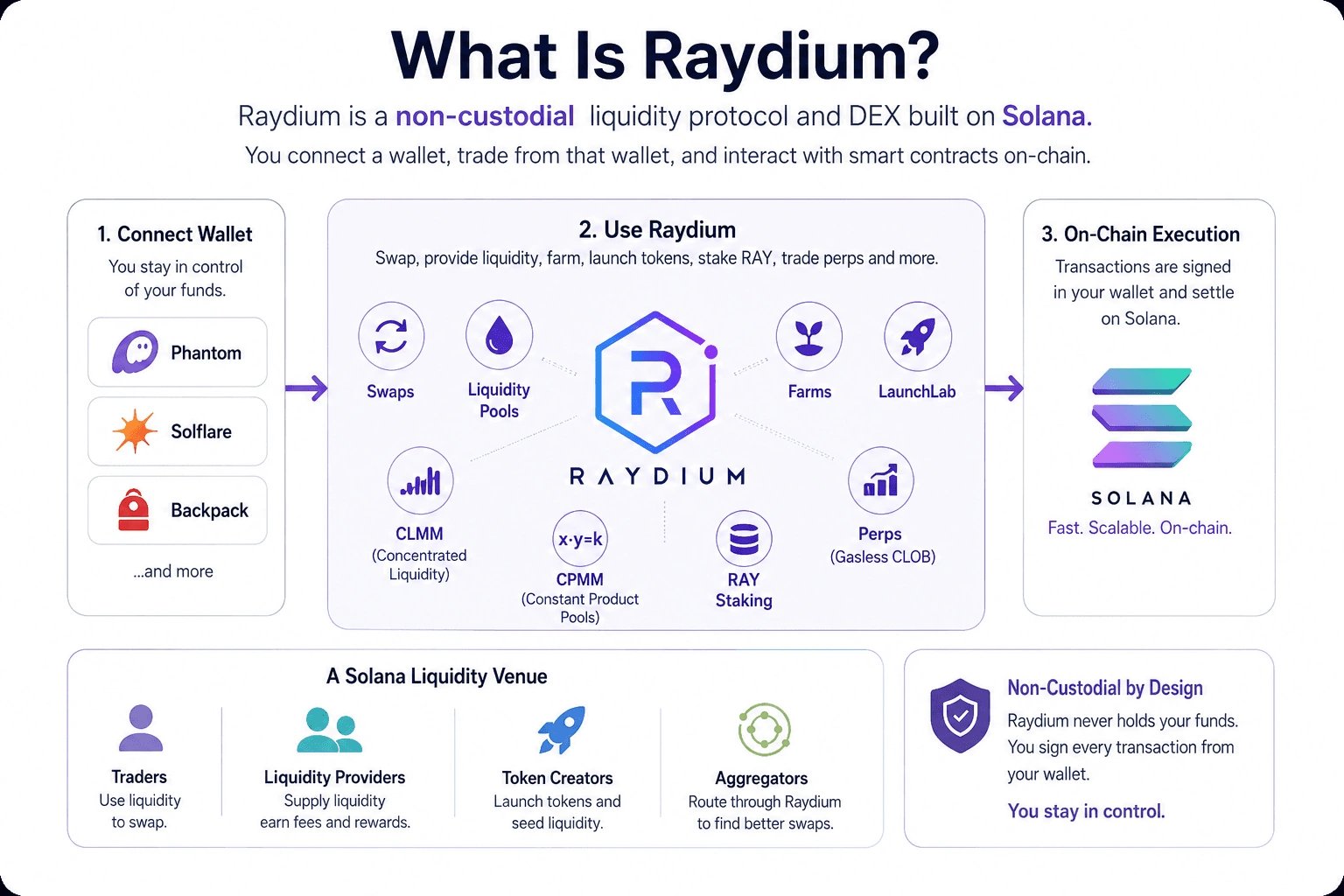
AMM v4 is Raydium's original automated market maker (AMM), launched in 2021. It was initially designed as a hybrid AMM that integrated with the OpenBook orderbook (formerly Serum), placing limit orders based on the pool's pricing curve to make liquidity accessible to orderbook traders and aggregators. However, a July 2026 program upgrade removed the OpenBook integration, making AMM v4 a standalone constant-product AMM in which all swaps execute directly against pool liquidity. The protocol still supports token swaps, liquidity deposits, and withdrawals, with liquidity providers earning fees from trading activity. It remains an active liquidity source for established trading pairs, including SOL-USDC and mSOL-USDC.
AMM v4 does not support Token-2022 assets and generally requires more computational resources for transactions than Raydium's newer CPMM product. Its legacy swap instructions retain account structures associated with the former OpenBook integration for backward compatibility, although newer V2 instructions no longer require those accounts. AMM v4 remains operational for existing pools, but Raydium no longer recommends it as the default for new pool creation. Instead, CPMM is the preferred option because it offers lower transaction costs, Token-2022 compatibility, and a simpler architecture without the former orderbook dependency. [3]
CPMM (Constant Product Market Maker), also known as Raydium's Standard AMM, is a native Solana automated market maker that uses a constant-product pricing model to facilitate token swaps and liquidity provision. Unlike the original AMM v4, CPMM does not rely on an external orderbook and supports both standard SPL tokens and selected Token-2022 extensions, including transfer fees and metadata configurations. Each pool consists of two token vaults and a liquidity provider (LP) token mint, with pricing determined by the relative balances of the vaults. The protocol also includes configurable trading and creator fees, an onchain time-weighted average price (TWAP) observation system, and support for locking LP tokens while still collecting trading fees. CPMM is Raydium's default option for creating new constant-product liquidity pools.
CPMM distributes liquidity across the entire price range rather than concentrating it around specific price levels, making it suitable for new token pairs and markets that do not require active liquidity management. Liquidity providers deposit both assets into a pool and receive LP tokens representing their share of the underlying assets and accrued fees. Traders swap between the pooled assets, with prices adjusting according to the constant-product formula and applicable fees. The protocol supports separate fee allocations for liquidity providers, the protocol, fund recipients, and pool creators, with creator fees configurable when a pool is established. For markets requiring concentrated liquidity around particular price ranges, Raydium provides its separate CLMM product. [4]
CLMM (Concentrated Liquidity Market Maker) is Raydium's Uniswap v3-style automated market maker, allowing liquidity providers to allocate capital within specific price ranges rather than distributing it across the entire price curve. This approach increases capital efficiency by concentrating liquidity around prices where trading is expected, potentially generating higher trading fees per dollar of deposited capital. Liquidity is organized into discrete price intervals called ticks, and each liquidity position is represented by a non-fungible token (NFT) rather than a fungible LP token. Fees are calculated and distributed individually for each position based on its liquidity and price range. CLMM also supports Token-2022 assets, multiple fee tiers, and up to three reward streams per pool.
CLMM also includes limit orders that execute when swaps cross specified price levels, configurable single-sided fee collection, and dynamic fees that adjust with market volatility. However, liquidity providers must actively monitor and adjust their positions because liquidity outside the selected price range becomes inactive and stops earning trading fees. Opening positions can also involve additional costs when new tick arrays need to be initialized. Unlike CPMM, which is designed for simpler, passive liquidity provision across all prices, CLMM is better suited to market makers and liquidity providers managing stable or highly correlated asset pairs who want to concentrate capital around specific price levels. [5]
Raydium’s Farm program distributes pre-funded reward tokens to users who stake eligible assets, typically LP tokens from CPMM or AMM v4 pools. Unlike pool trading fees, farm rewards are funded separately by the program creator and released at a predetermined rate over a specified period. Users must deposit their LP tokens or supported single assets into a farm to participate; simply holding LP tokens in a wallet does not generate rewards. The staked assets are held in a farm vault rather than burned, and users must withdraw them from the farm separately from any interaction with the underlying liquidity pool.
Raydium operates three farm program versions: v3, which supports one reward stream; v5, which supports two; and v6, which supports up to five. Each version uses reward-per-share accounting to calculate individual earnings based on the amount staked and the rewards distributed over time. Reward balances are updated when users deposit, withdraw, or harvest, rather than through continuous on-chain updates. Farms are independent of the pools they accompany and do not distribute trading fees or automatically track changes to LP holdings. They are used to provide additional incentives for liquidity providers or operate single-asset staking programs, while CLMM pools generally use their own built-in reward streams. [12]
Raydium Perps is a perpetual futures trading platform built on Solana and powered by Orderly Network's shared central limit order book (CLOB) infrastructure. Unlike Raydium's spot AMMs, which execute trades against onchain liquidity pools, Perps uses an off-chain matching engine and orderbook to process trades across multiple blockchain networks. The platform supports leverage of up to 100x, depending on the market, cross-margin accounts, and multiple collateral assets, including USDC, SOL, USDT, ETH, BNB, and WBTC, with profits and losses settled in USDC. It also supports several order types, including market, limit, stop, and scale orders, alongside execution options such as immediate-or-cancel and post-only.
Trading operations, including order placement, modification, and cancellation, are gasless and require locally signed orders rather than individual onchain transactions. Deposits and withdrawals are processed onchain, while the matching and settlement infrastructure operates through Orderly Network. The platform uses a self-custodial account structure, with funds remaining in the trader's Perps account rather than being held in a Raydium-controlled custodial wallet. Perps operates separately from Raydium's AMM products, with its own trading infrastructure, supported markets, and technical documentation. Access is restricted in certain jurisdictions, including the United States and other prohibited regions. [6]
Stable AMM is a standalone Raydium program that uses an interpolated lookup table instead of the constant-product formula used by AMM v4 and CPMM. Each pool stores a sparse array of reserve ratios and corresponding prices in a ModelDataInfo account, allowing the program to calculate swap quotes through binary search and linear interpolation. This approach is designed for stablecoins and other correlated assets, where the expected exchange rate is known, and slippage can be kept low around the target price. The program applies a 0.02% fee to swaps and holds liquidity in its own pool vaults. Although administrators could historically update the lookup table through the UpdateModelData instruction, that instruction has been removed, leaving existing tables fixed.
Stable AMM supports swaps, liquidity deposits and withdrawals, and administrative fee withdrawals through WithdrawPnl. Its former OpenBook market-making functionality is no longer active, and the related code was removed in a June 2026 upgrade. The program does not support Token-2022, and its liquidity is relatively limited, so integrations commonly access its pools through Raydium's AMM Routing program. Compared with AMM v4 and CPMM, Stable AMM is intended for tightly correlated asset pairs rather than general-purpose token markets. CPMM remains the more suitable default for new pools without a specific need for stable pricing. [7]
Raydium's AMM Routing program executes multi-hop swaps through a single on-chain instruction, connecting liquidity across multiple pools. A route specifies the pools, intermediate tokens, and swap parameters, including input or output amounts and slippage limits. The router executes each hop in sequence, transferring the output from one pool into the next as its input. It does not calculate prices or fees itself; each pool program handles its own pricing curve and fee structure through cross-program invocations (CPIs). The router supports Raydium's AMM v4, CPMM, CLMM, and Stable AMM pool types, and does not charge an additional routing fee.
The program provides a unified way to compose multi-hop swaps, particularly when another on-chain program needs to execute a route as part of a larger transaction. It validates the accounts used across the route and enforces slippage conditions, reverting the entire operation on failure rather than leaving a partially completed swap. Intermediate tokens can move through user-controlled associated token accounts or a shared program-derived address. However, client-side instruction composition remains the standard approach for many applications: clients can submit separate swap instructions in sequence within one transaction. This approach is generally simpler for short routes and routes involving pools outside Raydium, while the dedicated router is more useful when a single instruction is needed for programmatic integration or route submission. [8]
LaunchLab is Raydium’s token launch platform, which uses a bonding curve to facilitate trading before a token transitions into a standard CPMM pool. Unlike a conventional pool launch, which requires creators to provide initial liquidity in both assets, LaunchLab allows a token to begin trading without pre-seeded quote-side liquidity. Buyers send a supported quote asset, such as SOL or USDC, to the curve and receive base tokens at prices determined by the curve’s formula and current supply. As demand increases, the token’s price rises according to the configured pricing model, while sells reduce the price. Each launch has a predetermined graduation threshold based on the quote assets accumulated in its vault.
Once the quote reserve reaches the threshold, LaunchLab migrates the remaining token and quote reserves into a CPMM pool, where trading continues under the standard AMM mechanism. The migration also revokes the token’s mint authority, preventing additional supply from being created, and permanently ends trading through the bonding curve. During the curve phase, fees are distributed among the protocol, the curve liquidity side, and optionally the creator; after graduation, the CPMM pool’s fee configuration applies. The initial liquidity position is divided between platform locking and token burning according to predefined allocation scales. LaunchLab is intended for new tokens without established markets, particularly when creators want the opening market price to emerge through trading rather than setting it in advance. It is less suitable for existing tokens, launches requiring precise control over the initial pool price, or tokens that depend on unsupported Token-2022 extensions. [9] [10]
RAY is Raydium’s native token and connects to the protocol through trading-fee buybacks, staking, and liquidity provision. A portion of Raydium’s trading fees is used to purchase RAY on the market, linking token demand to activity on the platform. Users can also stake RAY through the Raydium app and claim rewards distributed in RAY. In addition, RAY is used as a base or quote asset in various Raydium liquidity pools, allowing holders to provide liquidity and participate in trading markets involving the token. [11]
RAY has a total supply of 555M tokens and has the following allocation: [11]
IQ.wiki is written by its community. Suggest an edit and an editor will review it.