0% read
Last updated:
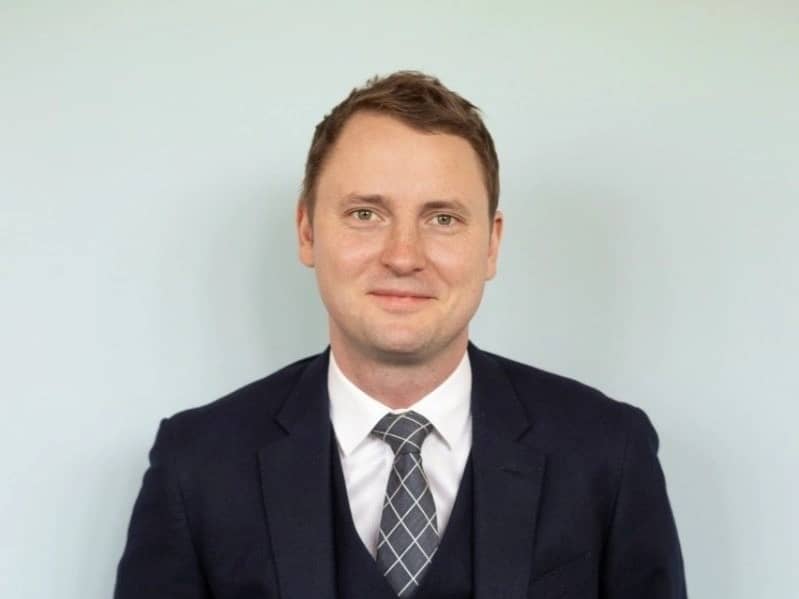
Peter Kadish
Peter Kadish is an investment professional whose career has focused on distressed assets, private equity and credit, and fixed-income markets. He has held investment and asset-management positions in Switzerland and Russia, including senior roles at LynxCap Investments, DDM Holding, RUSNANO, IFC Metropol, and Norvik Banka. [1]
Education
Kadish graduated from the University of Latvia with a Bachelor’s in Economics in 2005. At the same time, he also earned a Bachelor’s as an exchange student at Ghent University. In 2007, Kadish earned his Master’s in Economics from the University of Sheffield. He later attended the London Business School, where he received his MBA in 2018. [3]
Career
Kadish began his career in fixed-income and asset management, serving as Head of Asset Management/Fixed Income at Norvik Banka from 2008 to 2011. In that role, he was a board member of the Norvik Pension Fund and managed a mutual fund portfolio focused on fixed income and global macro strategies. He subsequently joined IFC Metropol in Moscow as Deputy Managing Director for Fixed Income, where he also served as Head of Syndicate and was involved in Gazprom Eurobond placements. From 2014 to 2015, Kadish worked at JSC RUSNANO as Investment Director/Acquisitions, within the firm's private equity and credit investment activities. He then joined DDM Holding in Switzerland as Vice President in December 2015, working with its distressed assets fund until August 2019. In August 2019, he became Managing Director at LynxCap Investments AG in Zug, where he continued to focus on distressed assets. [4]

Interviews
LynxCap
At the RWA Summit in February 2026, Kadish participated in a fireside chat with Ivan V. Ivanov of RWA Summit and UVECON VC about the firm's approach to real-world assets and their integration with blockchain. Kadish discussed LynxCap's investment focus on real estate and secured debt, its development of onchain products, and efforts to create products with lower entry requirements for retail investors. He also addressed differences in risk between traditional financial products and DeFi, arguing that the growth of the RWA sector depended on high-quality, regulated assets rather than poorly structured products with limited underlying value. The discussion examined the potential for tokenized real-world assets to generate more stable, asset-backed yields in Web3, while noting that much existing Web3 capital remained oriented toward short-term, higher-risk trading. Kadish also highlighted the need for greater investor education and regulatory development, particularly around recognizing blockchain-based records, which could reduce the costs associated with traditional transfer agents. The conversation concluded that blockchain-based RWAs could become an important part of financial markets, although regulatory adoption would likely take time. [5]

Panels
On-Chain Wealth
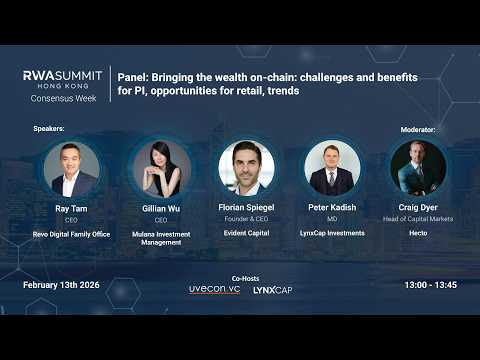
At the RWA Summit in February 2026, Kadish participated in a panel alongside Ray Tam of Revo Digital, Gillian Wu of Mulana Investment, and Florian Spiegal of Evident Capital, moderated by Craig Dyer of Hecto, examining the growing use of blockchain to bring wealth and real-world assets onchain. The panel discussed the shift from experimentation toward implementation, including the tokenization of large private-market assets, and identified institutional trust as a key challenge, noting that blockchain could automate processes but would not eliminate the need for due diligence, oversight, and human judgment. The panelists also examined liquidity in private markets, arguing that tokenization did not automatically create liquidity but could enable mechanisms such as secondary markets that improve liquidity over time. Hong Kong's regulatory framework was highlighted as an example of a jurisdiction combining clear rules, supervision, and engagement with the digital-asset industry. The discussion concluded with recommendations for investors and institutions to prioritize asset quality and work with licensed and established providers as blockchain-based assets become increasingly integrated into traditional financial markets. [6]
See something wrong?