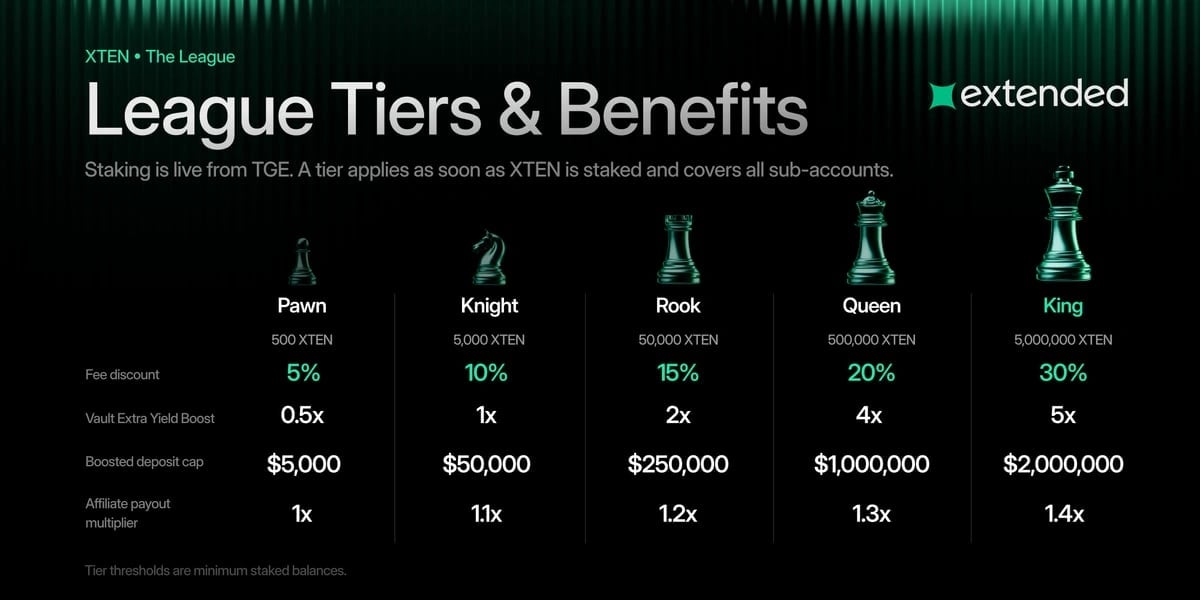
The Extended Vault is a USDC-based liquidity and yield mechanism that supports the exchange's liquidation and lending operations. Users deposit USDC and receive Extended Vault Shares (XVS), which represent a proportional claim on the vault's equity. XVS accrues base yield generated primarily through liquidation activity, plus additional yield funded by interest from the protocol's native money market and a share of exchange fees. The shares can also be used as trading collateral, with 90% of their value contributing to a user's equity and available trading balance. Additional yield depends on trading activity and league level, with a deposit cap applying to the balance eligible for these rewards.
The vault participates in liquidations across perpetual positions, spot balances, and XVS holdings, and acts as the primary lender in Extended's native money market. Deposits have a 24-hour lockup period, after which users can withdraw without a minimum amount, although withdrawals may require the vault to close a proportional share of its positions and can involve execution costs or settlement in assets other than USDC. The vault previously conducted market-making activities, but these have been discontinued. Its current operations remain exposed to liquidation losses, lending and collateral risks, market volatility, liquidity constraints, and technical or smart contract failures. Returns are variable and not guaranteed, and users may lose part or all of their allocation. [8]
Extended’s native money market supports its multi-asset collateral margin system by allowing users to borrow USDC against eligible collateral assets to trade perpetuals. Borrowing is currently restricted to use within the platform, and users cannot withdraw borrowed USDC or borrow assets other than USDC. A negative USDC balance may result from trading losses or withdrawing unrealised profits. Interest is charged when the negative balance is backed by non-stablecoin collateral, excluding Extended Vault Shares (XVS), which represent a claim on the vault’s equity. No interest is charged when XVS covers the balance or when unrealised profit from the position against which it was withdrawn continues to cover the amount. If that position's value falls below the withdrawn amount, interest applies only to the uncovered portion. The vault acts as the primary lender, collecting interest from borrowers and distributing it to depositors as additional yield.
Borrowing rates are determined by the higher of the vault's global utilization rate and the asset-specific utilization rate for the collateral used. Consequently, rates can differ across collateral assets, depending on how much USDC has been borrowed against each one. Both rates are updated approximately every minute, while interest is applied approximately every 15 minutes. The rate model uses a utilization-based curve with a maximum rate parameter initially set at 900% annualized, a target-utilization rate of 7.5%, and a zero-utilization rate of 3.6%. Initial target utilization is 10% for the overall vault, 10% for cirBTC and wETH, and 5% for EURC. The curve adjusts dynamically when utilization moves more than one percentage point above or below its target, changing the maximum rate parameter between 360% and 900%. When multiple collateral assets are used, borrowing is allocated first to the assets with the lowest interest rates, followed by those with higher rates. [7]
Extended uses an open request-for-quote (RFQ) model to support perpetual futures markets that may not have enough trading activity to sustain traditional order books. Rather than committing capital across multiple markets, external market makers provide liquidity when user orders are submitted through a public API, without requiring whitelisting or exclusive agreements. The system separates price discovery from execution through two order books: an indicative book that displays market-maker quotes and a real book where margin-backed orders are placed and filled. RFQ markets operate alongside Extended's central limit order book (CLOB), with both accessible through a unified cross-margin account. More liquid assets trade on the CLOB, while lower-volume markets use RFQ. Markets can move between the two models as trading activity changes, with existing resting orders carried over when a market transitions. RFQ orders support market, limit, take-profit, and stop-loss functionality. Market orders begin at the best indicative quote and can be repriced in up to eleven 100-millisecond intervals, subject to the user's maximum slippage limit. Orders that cannot be filled within that limit are canceled rather than executed at a worse price. The RFQ model uses an inverted fee structure in which market makers pay the lower maker fee, currently zero, and may receive rebates for filling user orders, while users pay the taker fee regardless of whether they submit market or limit orders. Both market makers and traders can interact with the system through public APIs, allowing traders to access indicative quotes and configure execution parameters while market makers monitor and fill margin-backed orders on the real book. This structure also allows Extended to list markets that may not support traditional standing liquidity, including US equities with trading sessions covering pre-market, regular hours, and after-hours. [5]