0% read
Last updated:
Newton Protocol
Newton Protocol is a decentralized policy engine that embeds compliance and risk management rules directly into on-chain transaction execution. The protocol provides a neutral, programmable framework that enables institutions, developers, and autonomous AI agents to operate within regulatory and operational constraints while maintaining the composability and privacy of open networks. It functions by evaluating transactions against predefined, machine-readable policies in real-time before they are settled on-chain. [1]
Overview
Newton Protocol was developed to address compliance and risk management gaps emerging from two significant trends in digital finance. Newton is a protocol designed to introduce programmable compliance into blockchain and AI-driven financial systems. It responds to two developments: the growing use of public blockchains for settling large volumes of assets, and the rise of AI agents acting autonomously in markets. Both trends highlight gaps in existing compliance and risk-management structures.
Newton functions as a decentralized policy engine that embeds rules for compliance, risk, and operational constraints directly into transaction execution. This approach shifts compliance from an external process to an integrated part of how assets and agents operate on-chain. It is intended to support assets such as stablecoins and tokenized real-world assets, for which traditional smart contracts often lack sufficient flexibility to meet regulatory or institutional requirements.
The protocol’s design focuses on creating a neutral, programmable layer that uses cryptographic verification, interoperability across chains, and real-time off-chain data inputs. These capabilities allow policies to adapt to changing conditions while remaining enforceable on-chain. [2]
Technology and Architecture
Newton Protocol operates on a layered architecture that separates policy definition, data integration, evaluation, and on-chain enforcement. This structure is designed to provide low-latency, verifiable, and privacy-preserving compliance checks before a transaction is finalized. The general information flow begins when an application submits a transaction "intent" to Newton's on-chain contracts. The task is broadcast to the operator network, which evaluates the intent against a policy, fetches necessary data from oracles, and reaches a consensus. A signed authorization receipt is then generated and returned to the application, which includes it in the final transaction for on-chain verification and execution. [3]
Core Components
Policy Engine
The Policy Engine is responsible for compiling high-level, human-readable rules into verifiable programs. Policies can be written in languages such as Rego (via a custom Domain-Specific Language) or WebAssembly (WASM), allowing developers to define complex compliance and risk logic. For policies involving sensitive data and requiring enhanced privacy, the engine executes the rules within a zero-knowledge virtual machine (zkVM), specifically the SP1 zkVM. This process generates a succinct proof (a type of zero-knowledge proof) that attests to the correct execution of the policy without revealing the underlying data or logic. [3]
Decentralized Operator Network
The Operator Network is a decentralized group of nodes that performs the off-chain evaluation of transaction intents against the defined policies. The network is secured through a dual mechanism: it functions as an Actively Validated Service (AVS) on Ethereum, utilizing its restaked security model, and incorporates a native delegated proof-of-stake (DPoS) system where operators must stake NEWT tokens. Operators are subject to slashing penalties, where a portion of their staked tokens can be confiscated for malicious behavior or incorrect evaluations, creating a strong economic incentive for honesty. After operators reach a quorum on an evaluation's outcome, they collectively produce a Boneh-Lynn-Shacham (BLS)-signed attestation or a succinct proof, which serves as the cryptographic "Authorization Receipt." [3]
Oracle Adapter Layer
This layer is responsible for securely integrating real-time on-chain and off-chain data into the policy evaluation process. The protocol uses Oracle Adapters that can employ Trusted Execution Environments and verifiable attestations to ensure the integrity and confidentiality of the data they provide. This allows policies to be dynamic and responsive to changing external conditions. Data sources that can be integrated include government sanctions lists, KYC/AML identity proofs from providers like Veriff, proof-of-reserves data from asset issuers, geolocation information, and fraud risk signals from on-chain monitoring services. [3]
On-chain Core Contracts
The Core Contracts are the smart contracts deployed on the blockchain that serve as the protocol's on-chain anchor. They are responsible for receiving transaction intents, creating evaluation tasks for the operator network, and, most importantly, verifying the final Authorization Receipt. When an application submits a transaction containing the receipt, the Core Contracts perform a cryptographic check on the proof or signature. The transaction logic is allowed to execute only if the receipt is valid, ensuring that the pre-execution policy checks were successfully completed. [3] [4]
Compliance Receipts and Audit Log Vault
For every policy evaluation, the protocol generates a tamper-evident cryptographic receipt. These receipts are stored in an append-only, Merkle-rooted log vault, creating an immutable and verifiable audit trail. Each receipt contains metadata such as the policy version, input data hashes, the proof hash, and the operator quorum ID. While the pass/fail result and proof are public, sensitive payloads in the receipt can be encrypted and accessed only by authorized parties, such as regulators. This enables continuous, machine-readable regulatory oversight without compromising user or institutional privacy. [3]
Features
Newton introduces a programmable compliance layer that enforces rules directly within transaction execution. It turns traditional KYC, AML, sanctions checks, daily limits, and Travel Rule requirements into machine-readable policies that run before a transaction settles. These policies allow institutions to embed jurisdiction filters, identity proofs, spending constraints, and counterparty checks without relying on manual reviews or retrospective monitoring. The protocol produces cryptographic receipts for every evaluation, enabling real-time auditability while keeping sensitive data private through zero-knowledge proofs and encrypted metadata. This structure allows for stablecoins, RWAs, DeFi platforms, and AI agents to operate with built-in guardrails that remain composable across chains and applications. [3]
NEWT Token
NEWT is the utility token that underpins the Newton Protocol’s operations. Issued as an ERC-20 token on Ethereum and intended to migrate to the protocol’s Keystore rollup, it supports staking in the delegated proof-of-stake system, pays for transactions and permission updates, and serves as collateral within the agent model registry where operators use NEWT to access models and earn protocol fees under slashing-based safeguards. The token will eventually enable governance once the protocol is sufficiently decentralized, allowing staked holders to vote on treasury decisions, parameter changes, and ecosystem priorities through a community-driven process, and any future changes to the token’s design will be subject to governance oversight. [5]
Tokenomics
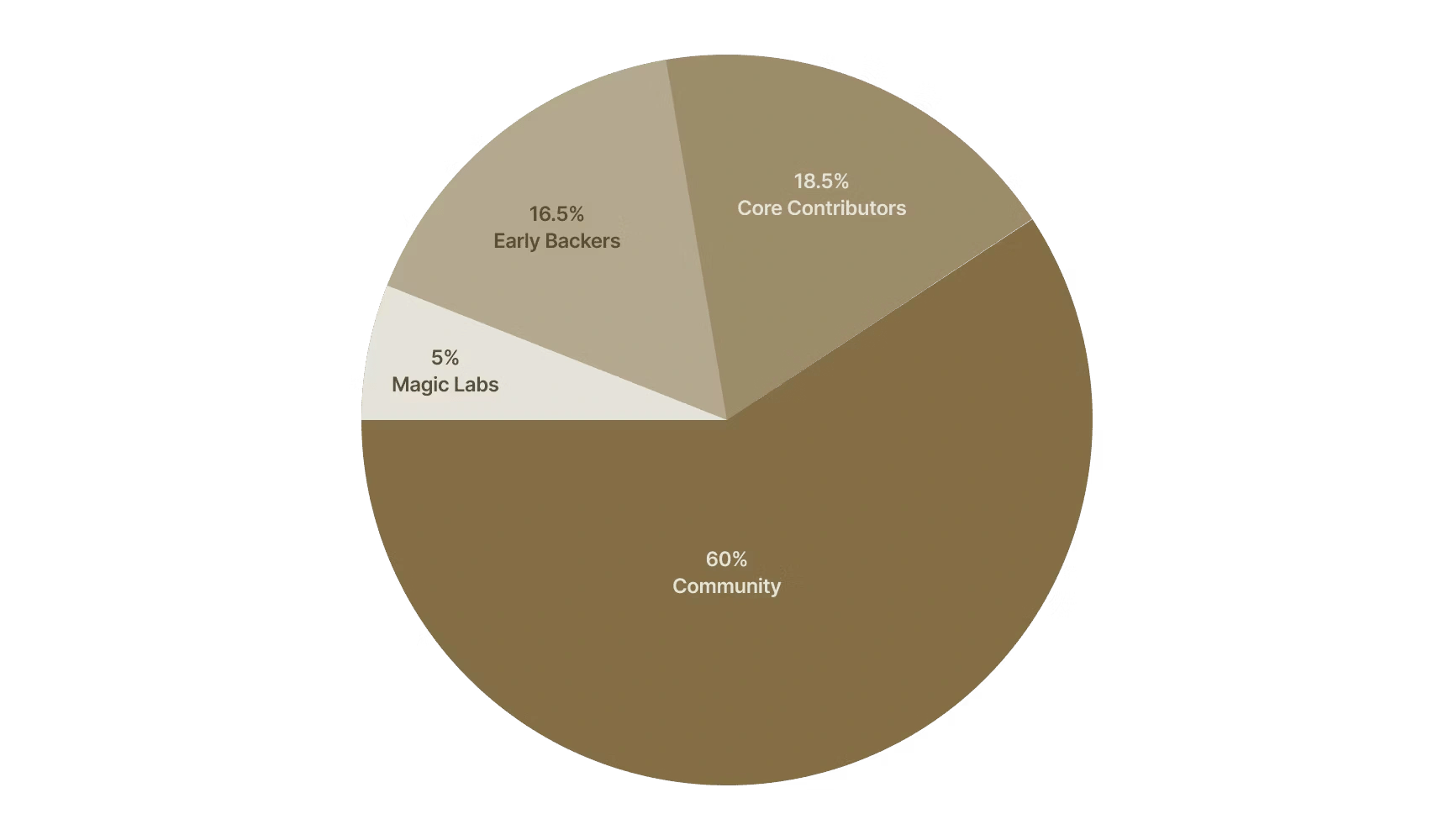
NEWT has a fixed total supply of 1 billion tokens and has the following allocation: [7]
- Core Contributors: 18.5%
- Early Backers: 16.5%
- On-chain Ecosystem Growth: 15.5%
- On-chain Ecosystem Development: 12.5%
- Initial Airdrop & Community Rewards: 10%
- On-chain Foundation Treasury: 9.5%
- Network Rewards: 8.5%
- Magic Labs: 5%
- Liquidity: 4%
Partnerships
See something wrong?

Official Website:
Social Profiles:
Founders:
Blockchains: