0% read
Last updated:
Norbert Vadas
Norbert Vadas is a researcher and product lead who specializes in zero-knowledge (ZK) proof infrastructure, decentralized proving networks, and the economic security of cryptographic protocols. He is Head of Product for ZkCloud. His work is primarily focused on systems for Ethereum and Layer 2 scalability, with an emphasis on improving proving efficiency and decentralization. [2]
Education
Vadas earned a Master’s degree in International Relations and Affairs from the Corvinus University of Budapest in 2011. [1]
Career
Vadas began his career in Hungary, working in financial services and technical support. From 2004 to 2008, he was a financial account manager at Brokernet Ltd./Global Partners Ltd., where he was responsible for sales and account management of financial products including mortgages, insurance, and investments. He then moved into information technology, serving as an IT support specialist at YGOMI Ltd. from 2009 to 2010, where he provided first-level technical support. In 2010, he became a proprietary trader at GHF Ltd., a role in which he focused on trading short-term interest rate futures until 2011.
Between 2011 and 2022, Vadas worked for two organizations within the United Nations. He joined the Food and Agriculture Organization of the United Nations (FAO) in Budapest in 2011, first as a support associate providing Oracle-based IT support for finance, procurement, travel, and HR systems. He later became a finance associate, a position in which he handled project budgeting, financial reporting to donors, grant monitoring, and staff training. In 2016, Vadas joined UNICEF as a payroll lead, a role he held until 2022. There, he oversaw payroll operations for a workforce of approximately 3,000 staff members, managed a small team, and led various process, systems, and cross-functional improvement initiatives.
In 2022, Vadas transitioned into the blockchain industry, taking a role as an ecosystem scout at Chainstack. His responsibilities included analyzing protocol ecosystems, conducting technical and on-chain research across multiple blockchain verticals, and contributing to industry-level analytical reports. In 2023, he was selected for the fourth cohort of the Ethereum Protocol Fellowship, where he focused on protocol research and design for zk-rollups. His research covered prover selection models, rollup economics, and cryptographic incentive structures.
Throughout 2024, Vadas worked as a researcher for several organizations in the ZK space, including ORA, Zero Computing, and ZkCloud. His work addressed topics such as protocol design, node coordination, cryptoeconomic models, and prover economics. In December 2024, he was appointed Head of Product at ZkCloud, where he guides the product's direction, informed by his background in protocol research and cryptoeconomics. [3] [4]
Interviews
Whole World Onchain
In July 2025, Vadas hosted an episode of the ZK Cloud Podcast featuring Declan Fox of Linea, focusing on the evolution of zero-knowledge infrastructure and broader trends in the crypto ecosystem. The conversation traced Fox’s path from automotive engineering and autonomous systems to blockchain, including early startup work and experience with enterprise permissioned ledgers, before turning to his role at ConsenSys, where he leads the ZK rollups effort and the development of Linea’s ZKVM and universal proof system. Fox discussed recent milestones, including Linea’s second anniversary, progress on proof completeness for EVM operations, and ongoing work to improve proving speed, security, and decentralization through multi-prover designs. The episode also examined the relationship between L1 and L2 scalability, challenges around user onboarding and fragmented messaging in Ethereum, emerging privacy requirements for enterprise adoption, and the value of combining deep technical expertise with financial literacy in the future of blockchain development. [9]

Presentations
Ethproofs Summit Keynote
In June 2025, Vadas delivered a keynote at House of ZK’s Ethproofs Summit outlining the design and real-world performance of ZK Cloud’s universal proving infrastructure, which launched in March 2024. He explained how the system is built to be proof-system agnostic, allowing users to run custom prover containers and adapt as new ZKVMs emerge, and described ZK Cloud’s decision to begin proving every Ethereum block in April 2025 to demonstrate the practical feasibility of snarking the EVM at low cost. Vadas shared performance data showing that more than 500,000 proofs were generated in roughly two and a half months at an average cost of about two cents per block, then walked through the technical challenges of the proving pipeline, including RPC bottlenecks, GPU utilization, and instability in CUDA provers. He detailed architectural changes that decoupled pre-proving from proving to improve parallelism, discussed the relationship between gas usage, execution cycles, and proving time as a potential attack surface, and concluded by outlining future work on multi-GPU proving and real-time proof generation as open-source ZKVM tooling matures. [7]

Challenges in Proof Outsourcing
In April 2025, Vadas presented at ETHDenver’s ZK Hub on the risks and design challenges surrounding proof outsourcing in the Layer 2 proving ecosystem. He argued that reliance on third-party proving marketplaces can introduce unhealthy dependencies, increase centralization, and expand attack surfaces across both L1 and L2 networks. Vadas outlined the core properties required of proof providers—neutrality, decentralization, high liveness, and low costs—while explaining the role of validity proofs in rollup finality and the coordination between sequencers and provers. He criticized auction-based mechanisms for validator and prover selection, drawing parallels to MEV relay concentration and warning that such systems can waste computation and reinforce centralization. As an alternative, he advocated for decentralized proving networks that rely on random prover selection and user-aligned economics, presenting ZK Cloud as a permissionless and cost-efficient solution designed to meet the long-term needs of rollups without introducing additional infrastructure risks. [5]

Fast and Cheap ZKPs
At ETHDenver’s Async House in February 2025, Vadas presented on the ZK Cloud’s approach to decentralized zero-knowledge proving infrastructure. He described ZK Cloud’s goal of making ZK proof generation fast, inexpensive, and resistant to centralization, outlining a three-layer architecture that separates universal proving, workload orchestration, and decentralized compute. Vadas explained the role of Fire Starter, a permissioned early network used to coordinate proving tasks and test economic and technical assumptions, including random prover selection and execution guarantees. He also detailed the platform’s pay-as-you-go pricing model, designed to reduce idle resource costs, and discussed future plans for economic security, reputation systems, and developer participation to support scalable, decentralized proof generation. [6]

Panels
Abundance vs Dystopia
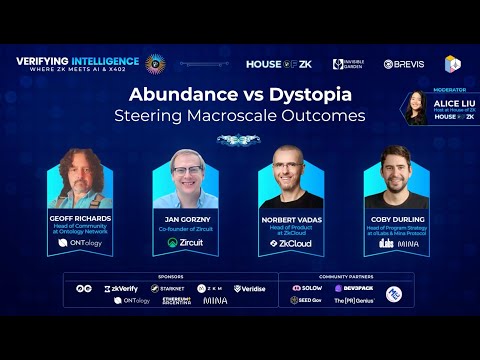
At House of ZK in November 2025, Vadas participated in a panel discussion alongside Geoff Richards, Jan Gorzny, and Coby Durling that examined the societal implications of artificial intelligence, particularly the tension between technological abundance and dystopian outcomes. The panel defined AI abundance as broad access to beneficial technologies serving the public good, while dystopia was framed as centralized control and erosion of individual autonomy, with real-world examples such as data manipulation and privacy abuses used to illustrate existing risks.
The discussion emphasized the need for verifiable information, decentralized governance, and trusted data sources to mitigate misinformation and maintain accountability in AI systems. Panelists also raised concerns about autonomous decision-making in high-stakes environments, arguing for human oversight and smaller, application-specific AI models that are easier to audit and secure, and concluded by stressing the importance of accountability frameworks to guide responsible AI deployment. [8]
See something wrong?
Official Website:
Social Profiles: