0% read
Last updated:
Zypto
Zypto is a self-custodial “crypto super app” and business payments platform founded in 2023.[11][12] It enables users and organizations to hold, swap, and spend more than 24,000 digital assets across over 20 blockchains.[3][4] It supports real-world payments including crypto Visa cards, bill payments, gift cards, mobile top-ups, pay-abroad services, and USDC-to-cash rails via partners such as MoneyGram and the Stellar network.[3][5] The ecosystem is built around the ERC-20 ZYPTO token and a ZYP rewards layer, with the independent Zypto Foundation administering token governance and reward distributions for eligible participants.[2][1][6]
Overview
Zypto develops applications, software, infrastructure, and services that enable the real-world use of digital assets across consumer and commercial environments.[3] Its product ecosystem includes Zypto App, a self-custodial multichain “crypto super app” that has become the flagship product and is described as the official wallet for Electroneum and ETN in Electroneum integration guides and Zypto’s own materials, as well as Zypto Pay, a crypto payment gateway, and related business services for merchants, enterprises, and institutions.[3][4][13][14]
Zypto’s offerings are designed to function as an access layer connecting wallets, blockchains, and payment systems, enabling digital assets to be used beyond storage or trading while leaving control of funds with users or client organisations rather than operating as a custodial exchange.[4] Zypto Pay sits alongside institutional crypto custody, multichain multi-party computation vaults, white-label card and wallet infrastructure, and developer APIs that allow other businesses to build on Zypto’s payment and settlement stack.[3]
History
Founded in September 2023, Zypto develops consumer and business crypto products with a focus on self-custodial access, crypto payments, and supporting infrastructure.[3] According to Zypto’s disclosures and third-party directory listings, the company operates as Zypto SP ZOO in Poland and is described as an EU Virtual Asset Service Provider.[11][12]
In 2024 Zypto launched the ZYPTO ERC-20 token, with the token’s issue date recorded as 2024-02-19, and established the Zypto Foundation to oversee token governance and ecosystem alignment.[2][1] During the same period, Zypto App reached version 1.26, introducing Chainlink Cross-Chain Interoperability Protocol (CCIP) integration for supported EVM-compatible chains and a KuCoin Pay integration that allowed KuCoin users to spend exchange balances on cards, gift cards, bill payments, mobile top-ups and USDC-to-cash services.[7] Subsequent releases, including Zypto App v1.28, expanded access to reloadable crypto cards across additional countries and US states, while v1.29 introduced a notifications centre, redesigned navigation, and refinements to bill payments, card top-ups, and gift-card flows.[8][9]
By Spring 2026, Zypto had expanded its Rewards Hub, detailing how users earn and redeem ZYP reward points across cards, payments, and selected products, and extended CCIP-powered cross-chain connectivity to Solana to complement earlier EVM integrations.[6][10] Zypto also continued to develop USDC-to-cash rails in partnership with MoneyGram and the Stellar network, positioning these services as complements to traditional remittance and banking channels.[5]
Products
Zypto’s product suite is anchored by Zypto App for consumer self-custodial wallets and payments, complemented by the Vault Key Card as an optional hardware-style security device and Zypto Pay for business payments and infrastructure.[3] Together these products link multichain wallets, cross-chain swaps, cards, and payment rails into a unified environment for individuals and organisations.
Zypto App
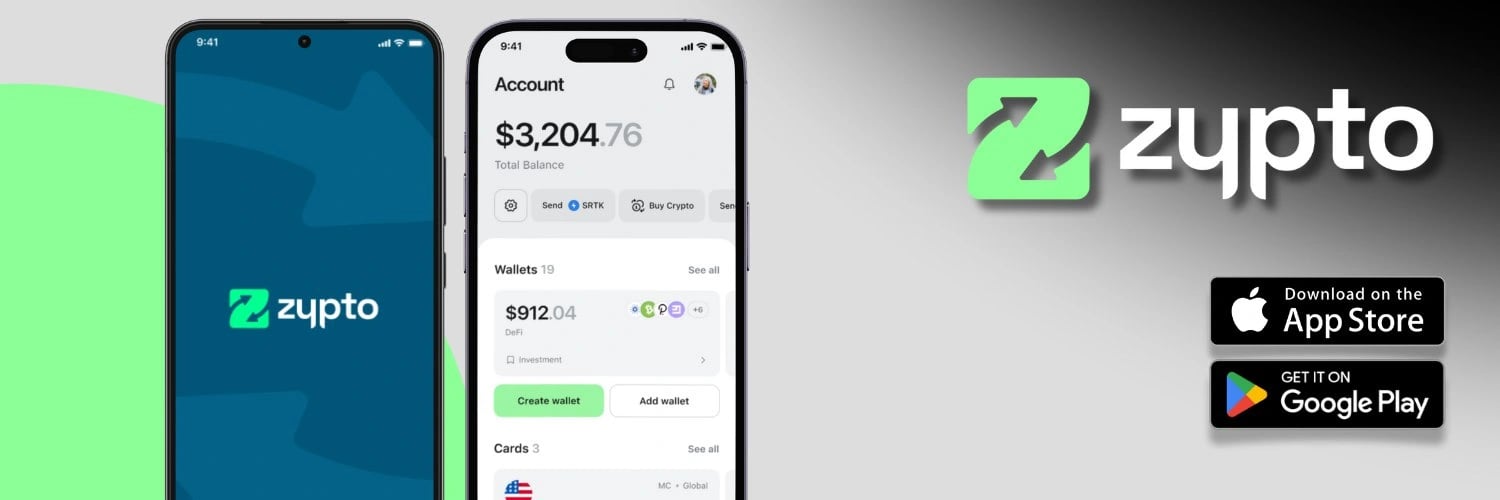
Zypto App is Zypto’s flagship consumer product, available on Android and iOS.[3] It is a self-custodial, multi-functional crypto application that enables users to create and manage non-custodial wallets directly within the app and use digital assets for decentralised finance and real-world crypto payments through a single mobile interface.[4] Zypto App is built to interact directly with blockchains rather than operating as a custodial exchange, with users retaining control of their wallets and on-chain activity.[4]
A core feature of Zypto App is its multichain architecture, which connects to more than 24,000 assets across over 20 blockchains and supports over 1,000,000 cross-chain swap routes.[4][10] Users can manage wallets on different networks and perform cross-chain swaps from a single interface, enabling movement of value between supported blockchains without relying on external tools or manually using blockchain bridges.[4]
In addition to wallet creation and DeFi access, Zypto App integrates a range of consumer crypto services intended for everyday use. These include crypto Visa card products, bill payments, gift cards, mobile top-ups, pay-abroad services, and USDC-to-cash and cash-to-USDC rails in supported countries via partners such as MoneyGram and the Stellar network, allowing users to apply digital assets beyond storage or trading while maintaining a self-custodial setup.[3][5]
The Zypto Vault Key Card (VKC)
The Vault Key Card is a physical security device designed to enhance protection for self-custodial wallets used within Zypto App.[3] It provides hardware-style security for sensitive actions, functioning as an additional authorisation layer that enables users to approve transactions or access protected wallets.
The Vault Key Card is intended as an optional add-on to Zypto App, offering an alternative to traditional hardware wallets by delivering cold-style security integrated directly into a mobile-first crypto application.[3] Users can purchase and manage Vault Key Cards from within Zypto App, and may apply ZYP reward points towards the cost where supported, preserving a mobile-first user experience while adding a dedicated physical security layer for those who want stronger self-custody protection.[6]
Zypto Pay and Business Services
Zypto Pay is Zypto’s crypto payment gateway and settlement solution for merchants and businesses.[3] It provides crypto payment infrastructure that enables businesses to accept digital-asset payments through online, in-person, and API-based integrations, with support for multichain payments and settlement in cryptocurrency or local currency depending on merchant configuration and regulatory requirements.[3] Zypto Pay supports both on-chain and closed-loop payment options and can be used through soft-POS solutions or integrated directly with existing POS terminals, allowing businesses to accept crypto payments in physical and digital environments without major changes to their checkout systems.[3]
Beyond payments, Zypto provides business and institutional crypto services including custody solutions, multichain MPC vault systems, and wallet and card infrastructure for scalable custodial and non-custodial deployments.[3] These services are designed to support enterprises, fintechs, and Web3 companies seeking crypto infrastructure aimed at institutional and enterprise use, and can be accessed via white-label programs and developer APIs that expose wallets, cards, payments, and settlement flows.[3] Zypto also offers blockchain and Web3 development services across areas such as crypto wallets, decentralised applications, payment systems, and cross-chain solutions, delivered for businesses seeking custom or white-label blockchain products built on established networks and supported by Zypto’s underlying infrastructure.[3]
Technology and Architecture
Zypto App is built as a self-custodial multichain wallet and payments application that connects to over 24,000 crypto assets across more than 20 blockchains.[4] Its architecture supports more than 1,000,000 cross-chain swap routes by aggregating decentralised liquidity, enabling users to move assets between supported networks without relying on custodial exchanges or separate bridging tools.[4][10] The app interacts directly with blockchains via non-custodial wallets, so users retain control over private keys and on-chain transactions rather than depositing assets into a centralised platform.[4]
Chainlink Cross-Chain Interoperability Protocol (CCIP) is integrated into Zypto App to provide protocol-level cross-chain connectivity across supported EVM-compatible chains and Solana.[7][10] CCIP enables secure transfers and messaging between networks using Chainlink’s infrastructure, allowing supported assets to move between Solana and other integrated chains inside the app’s unified wallets, swaps, and payments interface.[10]
Zypto App supports multiple wallet types, including recovery-phrase wallets, imported wallets via private keys across supported chains, and connections to hardware wallets, reflecting a focus on user-controlled key management.[4][9] The Vault Key Card adds an optional hardware-style security layer by acting as a physical key card that authorises sensitive operations for self-custodial wallets in the app, bridging mobile-first usage with cold-style protection.[3]
Security
Zypto’s security model is based on self-custodial wallets, with users creating and managing non-custodial addresses directly in Zypto App and retaining control of their private keys and on-chain transactions.[4] The app supports recovery-phrase wallets, imported wallets via private keys, and connections to hardware wallets, and can be paired with the Zypto Vault Key Card, a physical card used as an additional authorisation factor for sensitive operations.[4][3] For institutional and enterprise deployments, Zypto offers multichain multi-party computation (MPC) vault systems that distribute key control across multiple parties or devices.[3] CoinMarketCap’s listing for ZYPTO also records the presence of an external smart-contract audit by CertiK, indicating that at least one independent security assessment has been conducted on the token’s contract.[2]
ZYPTO Token
The Zypto Token, ZYPTO, is an ERC-20 token used within the Zypto ecosystem, with its issue date recorded as 2024-02-19.[2] It is primarily utilised for ecosystem rewards, incentives, and participation within Zypto App and related products, rather than as a governance token for the application itself.[3] ZYPTO operates under a separate foundation structure, the Zypto Foundation, which is responsible for the token’s governance framework, distribution models, and funding decisions that support infrastructure and capabilities used by the Zypto ecosystem.[1]
According to its CoinMarketCap listing, ZYPTO has a recorded total supply of 896,452,057 ZYPTO and a maximum supply capped at 1,000,000,000 ZYPTO, with the circulating supply reported on the listing and updated over time.[2] Distribution and rewards, including allocations used for ecosystem incentives, are administered by the Zypto Foundation under its published governance and distribution framework.[1]
Inside Zypto App, Zyptopia functions as a dedicated rewards space for ZYPTO holders, allowing users who hold and connect eligible ZYPTO wallets to claim ZYP reward points distributed by the Zypto Foundation.[6] Zyptopia rewards are distributed on a rolling basis and must be claimed periodically—at least once every 7 days—to avoid missing accruals, and availability and benefits vary by region in line with the Foundation’s important notice.[6][3]
Partnerships
Zypto has formed several integrations and partnerships to extend its payments and interoperability capabilities. An integration with KuCoin Pay allows KuCoin users to connect exchange balances to Zypto App and fund payments such as cards, gift cards, bill payments, mobile top-ups, and USDC-to-cash services without separate bank transfers.[7][4] Partnerships with MoneyGram and the Stellar network underpin Zypto’s USDC-to-cash rails, which provide bridges between stablecoins and local cash in supported countries.[5]
On the interoperability side, Zypto integrates Chainlink’s Cross-Chain Interoperability Protocol (CCIP) to support secure cross-chain connectivity across EVM-compatible chains and Solana, using Chainlink infrastructure to route transfers and messaging between networks.[7][10] Zypto App is described as the official wallet for the Electroneum ecosystem in Electroneum’s integration guides and Zypto’s own announcement materials, positioning the app as a primary wallet interface for ETN and related services.[13][14]
See something wrong?