0% read
Last updated:
Jason Green
Jason Green is the co-founder and General Partner (Emeritus) of Emergence Capital. He is recognized as a pioneering investor in the enterprise cloud and Software-as-a-Service (SaaS) sectors, having led early investments in foundational companies such as Salesforce, Veeva Systems, Zoom, and Box. After a multi-decade career in venture capital, Green transitioned his primary focus to philanthropy and impact investing through the Greenbridge Foundation. [1] [2]
Early Life and Education
Green was raised in Long Island, New York, where he attended Glen Cove High School. [3] [4] He pursued his undergraduate studies at Dartmouth College, graduating cum laude with a Bachelor of Arts in Economics and also studying computer science. [5] [3]
Following his time at Dartmouth, Green enrolled at Harvard Business School, where he earned a Master of Business Administration (M.B.A.) with Distinction. [2] Upon graduation, he was awarded the Charles Williams Fellowship to conduct post-graduate research in entrepreneurship and finance with Professor Bill Sahlman. [4] In 2023, he became a Fellow at the Stanford Distinguished Careers Institute (DCI), a program for established leaders to explore new avenues for social impact. During his fellowship, he focused on the future of work and leading a purpose-driven life. [3] [6]
Career
Early Career and Venture Capital Beginnings
Green began his professional career as a management consultant at Bain & Company, working in the firm's Boston and San Francisco offices. [3] He later gained international experience living and working for a technology company in Budapest, Hungary. [4]
His career in venture capital started when he joined Venrock in New York as a member of the inaugural class of the Kauffman Fellows Program. [5] In 1997, he relocated to Silicon Valley to join U.S. Venture Partners (USVP), where he eventually became a General Partner, focusing on software and telecommunications investments. [1] [3]
Emergence Capital
In the winter of 2002-2003, during the downturn following the dot-com bust, Green co-founded Emergence Capital with Gordon Ritter and Brian Jacobs. [5] [7] The firm was established with the specific and, at the time, contrarian thesis of investing exclusively in early-stage enterprise cloud companies. Green's vision was that consumer adoption of cloud technologies would precede and drive enterprise adoption. [5]
As a Founder and General Partner, Green played a central role in shaping the firm's culture and investment strategy, helping to establish it as a leader in SaaS investing. He promoted a collaborative culture where success was shared, with the goal of building an "enduring franchise" that could be led by future generations. [7] The firm's first institutional investment was in Salesforce.com, a pivotal investment that validated its focused thesis. [6] [8]
Investment Philosophy
Green is a proponent of "thematic investing," which involves developing deep expertise in a single sector. [1] Emergence Capital's exclusive focus on enterprise cloud from its inception is a prime example of this strategy. He often sought out companies that were creating new categories or dominating specific vertical markets, a model he refers to as "Industry Cloud." A key example he cites is Veeva Systems, which focused on the life sciences industry. [8]
When evaluating companies, Green looks for several key attributes or "X factors" in founders and their businesses. These include a large, world-changing vision; a unique insight or "unfair advantage"; strong founder-market fit; a "maniacal focus" on the customer; and a "beginner's mind" to remain adaptable. [6] He has emphasized the importance of storytelling in fundraising, advising entrepreneurs that pitches must build a compelling narrative around the team, market, and product. [1]
Green often highlighted his firm's focus by stating, "We live, we breathe, we bleed SaaS." He believed that a shared deep expertise among the partners allowed for more informed decisions and required "unanimous enthusiasm" for any new investment. [8]
Notable Investments and Board Roles
Throughout his career at Emergence, Green led or was instrumental in investments in many definitive SaaS companies. He served on numerous corporate boards, guiding companies from their early stages through major growth milestones including IPOs and acquisitions. [2] [1]
- Salesforce: Emergence Capital was the first institutional investor in the company. [6]
- Veeva Systems (VEEV): Green led the Series A investment and served on the board for over a decade, helping guide the company through its IPO. [1]
- Zoom (ZM): Emergence was an early institutional investor in the video communications platform. [3]
- Box (BOX): He was an investor and served on the board from 2007 to 2017. [2] [6]
- Yammer: Green was an investor and board member. The company was acquired by Microsoft for $1.2 billion in 2012. [5]
- SuccessFactors: The firm was an investor in the company, which was acquired by SAP for $3.4 billion in 2011. [1]
- ServiceMax: Emergence was an early investor, and Green was instrumental in recruiting CEO Dave Yarnold. The company was acquired by GE Digital for nearly $1 billion in 2016. [9]
- SteelBrick: Green led the Series A investment. The company was acquired by Salesforce in 2015. [5]
His other investments and board roles have included Gusto, SalesLoft, G2, Bill.com, Doximity, ASAPP, BetterWorks, Oyster, and Drishti. [2] [3]
Transition and "Rewirement"
In May 2021, after nearly 20 years at Emergence, Green announced he was transitioning from his active, day-to-day investing role to become a Partner Emeritus and Founding Advisor. [7] He described the move not as a retirement but a "rewirement," shifting his focus from "hunting to farming." [1]
In his new phase, Green has focused on his philanthropic work, mentoring, and investing as a Limited Partner (LP) in emerging venture funds, particularly those led by women and underrepresented managers. [7] His personal investments include New Age Capital, a seed-stage firm that backs startups founded by Black and Latino entrepreneurs. [10]
Philanthropy and Social Impact
Green's personal mission is "to help unlock human potential while protecting the planet in the process." [2] His philanthropic activities are primarily channeled through his family foundation and his involvement with several non-profit organizations. [11]
Greenbridge Foundation
Green co-founded the Greenbridge Family Foundation with his wife to serve as the primary vehicle for their impact investing and "venture philanthropy" efforts. [12] The foundation's mission is to "bridge the opportunity divide" by supporting social entrepreneurs who create scalable and sustainable solutions. [1] Its focus areas include racial equity, climate change, education, economic opportunity, criminal justice reform, and restoring democracy. [12] [13]
Freeworld
Green is a co-founder and the Chairman of the Board of Freeworld, a non-profit organization dedicated to ending recidivism by training and placing formerly incarcerated individuals into high-wage careers, particularly in the trucking industry. [4] [6]
Other Board Memberships and Affiliations
Green has been actively involved in several organizations supporting entrepreneurship and venture capital.
- Endeavor: He was a founding global board member of Endeavor, a non-profit that supports high-impact entrepreneurs in emerging and growth markets, and served on its board for 25 years. [14]
- Kauffman Fellows Program: He served as the founding chairman of the program when it was spun out of the Kauffman Foundation to become an independent educational institute for venture capitalists. [2]
- Impact Assets: He serves as a board member for the donor-advised fund that supports impact investors. [4]
- Past Affiliations: He previously served on the board of the National Venture Capital Association (NVCA) and was chairman of Harvard Business School's West Coast Research Center. [2]
Awards and Recognition
Green's success as a venture capitalist has been recognized by several industry publications. He has been named to the Forbes Midas List of the world's top 100 technology investors on multiple occasions, ranking as high as #14 in 2016 and #19 in 2021. [1] [6] He has also been recognized by The New York Times and CB Insights as one of the top 100 venture capitalists globally. [1]
Interviews
Venture Capital Criteria in Enterprise SaaS #01
On February 26, 2015, an interview featuring Jason Green was published on the YouTube channel SaaStr AI. Green, General Partner and co-founder of Emergence Capital, discussed factors that influence venture capital investment decisions in Software-as-a-Service (SaaS) companies.
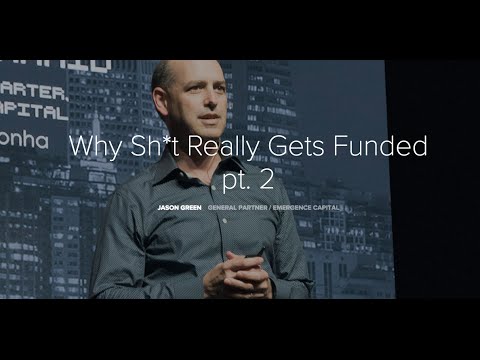
Green described Emergence Capital as a firm established in 2003 with an exclusive focus on enterprise cloud and SaaS businesses. He stated that venture capital firms operate under a risk model in which the downside of an investment is assumed to be a total loss. As a result, investment decisions prioritize companies with the capacity to achieve large-scale outcomes. In this context, he referenced the term “deca-corn,” defined as a privately held company valued at $10 billion or more, as a benchmark that reflects the scale of return sought by venture investors.
He identified patterns observed across the firm’s portfolio, which includes investments in companies such as Salesforce, Yammer, Box, and Zoom. According to Green, companies that attract venture funding frequently present a combination of measurable growth indicators and structural characteristics. These include:
- Evidence of product-market fit supported by user or revenue expansion.
- Founding teams with prior operational or domain experience.
- Large total addressable markets.
- Distribution models that enable scalable customer acquisition, including freemium structures.
- Differentiating attributes referred to as “X Factors.”
Green cited Box as an example of a company that shifted from a consumer-oriented model to enterprise SaaS, incorporating a freemium distribution approach alongside revenue growth. In the case of Yammer, he pointed to user adoption trends and freemium conversion rates as data points that informed the investment decision. Regarding Zoom, he referenced early user growth achieved with limited marketing expenditure and a founding team with prior experience in video communications technology.
The interview also addressed Emergence Capital’s internal evaluation process. Green stated that the firm applies a collaborative review structure in which investment decisions require collective agreement among partners. He attributed this approach to the firm’s sector specialization, which centers exclusively on enterprise cloud software.
A recurring concept in Green’s remarks was the presence of multiple “X Factors.” He described these as distinct characteristics that, when combined, increase the likelihood of securing venture capital. Examples mentioned include team composition, market size, product architecture, business model design, and quantifiable growth metrics.
The interview presents Green’s account of how venture capital firms assess SaaS companies. The discussion focuses on scale potential, risk tolerance, and identifiable operational indicators rather than incremental performance improvements. [16]
SaaStr AMA on SaaS Investments #02
On January 14, 2016, Jason Green participated in a live AMA hosted by SaaStr AI titled “Changing Landscape: SaaS Investments in 2016.” During the discussion, he shared his perspective on SaaS market dynamics, founder profiles, valuation trends, and long-term investment strategy.

According to his view, the SaaS market in early 2016 was undergoing a normalization rather than a collapse. Having experienced previous downturns, he characterized the cooling of public markets as a potentially healthy adjustment after several years of strong growth. He highlighted a valuation disconnect between public and private SaaS companies, noting that public firms were increasingly scrutinized for operating leverage and cash flow generation, while private valuations had not yet fully reflected that shift.
Reflecting on the acquisition of SteelBrick by Salesforce in late 2015, he described it as a meaningful indicator of SaaS maturity. In his assessment, repeat founders can execute faster due to accumulated experience, but sustained ambition and drive remain essential. He emphasized that exceptional founders tend to combine high intelligence, resilience, and long-term vision. However, he also noted that execution and early product-market fit remain critical, and that founder adaptability is often more important than rigid adherence to an initial strategy.
On geographic considerations, he observed that companies built outside the Bay Area often take longer to scale but may develop stronger foundational discipline before accelerating growth. In his view, market leadership in SaaS tends to follow a power-law dynamic: while true “winner-takes-all” markets are rare, category leaders frequently capture disproportionately higher returns than second
- or third-place competitors.
Regarding growth versus dilution, he framed capital raising as a strategic tool rather than an ideological choice. In highly competitive markets, significant capital may be necessary to secure leadership. However, he acknowledged that excessive dilution can materially impact long-term founder outcomes. He suggested that strong fundraising capability enables founders to balance ownership and expansion more effectively.
He also addressed SaaS business models, expressing a preference for simplicity and predictability in recurring revenue structures. In his view, operational clarity and efficiency metrics—such as sales and marketing productivity—are central to scaling successfully.
Overall, his perspective during the session emphasized long-term thinking, disciplined growth, founder quality, and strategic capital allocation as core determinants of durable SaaS success. [17]
See something wrong?