0% read
Last updated:
Marco Monaco
Marco Monaco is an Italian technology executive and blockchain specialist with experience in enterprise architecture, consulting, Ethereum ecosystem development, and business growth. He is Growth Lead at TAC and previously served in leadership roles at Consensys, where he contributed to the development and expansion of Linea. [1]
Education
Monaco studied telecommunications engineering at the University of Naples Parthenope, earning a first-level degree between 2001 and 2005. He continued his studies at Università degli Studi di Napoli Federico II, where he completed a second-level degree in telecommunications engineering from 2005 to 2008. Following his university studies, Monaco attended the Junior Consulting Academy at ELIS between 2008 and 2009. [2]
Career
Monaco began his career in 2008 as a junior analyst at ELIS, working on software analysis and development projects. He subsequently joined Reply as a functional analyst, supporting software and systems projects for telecommunications clients. In 2010, he moved to AlmavivA, where he held a series of technical and management roles, including software administrator, system manager, technical director, system integrator, and enterprise architect. His work focused on software development, systems administration, enterprise architecture, cloud infrastructure, and integration projects across both public
- and private-sector organizations. In 2015, he briefly founded Tip SRLs, providing blockchain advisory services.
From 2016 to 2021, Monaco worked at PwC Italy, progressing from manager to senior manager and later director. During this period, he led the firm's Blockchain Competence Center, overseeing blockchain-related initiatives and advisory activities. In parallel with his professional roles, he became active in the cryptocurrency and blockchain sector from 2012 onward, participating in blockchain communities and supporting Web3-related business development initiatives.
In 2021, Monaco joined Consensys as Business Development Manager for the EMEA region. He later became a co-founder and Growth Lead at Linea, contributing to the network's ecosystem development and growth. Since September 2024, he has served as Growth Lead at TAC, where he works on ecosystem development and adoption initiatives for blockchain applications that connect Ethereum-compatible infrastructure to the TON ecosystem. [3]
Interviews
TON on EVM
In an interview with TokenPost in October 2025, Pavel Altukhov and Monaco discussed the development and growth of TAC, a blockchain network integrated with the TON and Telegram ecosystems. Altukhov described his early involvement in cryptocurrency markets and the Ethereum ecosystem, explaining how those experiences influenced the creation of TAC. Monaco discussed his background in asset management and blockchain, as well as the technical challenges involved in introducing EVM compatibility and cross-chain functionality to connect Ethereum-based applications with Telegram users. The interview focused on TAC’s architecture, including its EVM-compatible infrastructure, cross-chain design, and efforts to simplify user interactions with decentralized applications through Telegram. The speakers outlined strategies for ecosystem growth, including liquidity incentive programs, user experience improvements, and support for decentralized finance services such as staking and other financial applications. They also reviewed developments following TAC’s mainnet launch in July 2025, including exchange listings, user growth, community engagement, and expansion efforts in international markets, including South Korea. Looking ahead, they identified network security, ecosystem expansion, scalability, and the development of token utility as key priorities for the following six to twelve months, while emphasizing the role of Telegram-based applications in broadening access to blockchain and decentralized finance services. [4]

Future of Interoperability
In an interview with Bitcoin.com News in May 2025, Monaco discussed his background in blockchain technology and the development of TAC. He described his introduction to Bitcoin in 2012 and his subsequent involvement in the Ethereum ecosystem, including work on Layer 2 infrastructure and Ethereum-based projects. Monaco explained that his interest in the TON ecosystem was driven by its integration with Telegram and the potential to connect blockchain applications with a large existing user base.
The interview focused on TAC’s role in enabling interoperability between Ethereum-compatible applications and TON. Monaco outlined the network’s architecture, including its Cosmos SDK-based EVM Layer and the TON Adapter, a cross-chain framework that facilitates communication between the two ecosystems. He discussed efforts to allow Ethereum developers to deploy applications within the TON environment without substantial redevelopment, as well as collaborations with decentralized finance projects and planned liquidity initiatives. Monaco also highlighted the importance of simplifying user interactions with blockchain applications and described a long-term vision in which decentralized finance services are integrated into familiar consumer platforms, reducing the complexity typically associated with blockchain technology. [5]

Presentations
Going Mainstream
At the dApps and Mini-Apps Day event in Dubai in May 2025, Monaco discussed the role of consumer applications in expanding access to decentralized finance services. He examined Telegram’s development as a platform for blockchain-enabled applications, highlighting its Mini App framework and integrated cryptocurrency functionality as mechanisms for reaching a large user base. Monaco argued that widespread adoption of decentralized finance depends not only on technological innovation but also on effective distribution through platforms that users already engage with regularly.
During the presentation, Monaco outlined how established decentralized finance functions, such as token swaps, lending, and yield-generating products, could be incorporated into Telegram Mini Apps, enabling blockchain-based services to be delivered through familiar user interfaces. He presented examples of financial and consumer-oriented use cases that combine decentralized finance infrastructure with everyday digital services and discussed how these integrations could expand access to blockchain applications beyond traditional cryptocurrency users. The presentation emphasized the importance of simplifying user experiences and leveraging existing consumer platforms as a pathway toward broader adoption of decentralized finance technologies. [6]

DeFi GM
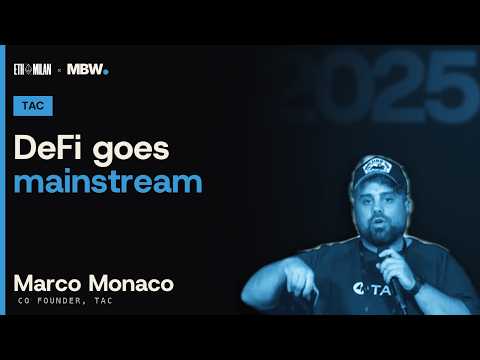
At ETHMilan 2025 in July, Monaco presented his perspective on the factors required for decentralized finance to reach a broader audience. Drawing on his experience in both the Ethereum and TON ecosystems, he argued that distribution is a key determinant of adoption and highlighted Telegram’s large user base, Mini App framework, and integrated wallet infrastructure as potential channels for delivering blockchain-based services to mainstream users. Monaco discussed efforts to bring Ethereum-compatible decentralized finance applications to the TON ecosystem, addressing limitations created by differences between the two blockchain environments. He outlined how financial functions such as token swaps, lending, liquidity provision, and collateralized payment models could be embedded within consumer-facing applications, allowing users to access decentralized finance services through familiar interfaces. The presentation focused on integrating blockchain infrastructure with widely used digital platforms and examined how consumer applications could serve as a distribution layer for decentralized finance products. Monaco also discussed the planned launch of TAC’s mainnet and its role in enabling Ethereum-compatible protocols to operate within the TON and Telegram ecosystems. [7]
See something wrong?