0% read
Last updated:
ADA (Cardano)
ADA (₳) is the Cardano network’s native token. It was named after 19th-century mathematician Ada Lovelace, widely regarded as the world’s first computer programmer. The ADA token is a digital currency and is also used to perform transactions on the Cardano network. [1]
Compare Cryptoassets
Select an asset to compare its price and other stats against ADA (Cardano).
Overview
The ADA token can be used for staking on the Cardano platform to help verify transactions. Staking rewards users with more ADA cryptocurrency and the Proof of Stake (PoS) system helps maintain the network's security. ADA can also be used to facilitate smart contracts and run applications on the Cardano network. [2][3]
ADA token holders who stake their ADA tokens will be able to participate in on-chain governance and vote on development proposals. [5]
Distribution
The initial token launch for Cardano (ADA) was on the 29th of September, 2017.
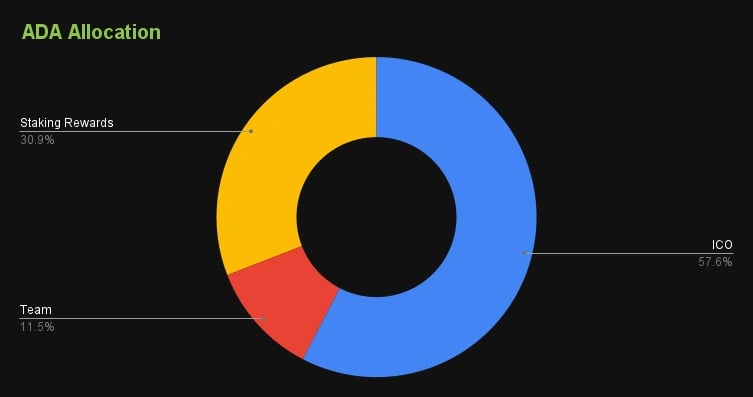
57.6% of the total ADA supply was distributed to investors in an Initial Coin Offering (ICO), in which Cardano raised $62.2 million. 11.50% was allocated to the Team (IOHK, EMURGO, and Cardano Foundation) and 30.90% to Staking Rewards. [2]
Staking ADA
Validators - also known as pool operators - charge a commission fee for running staking pools. Delegators receive staking rewards in proportion to the amount staked.
Every 5 days, the protocol automatically allocates and compounds staking income. Users are able to delegate to any staking pool without a lock-up period, and can freely move their stake. Rewards can be withdrawn without an unbounding period, though there is a latency period of 15-20 days before the initial stake begins to earn rewards. [5]

See something wrong?