0% read
Last updated:
Ariah Klages-Mundt
Ariah Klages-Mundt is an applied mathematics researcher and entrepreneur known for his work in decentralized finance (DeFi), particularly in the areas of systemic risk modeling and stablecoin design. He is a co-founder of Gyroscope, a DeFi protocol that emerged from his academic research, and is recognized for his early public warnings about the collapse of algorithmic stablecoins like Terra/UST. [1]
Education
Klages-Mundt's academic background is centered in applied mathematics and computer science. He graduated magna cum laude from Amherst College in 2012 with a Bachelor of Arts in Mathematics. During his undergraduate studies, he spent the 2010–2011 academic year as a visiting mathematics student at the University of Oxford’s Lady Margaret Hall. He later pursued non-degree, PhD-level mathematics coursework at New York University in 2015. Between 2016 and 2023, he attended Cornell University, where he earned both a Master of Science (MSc) and a PhD in Applied Mathematics, with a minor in Computer Science. As part of his doctoral work, he was a Bloomberg Fellow and a visiting PhD student at the London Business School from 2018 to 2019, focusing on Management Science and Operations. [2]
Career
Klages-Mundt's career began with diverse research experiences even before his graduate studies. From 2005 to 2008, while in high school, he conducted engineering research on hydrogen storage in collaboration with university labs and presented his work at international science fairs. In 2008, he served as a legal intern at Southern Minnesota Regional Legal Services. He continued his research pursuits with geology fieldwork at Winona State University in 2009, focused on hydrology and geophysics simulations, and later worked on computational neuroscience at Rice University in the summer of 2010. From 2011 to 2012, he conducted computational number theory research on elliptic curves, resulting in a presentation at the ANTS X conference and contributions to academic publications.
After graduating from Amherst, Klages-Mundt worked as a freelancer from 2012 to 2013, spanning financial asset analysis, paralegal work, and business modeling. He then transitioned into the financial technology industry, working as an Analyst at Locus Analytics from 2013 to 2015, where he developed economic network models and a business classification system. From 2015 to 2016, he was a Technology Engineer at Andrew Davidson & Co., contributing to risk analytics systems and modeling tools for fixed-income instruments like mortgage-backed securities. His work in the blockchain space began formally in 2017, while he was conducting PhD research at Cornell on economic networks and systemic risk. This research laid the groundwork for his eventual co-founding of the Gyroscope protocol in 2021. [2] [4]
Interviews
Redefining Money with Stablecoins
In an October 2024 episode of the WTF is OpenSociety podcast, Klages-Mundt discussed how decentralized stablecoins shape digital systems and influence emerging forms of openness and risk. He outlined his academic background in mathematics and financial modeling, his move from research into Web3, and his focus on designing economic systems for decentralized finance. The conversation explored economic complexity, differences between custodial and non-custodial stablecoins, and the risks revealed by past financial crises and mechanisms like MakerDAO’s short squeezes. He introduced a framework for evaluating stablecoins based on collateral and issuance design, reviewed trends in existing models such as DAI and FRAX, and explained how Gyroscope approaches stability, liquidity, and governance. The interview concluded with a discussion about the future potential of decentralized stablecoins and the importance of stronger risk management across the category. [5]

Building Resilient DeFi
In a May 2023 interview with the IC3 Initiative at Cornell Tech, Klages-Mundt discussed his mathematical background and his move from traditional finance and fintech into blockchain in 2017. He described the potential of decentralized finance, noting both its accessibility and composability as well as the risks that come with removing intermediaries. Stablecoins were highlighted as a central element of DeFi’s growth, especially in regions like Latin America. He outlined Gyroscope’s attempt to form a third category of stablecoin by addressing issues such as risk concentration, governance delays, oracle reliability, and liquidity under stress. The conversation also covered Gyroscope’s origins in academic research, ongoing regulatory uncertainties for DeFi, and the project’s dynamic redemption mechanism designed for stability during market shocks. Klages-Mundt concluded by describing upcoming work on protocol launch and governance development, along with research areas in oracle security, incentive alignment, and governance extractable value. [4]

Presentations
Superliquid Mechanisms
At Devcon 2024, Klages-Mundt outlined the state of decentralized stablecoins, noting that centralized options still dominate while decentralized models struggle with liquidity, higher costs, and technical challenges in minting and redemption. He emphasized the importance of decentralization for reducing counterparty and censorship risks, introduced Gyroscope’s on-chain mechanisms to improve liquidity, and presented new innovations, such as duplex yield and secured swap lines, designed to support efficient market-making and strengthen stablecoin stability. [7]

Assessing Oracles with CPF
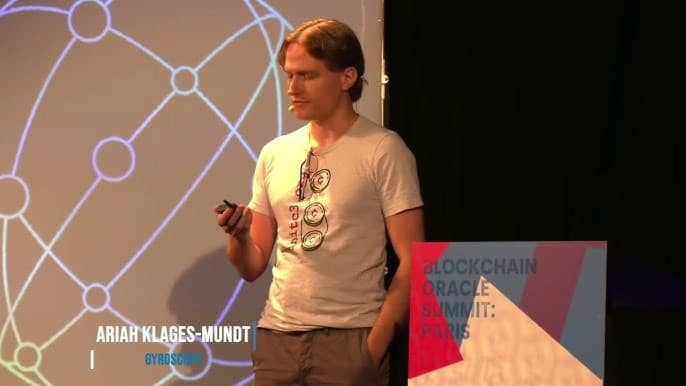
At the Blockchain Oracle Summit in June 2023, Klages-Mundt presented Gyroscope’s work on a Consolidated Price Feed designed to reduce Oracle risks by treating price inputs as candidates rather than absolute values and validating them against on-chain and off-chain data. He outlined the system’s goals—speed, liveness, resistance to manipulation, and stale-price detection—described its multi-source design and early performance on Polygon, and highlighted future improvements aimed at strengthening Oracle security and supporting broader deployment. [6]

Panels
Optimising Liquidity
At the Stable Summit in November 2024, Klages-Mundt joined Alessandro Buser (Dialectic), Martin Krung (Curve), Gabe Pohl-Zaretsky (Gauntlet), and moderator Sonya Kim (Steakhouse Financial) for a discussion on how to optimize stablecoin liquidity across different platforms. The panel explored why liquidity matters for reducing slippage, the distinction between primary and secondary liquidity, and how efficient secondary markets support stable pricing. The conversation moved through strategies for where stablecoin teams should build liquidity first, the economic expectations and risk considerations of liquidity providers, and how incentives can bootstrap use but should not become long-term crutches. The panelists also addressed cross-chain liquidity challenges, noting the additional risks posed by new chains and bridge designs, before concluding with advice for stablecoin builders: set clear plans, deploy incentives strategically, and ensure liquidity remains attractive on a risk-adjusted basis. [8]

See something wrong?
Social Profiles:
Blockchains: