0% read
Last updated:
Hydrex
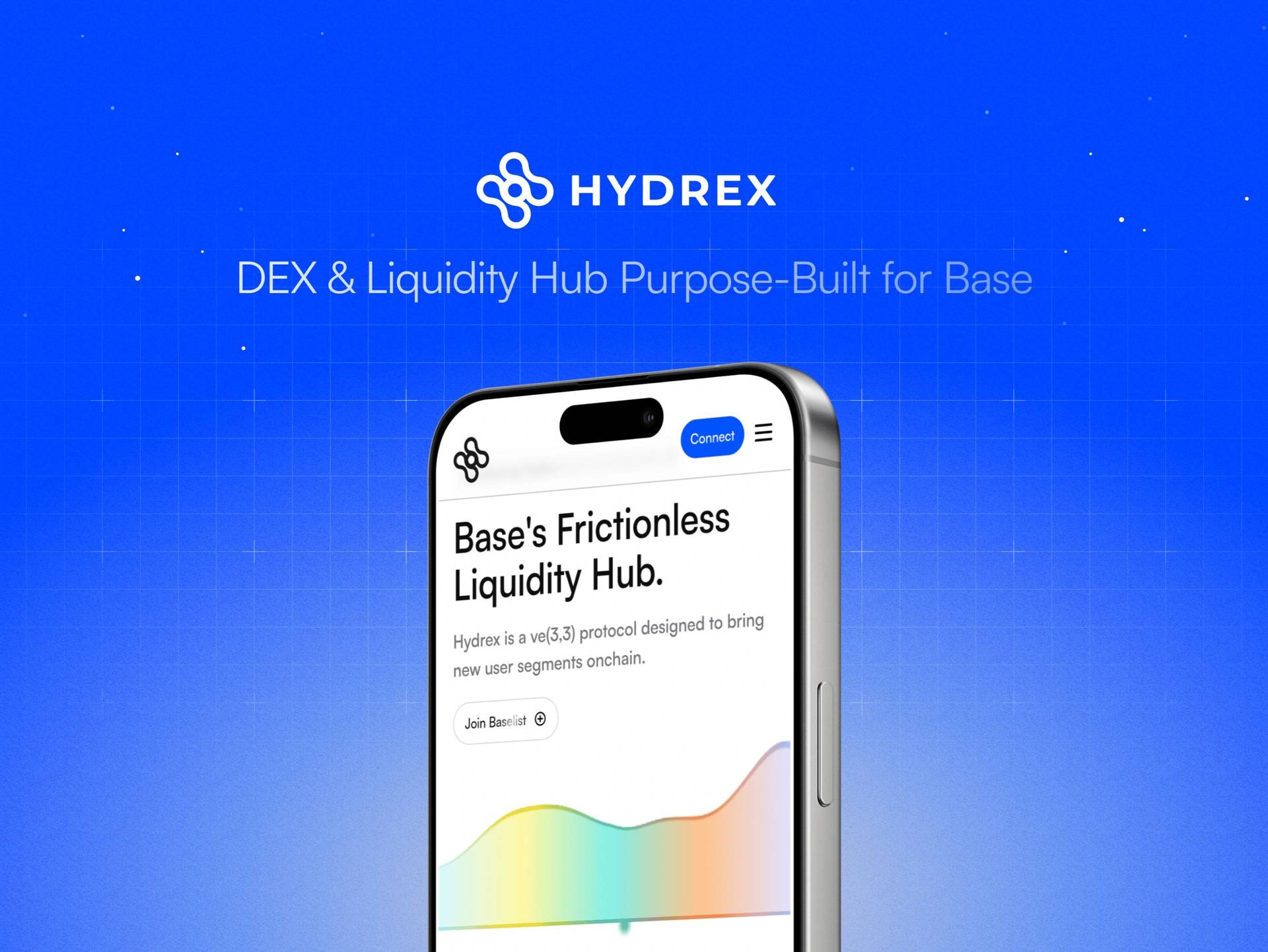
Hydrex is a decentralized exchange (DEX) that operates on the Base blockchain. The platform describes itself as an "Omni-Liquidity MetaDEX" designed to simplify the process for new users to engage with decentralized finance (DeFi).
It provides core DEX functionalities such as cryptocurrency trading and yield generation through liquidity provision, alongside a governance framework and an integrated analytics dashboard. [1]
Overview
Hydrex functions as a key component of the Base ecosystem, an Ethereum Layer 2 scaling solution. The project's stated mission is to facilitate user onboarding to on-chain activities by offering an accessible and feature-rich trading environment. As a MetaDEX, its architecture is designed to aggregate liquidity from multiple sources, differing from traditional DEXs that rely solely on their own liquidity pools. This model aims to provide users with more efficient trade execution by sourcing the best possible prices across various liquidity venues on the Base network. [1]
The platform is structured around four main features: Trade, Earn, Vote, and Analytics. The "Trade" component offers a standard interface for swapping digital assets. The "Earn" feature allows users to generate yield on their assets, primarily through liquidity provision where they earn rewards in the form of "options tokens."
The "Vote" feature indicates a decentralized governance model, wherein holders of the platform's native token, HYDX, can participate in decision-making processes. Finally, the "Analytics" tab provides users with a dashboard for monitoring platform-wide data, pool performance, and other relevant metrics. The project's technology also powers other applications within the ecosystem, highlighting its role as a foundational liquidity layer. [1] [2]
Technology and Features
Hydrex's functionality is built upon several interconnected components that together form its Omni-Liquidity MetaDEX structure. This design is central to its value proposition within the competitive landscape of decentralized exchanges on the Base network. [1]
Omni-Liquidity MetaDEX Architecture
The designation "Omni-Liquidity MetaDEX" suggests that Hydrex's core protocol acts as an aggregator. Instead of being limited to the liquidity provided by its own users, the platform's smart contracts likely scan and route trades through various other liquidity sources on the Base network. These sources could include other DEXs, lending protocols, and concentrated liquidity pools.
By aggregating liquidity, a MetaDEX can offer users benefits such as reduced price slippage on large trades, better exchange rates, and deeper liquidity for a wider range of tokens. This approach abstracts the complexity of sourcing liquidity away from the end-user, who interacts with a single interface to access a broad market. [1]
Core Platform Components
The user-facing platform is divided into four primary sections, each serving a distinct purpose within the Hydrex ecosystem. [1]
Trade
The "Trade" feature is the platform's central exchange interface. It allows users to connect their Web3 wallets and swap one cryptocurrency for another on the Base network.
Leveraging the MetaDEX architecture, this swap function is designed to find the most efficient route for the trade, potentially splitting the order across multiple liquidity pools to achieve the optimal price for the user. [1]
Earn
The "Earn" section is dedicated to yield-generating opportunities. Here, users can provide their digital assets to the protocol to become liquidity providers (LPs). By depositing assets into liquidity pools, LPs help facilitate trades on the platform and are compensated for doing so. According to the source material, users who provide liquidity earn rewards in the form of "options tokens."
This mechanism may differ from standard LP reward models and could involve tokenized, tradable call or put options on other assets, providing a unique form of yield. [1]
Vote
The "Vote" tab points to the existence of a decentralized autonomous organization (DAO) or a similar governance structure. This feature implies that holders of the HYDX token have the right to participate in the protocol's governance.
This typically includes proposing changes to the platform, such as adjustments to fees, decisions on which new pools to incentivize, or modifications to the protocol's treasury management. Token holders can then vote on these proposals, with their voting power often proportional to the amount of tokens they hold. [1]
Analytics
Hydrex includes an integrated "Analytics" dashboard. This tool provides on-chain data and key performance indicators for the protocol. Users can typically view metrics such as Total Value Locked (TVL), trading volume over various timeframes, the performance of individual liquidity pools, current APRs, and transaction data.
This transparency allows liquidity providers and traders to make more informed decisions based on the platform's real-time activity and historical performance. [1]
HYDX Token
HYDX is the native utility and governance token of the Hydrex protocol. Its presence and function are inferred from the platform's features and the composition of its primary liquidity pools. [1]
Utility and Tokenomics
According to token data, HYDX has a circulating supply of 32,311,809 and a total supply of 71,088,671. The token does not have a fixed maximum supply. [3]
Governance
The existence of a "Vote" feature strongly suggests that HYDX serves as the governance token for the Hydrex protocol. In typical DeFi governance models, token holders can stake their tokens to create and vote on proposals that direct the future development and management of the platform. [4]
This can include anything from modifying smart contract parameters to allocating community treasury funds. This gives the community of token holders a direct say in the protocol's long-term strategy. [1]
Liquidity Incentives
A key utility of the HYDX token appears to be its role in incentivizing liquidity provision. Historical data from the platform showed a HYDX/USDC liquidity pool with a significantly higher Annual Percentage Rate (APR) compared to other pools.
For instance, at one point, this pool offered a 126.94% APR, while pools for major assets like WETH/USDC offered around 24.05%. This practice, often called liquidity mining, involves rewarding LPs with the native token (HYDX) in addition to standard trading fees.
The goal is to encourage users to provide deep liquidity for the native token pair, which helps stabilize the token's price, reduce slippage for traders, and foster a healthy on-chain market for the token. The HYDX/USDC pool at one point held a Total Value Locked (TVL) of $1,893,504.82, indicating significant community participation in this incentive program. [1]
Liquidity and Yield Generation
Hydrex provides a wide range of opportunities for users to provide liquidity and earn yield. The platform's health and utility are closely tied to the depth and diversity of its liquidity pools. [1]
Liquidity Pools
At one point in time, the Hydrex platform supported 336 distinct liquidity pools, offering users a broad selection of assets and strategies to engage with. These pools allow users to deposit pairs of assets and earn a share of the trading fees generated when other users trade against their liquidity. The platform's top pools by TVL indicate a focus on both major cryptocurrencies and protocol-specific integrations. [1]
An analysis of historical data revealed the top five liquidity pools by Total Value Locked (TVL), a metric representing the total value of assets deposited in a pool:
| (Pool) | TVL (USD) | Average APR |
|---|---|---|
| | $2,314,839.97 | 12.43% |
| WETH/cbBTC | $1,949,263.67 | 22.16% |
| HYDX/ | $1,893,504.82 | 126.94% |
| WETH/ | $1,013,059.75 | 24.05% |
| /cbBTC | $920,535.43 | 56.33% |
Note: The TVL and APR figures represent a historical snapshot and are subject to change. [1]
Analysis of Top Pools
The composition of the top pools provides insight into Hydrex's strategy and position within the Base ecosystem.
- USDC Morpho: The largest pool by TVL in the dataset was a single-asset USDC pool integrated with Morpho, a decentralized lending protocol. This suggests that Hydrex users could deposit USDC to earn a base lending yield from Morpho, possibly augmented with additional rewards from Hydrex. This integration demonstrates an advanced strategy that combines DEX functionality with broader DeFi yield sources.
- WETH/cbBTC and WETH/USDC: The presence of pools for Wrapped Ether (WETH), Coinbase Wrapped Staked BTC (cbBTC), and USDC among the top five highlights the platform's support for core, high-volume trading pairs. These are foundational pairs for any DEX, and their significant TVL indicates that Hydrex serves as a venue for trading major digital assets on Base.
- HYDX/USDC: As previously noted, this pool's exceptionally high APR (126.94% in the snapshot) serves as a powerful incentive to deepen liquidity for the project's own token, which is a critical goal for any new protocol.
- USDC/cbBTC: The high TVL and strong APR for this pair underscore the importance of Coinbase-affiliated assets (like cbBTC) within the Base ecosystem, and Hydrex's role in facilitating markets for them.
These statistics from a historical point in time showed a diverse range of strategies, from stablecoin lending integration and incentivization of the native token to providing liquidity for blue-chip crypto assets. [1]
Ecosystem and Collaborations
Hydrex has established itself as an integrated part of the Base blockchain through strategic technical integrations and direct collaborations with the Base team. [1] [2]
Role within the Base Ecosystem
As a project built natively on Base, Hydrex contributes to the network's overall liquidity and DeFi activity. By offering a MetaDEX, it helps improve the efficiency of the entire on-chain market, which can benefit users of other applications on the network as well.
Its explicit mission to bring new users "onchain" aligns with the goals of the Base network itself, which aims to provide an accessible entry point to Ethereum's decentralized ecosystem. [1]
Key Partnerships and Integrations
A significant technical integration for Hydrex is its role as the underlying power for the Send. App. This indicates that Hydrex's exchange and liquidity-routing technology is robust and modular enough to be used as a backend infrastructure for other user-facing applications.
Such a partnership, often referred to as a "DEX-as-a-service" model, signals a level of technical maturity and a B2B (business-to-business) aspect to Hydrex's operations beyond its own platform. [1] [2]
Collaboration with Base and Promotions
Hydrex has engaged in direct collaborations with the core Base team. The project hosted a trading competition with a $20,000 prize pool, which was officially sponsored by Base.
This type of event serves multiple purposes: it drives trading volume and user engagement on the Hydrex platform, increases visibility for the project, and signals a strong, supportive relationship between Hydrex and the foundational layer it is built upon. Sponsorship from the core blockchain team is often viewed as a vote of confidence in a project's technology and team. [2]
See something wrong?