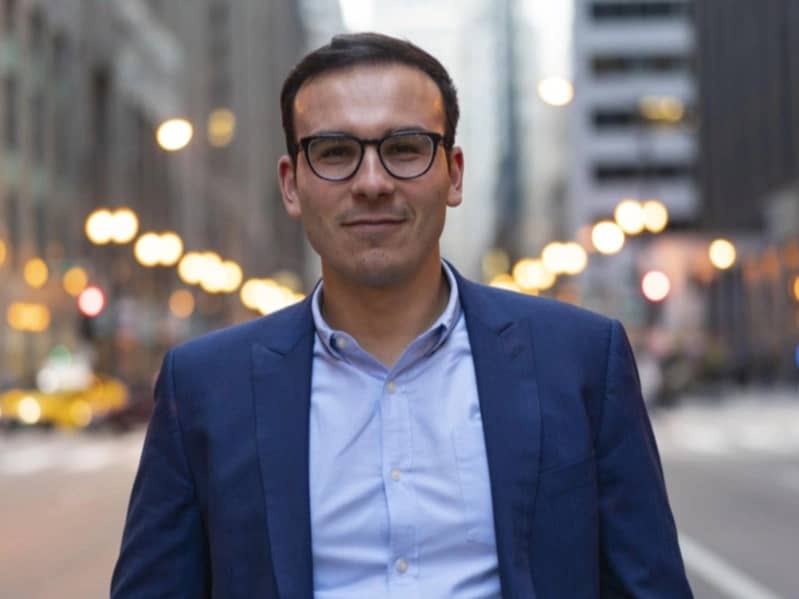
Edward Woodford
Edward Woodford is the co-founder, and Chief Executive Officer of zerohash, a business-to-business (B2B) digital-assets-as-a-service infrastructure company. A prominent figure in the financial technology (fintech) and cryptocurrency industries, he is known for his focus on market structure, regulatory compliance, and the convergence of traditional finance (TradFi) and decentralized finance (DeFi). Woodford advocates for the thesis that these two systems will merge into a single financial system, a concept he refers to as "just Fi." [1] [2]
Education
Woodford earned a Bachelor of Arts degree with First Class honors in Philosophy, Politics, and Economics from the University of Warwick in the United Kingdom. [3] [4] Following his undergraduate studies, he moved to the United States and attended the Massachusetts Institute of Technology (MIT), where he received a Master of Finance degree. [3] [4] His interest in blockchain technology was ignited during his time at MIT in a class taught by Professor Christian Catalini, which led him to purchase his first Bitcoin at the MIT bookstore. [2]
Career
Woodford began his career in finance with summer analyst positions at The Blackstone Group in 2013 and PJT Partners in 2014. [5] He then worked as a quantitative trader at the Chicago-based proprietary trading firms Chopper Trading and DRW, which served as a basis for working with digital assets. [1] [6]
In 2015, at the age of 22, Woodford co-founded Seed CX with Brian Liston. [5] [6] Seed CX was established as an institutional-focused cryptocurrency exchange and a licensed derivatives execution venue registered with the Commodity Futures Trading Commission (CFTC). [7] The venture was later sold to the online brokerage firm tastytrade. [3]
Zero Hash
In 2017, Woodford led the strategic pivot from Seed CX's exchange model to launch Zerohash, spinning out the company's settlement and custody infrastructure to focus on a B2B "crypto-as-a-service" offering. [6] As Co-Founder and CEO, Woodford has guided Zerohash in building a comprehensive, API-driven platform that allows businesses such as neo-banks, broker-dealers, and payment platforms to embed digital asset services for their end-users. [8] The company handles the underlying technological and regulatory complexities, including digital asset custody, liquidity, trading, settlement, and compliance. [1]
A core component of the company's strategy under Woodford has been to build a robust regulatory framework. Zerohash LLC is registered as a Money Service Business (MSB) with the Financial Crimes Enforcement Network (FinCEN) and holds a BitLicense from the New York Department of Financial Services (NYDFS), in addition to Money Transmitter Licenses in over 50 U.S. states and territories. [1] [5]
Growth and Funding
Woodford has led Zerohash through several significant challenges and funding rounds. During the COVID-19 pandemic, the company reportedly faced a critical cash shortage and an attempted hostile takeover by an existing investor. The company was stabilized through a rescue deal financed by mentor and investor Tom Sosnoff. [2]
Zero Hash has since secured substantial funding from major financial institutions. Key funding rounds include:
- Series C: $35 million raised in September 2021. [1]
- Series D: $105 million raised in January 2022, with participation from investors including Point72 Ventures and NYCA Partners. [4]
- Series D-2: $104 million raised on September 23, 2025. This round was led by Interactive Brokers and included participation from Morgan Stanley, SoFi, and Apollo Global Management. [9] [10]
In early 2026, it was reported that Zerohash had previously rejected a $2 billion acquisition offer from Mastercard. Woodford explained the decision by stating a fundamental belief that the company's potential for independent growth over the next few years would far exceed the offer. [2] [11]
Partnerships and Integrations
Under Woodford's leadership, Zerohash has formed partnerships with a wide range of companies across finance and technology. Clients and partners include Stripe, Franklin Templeton, Interactive Brokers, Shift4, MoneyLion, tastytrade, DraftKings, and Wirex. [3] [5]
Notable integrations and collaborations include:
- Providing the infrastructure for USDC funding across multiple blockchains for BlackRock's tokenized BUIDL fund. [2]
- Enabling global investors to fund tastytrade brokerage accounts 24/7 using stablecoins, a feature launched in July 2025. [4]
- Partnering with Mastercard and others to help its cardholders purchase cryptocurrency directly on-chain. [1]
- Integrating with the Monad network to provide high-performance, low-cost stablecoin payment infrastructure. [[markets.businessinsider.com/news/stocks/zerohash-brings-high-performance-stablecoin-payments-to-monad-network-1035819664][Business Insider on Zero Hash and Monad partnership]]
- Partnering with remittance platform Felix to integrate stablecoins and AI for its borderless payment solutions in October 2024. [4]
Views and Philosophy
In an interview from February 2026, Woodford explained his long-term vision for Zerohash and its intersection with the broader financial ecosystem.
On Market Convergence
Woodford's founding thesis for Zerohash is that the worlds of traditional finance and decentralized finance are destined to merge into a single, unified system he calls "just Fi." He views the company's funding from major financial institutions like Morgan Stanley and Interactive Brokers as validation of this belief becoming a reality. [1] [10]
On Artificial Intelligence and Cryptocurrency
Woodford argues that autonomous AI agents will become significant economic actors and will require a native, programmable, and 24/7 financial system to operate. He posits that stablecoins on public blockchains are the ideal financial rail for these agents. He also stresses the need for accountability in these systems, stating, "Accountability in AI is crucial for trust." [7] In a February 2026 podcast, he stated, "We're very close to AI agents being the number one transactor of blockchains on a transaction basis... And so the whole thesis is very much, how do you enable AI agents to use programmatic money?" [6]
On Market Focus and Regulation
Woodford has been critical of what he sees as the crypto industry's "overly focused" attention on interest rates, arguing that it distracts from more fundamental issues like building real-world utility and improving market structure. [7] He is a strong proponent of clear legal frameworks, believing that "regulatory clarity is essential for market stability." He has criticized the "regulation by enforcement" approach in the U.S. and maintains that a clear definition of what constitutes a security would resolve much of the industry's uncertainty. [7]
On Entrepreneurship
Reflecting on the challenges of building Zerohash, including several "near-death" moments, Woodford has emphasized the importance of psychological resilience for founders. He advocates for separating one's personal identity from the business to make more rational decisions, stating, "You have to separate yourself and identity, otherwise it will completely destroy you. I’ve almost grieved the business three or four times." He also advises founders to carefully vet investors, distinguishing between those who rely on contractual "power" and those who build relational "influence." [2]
Awards and Recognition
Woodford has received several personal accolades for his work in finance and technology, and Zero Hash has earned numerous awards for its growth under his leadership.
- Forbes 30 Under 30 - Finance (2019) [1]
- Crain's Chicago Business 20 in their 20s (2018) [1]
- Titan 100 - Chicago’s Top 100 CEOs & C-level executives (2025) [3]
- Goldman Sachs' Most Exceptional Entrepreneurs (2023) [3]
- Deloitte’s Technology Fast 500™: Ranked 4th (2024) and 21st (2023) fastest-growing company in North America. [3]
- Inc. 5000: Ranked the 46th fastest-growing company (2023). [3]
- Fintech Breakthrough Award for "Cryptocurrency Innovation" (2024). [3]
- Fast Company's World Changing Ideas Finalist (2023). [3]
Interviews
Stablecoin Infrastructure and Connect #01
On June 16, 2025, Edward Woodford, Founder and CEO of Zerohash, delivered a keynote at Stablecon, published on the company’s YouTube channel. In the address, he described stablecoins as a technological development in digital payments and compared their trajectory to earlier shifts in mobile communications. He characterized stablecoins as blockchain-based instruments designed to facilitate digital transfers of value across jurisdictions. Woodford framed the sector as consisting of multiple layers, including underlying blockchains, issued digital assets, infrastructure providers and end-user applications.
Woodford stated that Zerohash operates at the infrastructure layer, providing application programming interfaces intended to manage interactions across different blockchains and stablecoins. According to his explanation, the company’s services include payins, payouts, account funding, on
- and off-ramps, remittance processing and tokenization-related payment rails. He outlined three propositions regarding the market: that stablecoins are influencing payment mechanisms, that issuance is expanding across additional blockchains, and that the resulting fragmentation increases the need for interoperability tools. He also referenced regulatory developments affecting the sector and noted that Zerohash holds registrations in multiple jurisdictions, including a virtual asset service provider registration in Argentina.
During the presentation, Woodford cited operational examples involving freelancer compensation, brokerage account funding, cross-border remittances conducted through messaging platforms and payment flows associated with tokenized funds. He introduced a product suite named “Connect,” described as a framework combining identity verification, account authentication and transfer functionality. According to Woodford, the system is designed to allow businesses to integrate stablecoin-based transactions while managing compliance and technical processes through a unified interface. [13]
Stablecoins and Payment Infrastructure #02
On January 22, 2026, Edward Woodford appeared on the Leaders in Payments Podcast (Episode 460), hosted by Greg Meyers. During the interview, he discussed his professional background, the establishment of zerohash in 2017, and his views on the use of stablecoins and tokenized deposits within payment systems.
Woodford stated that his interest in blockchain technology originated while studying at MIT, where he was exposed to early academic and practical discussions surrounding Bitcoin and distributed networks. He described zerohash as a company that provides infrastructure for digital asset and payment workflows, focusing on regulatory compliance, transaction processing, and technical integration for merchants, payment service providers, and financial institutions.
He outlined two core product categories: account funding and payouts. According to his description, these services use stablecoins as a transfer mechanism for activities such as funding brokerage or gaming accounts and facilitating cross-border payments. He cited examples involving transfers to recipients in countries including the Philippines and Brazil, where stablecoins may be converted into local currency through integrated financial platforms. He identified interoperability across multiple blockchains and token standards as an operational challenge and stated that the company’s approach involves abstracting network and asset selection within its infrastructure.
The interview also addressed regulatory developments in the United States, including the timeline associated with the implementation of the Genius Act. Woodford indicated that regulatory clarification could affect how banks engage with stablecoins as payment instruments. He also discussed tokenized deposits, stating that financial institutions may evaluate them as an alternative to issuing proprietary stablecoins, particularly in relation to balance sheet treatment and reserve structures.
In discussing industry developments, Woodford referred to a shift toward vertical integration within the payments sector, including scenarios in which processors establish proprietary networks or pursue banking licenses. He stated that such structural changes may influence pricing models, settlement processes, and competitive dynamics. He also referenced streaming payments and automated transaction models as potential use cases associated with continuous settlement capabilities.
Throughout the conversation, Woodford described zerohash as operating at the infrastructure layer of digital payments, facilitating interaction between traditional financial systems and tokenized assets. He indicated that broader adoption would depend on system usability and integration, with end users interacting primarily through conventional financial interfaces rather than directly with blockchain networks. [14]
Interviews
Stablecoins and Payment Infrastructure (Leaders in Payments Podcast, January 22, 2026)
On January 22, 2026, Edward Woodford appeared on the Leaders in Payments Podcast (Episode 460), hosted by Greg Meyers. During the interview, he discussed his professional background, the establishment of zerohash in 2017, and his views on the use of stablecoins and tokenized deposits within payment systems.
Woodford stated that his interest in blockchain technology originated while studying at MIT, where he was exposed to early academic and practical discussions surrounding Bitcoin and distributed networks. He described zerohash as a company that provides infrastructure for digital asset and payment workflows, focusing on regulatory compliance, transaction processing, and technical integration for merchants, payment service providers, and financial institutions.
He outlined two core product categories: account funding and payouts. According to his description, these services use stablecoins as a transfer mechanism for activities such as funding brokerage or gaming accounts and facilitating cross-border payments. He cited examples involving transfers to recipients in countries including the Philippines and Brazil, where stablecoins may be converted into local currency through integrated financial platforms. He identified interoperability across multiple blockchains and token standards as an operational challenge and stated that the company’s approach involves abstracting network and asset selection within its infrastructure.
The interview also addressed regulatory developments in the United States, including the timeline associated with the implementation of the Genius Act. Woodford indicated that regulatory clarification could affect how banks engage with stablecoins as payment instruments. He also discussed tokenized deposits, stating that financial institutions may evaluate them as an alternative to issuing proprietary stablecoins, particularly in relation to balance sheet treatment and reserve structures.
In discussing industry developments, Woodford referred to a shift toward vertical integration within the payments sector, including scenarios in which processors establish proprietary networks or pursue banking licenses. He stated that such structural changes may influence pricing models, settlement processes, and competitive dynamics. He also referenced streaming payments and automated transaction models as potential use cases associated with continuous settlement capabilities.
Throughout the conversation, Woodford described zerohash as operating at the infrastructure layer of digital payments, facilitating interaction between traditional financial systems and tokenized assets. He indicated that broader adoption would depend on system usability and integration, with end users interacting primarily through conventional financial interfaces rather than directly with blockchain networks.