0% read
Last updated:
MAGNE.AI
MAGNE.AI is a blockchain platform that merges artificial intelligence compute infrastructure with Web3 applications. [1][2]
Overview
MAGNE.AI describes itself as a next-generation blockchain platform that unites AI compute infrastructure, DePIN networks, and Web3 applications, with the intention of building a mobile-native, embedded, and autonomous AI-powered Web3 world.[4] DePIN, short for Decentralized Physical Infrastructure Network, is a model in which physical hardware owned by ordinary users acts as network infrastructure in exchange for token rewards. In the MAGNE.AI design, edge devices such as its own phone serve as nodes: their owners share idle compute and earn the platform's MHA token in return.[4]
The company's stated purpose is to redefine the boundary between "smart devices" and "decentralized infrastructure," enabling trusted AI execution, traceable model provenance, data ownership, and collaboration across multiple devices.[4] Beyond mining, the platform is designed to let AI models themselves be deployed, validated, priced, and used on-chain — a capability MAGNE.AI calls a Web3-native form of AI-as-a-Service — and it offers AI APIs and software development kits so outside developers can build decentralized, AI-integrated applications.[4]
The broader ecosystem is organized into base infrastructure, a hardware device matrix, and an application layer. The device matrix is planned to include AI-powered phones, earbuds, and glasses, while the application layer is to host a decentralized-application hub named Shin Getter Nexus alongside AI assistants, Web3 games, and NFT platforms, all coordinated by a single token economy built on MHA.[4]
Features
MAGNE Layer1
MAGNE Layer1 is described as a mobile-first, EVM-compatible, Proof-of-Work (PoW) blockchain where smartphones and edge devices can take part in mining and consensus.[4][1] EVM compatibility means the chain runs software written for the Ethereum Virtual Machine, allowing existing Ethereum tooling and contracts to be reused.[3]
M Hash Layer2
M Hash Layer2 is a high-throughput chain built on the OP Stack, the open-source toolkit used to construct Optimism-style rollups.[1] Its defining feature is an asynchronous consensus mechanism that separates consensus from execution; the company states this separation is meant to raise throughput and efficiency while keeping transactions secure and low-cost.[4]
MAGNE.AI states the network targets block times of 400 milliseconds and thousands of transactions per second, with fees for both developers and users kept below US$0.0025, and it says throughput will rise as consumer hardware becomes faster.[5] The company also describes the network as validated by thousands of independently operated nodes, which it says keeps data secure and censorship-resistant, and it attributes energy efficiency to protocol and infrastructure optimizations across the L1 and L2 layers, cautioning that energy characteristics vary by configuration and workload.[5] These performance figures are presented by the company, which states that benchmark methodology is available only through controlled due diligence.[5]
MAGNE Kit and Agent Pay
A third component, the MAGNE Kit Modular Execution Framework, is described as a re-engineered execution layer optimized for low-latency smart-contract processing and tailored for mobile use and AI-native workloads.[4] Above the chains, the company plans a settlement product called MAGNE Agent Pay — a programmable settlement stack for AI agents that supports machine-to-machine transactions and usage-based service fees, allowing autonomous programs to pay one another for services rendered.[3]
MAG1 Hardware
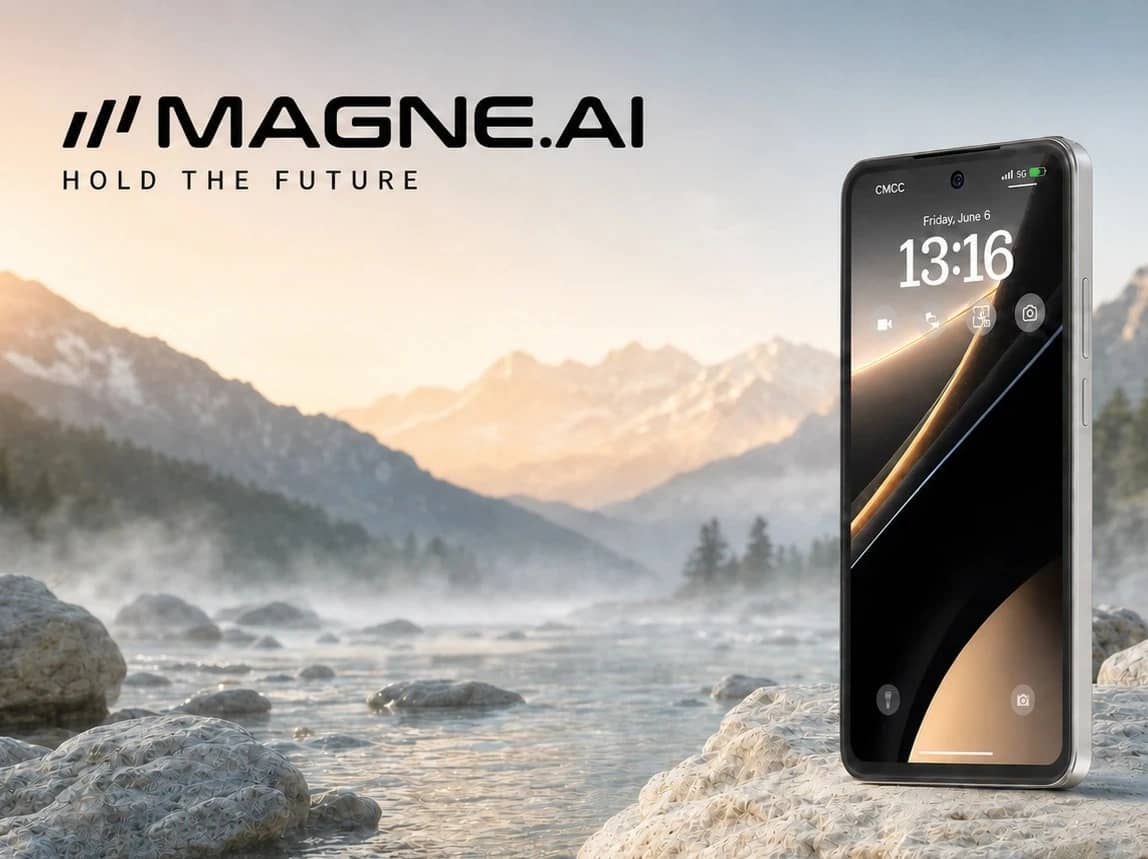
The flagship device is the MAG1, marketed under the phrases "HOLD THE FUTURE" and identified as "MAG1 · TAC 01681300," referring to its Type Allocation Code.[2] It performs the functions of a conventional handset — making calls, taking photos, and connecting to networks — while placing AI and cryptographic signing on the device itself.[2] The company frames it as "a terminal that remembers you. Not a server that remembers you."[2]
The MAG1 is built on the UNISOC T9100 5G mobile computing platform and pairs it with an IMG AX3596 neural processing unit (NPU) that the company rates at 10 TOPS (trillion operations per second) of INT8 performance, specified elsewhere as running at 1.2 GHz.[2] The NPU provides hardware acceleration for on-device AI inference, offloading model computation from the main processor. Other listed specifications include up to 24 GB of Hyper RAM combining physical and virtual memory, 512 GB of UFS 3.1 local storage, a 5,000 mAh battery with 33 W USB Power Delivery wired charging, and a 6.78-inch FHD+ display at a 120 Hz refresh rate.[2][3][6]
Tokenomics
The native token of MAGNE Layer1 is $MHA, which has a fixed total supply of 10,000,000,000 tokens and 18 decimals.[7] MHA functions as gas for transactions, as staking collateral securing validators, and as the base currency for governance and ecosystem incentives distributed through a Proof-of-Liquidity (PoL) mechanism.[7] A companion token, $mBGT, is a utility and governance token used to coordinate validator emissions and to vote on protocol-level decisions.[7]
Allocation
The 10 billion MHA supply is divided across ten categories. Mining Nodes receive the largest share at 3,000,000,000 tokens (30%), followed by Staking Nodes and the Ecosystem/DAO treasury at 1,500,000,000 each (15% apiece). Team & Advisors and venture-capital investors each hold 1,000,000,000 tokens (10%), Early Supporters 800,000,000 (8%), Early Liquidity Market Makers 700,000,000 (7%), the Subscription/Public Sale 300,000,000 (3%), and Equipment-Sale Agents and Exchange Campaigns 100,000,000 each (1%).[7]
Mining Issuance
The Mining Nodes pool rewards devices that supply valid workloads across PoAI and DePIN computation, bandwidth provisioning, and distributed storage, settling rewards on an overall contribution score that blends compute power, throughput, uptime, and quality.[7] At this stage only the MAGNE.AI Phone GEN1, rated at 8 TOPS, is activated for mining; other hardware is reserved for future activation pending mass production and governance approval.[7] The GEN1 sub-pool has a ceiling of 400,000,000 MHA, and its issuance halves each year, with the first year set at 200,000,000 MHA.[7] The annual allocation follows the formula Yn = 200,000,000 × (1/2)^(n−1), and the resulting first-year monthly base ceiling is 16,666,666.67 MHA. To manage early selling pressure, the first quarter is smoothed: the month-one ceiling is set to 20% of the base (3,333,333.33 MHA), month two to 60% (10,000,000.00 MHA), and months three through twelve to the full base, with unspent month-one and month-two portions reverting to the main pool.[7]
Each device's share is calculated from a valid-workload measure the tokenomics calls ECU, defined as ECU = TOPS^α × Uptime^β × Quality^γ × Eff^η × Geo × M_class, with parameters α = 0.6, β = 0.5, γ = 0.3, η = 0 (the efficiency factor is not yet used for the GEN1 phone), a geographic factor between 0.85 and 1.15, and a machine-class multiplier fixed at 1.0.[7] The measure is time-weighted by the fraction of the period a device is online, so that earlier, longer, and higher-quality participation earns more.[7] Rewards are split 40% immediately available and 60% released linearly over three months; only the available and unlocked portions count toward circulating supply, while a voluntary lock of 6, 9, or 12 months redistributes rewards by raising a device's ECU weight by 10%, 15%, or 20% in the next period.[7]
To qualify, an operator must register and pass remote hardware-fingerprint and firmware-signature authentication, with KYC optional, and must meet monthly thresholds of at least 240 hours online, 95% uptime, and 98% quality.[7] Extended offline time reduces rewards, repeated lapses move an operator to an observation list, and falsification or malicious behavior zeroes the period's rewards, draws penalties from the unlocked balance, and can blacklist the entity for 3 to 12 months.[7] Anti-Sybil rules merge multiple devices from the same entity or network provider, deduplicate fingerprints, and weight geographic and operator diversity to resist centralized manipulation; operators may optionally self-stake a small amount of MHA for a 1.05–1.15× multiplier, subject to slashing for violations.[7]
See something wrong?
Official Website:
Social Profiles: