0% read
Last updated:
Permissionless blockchain
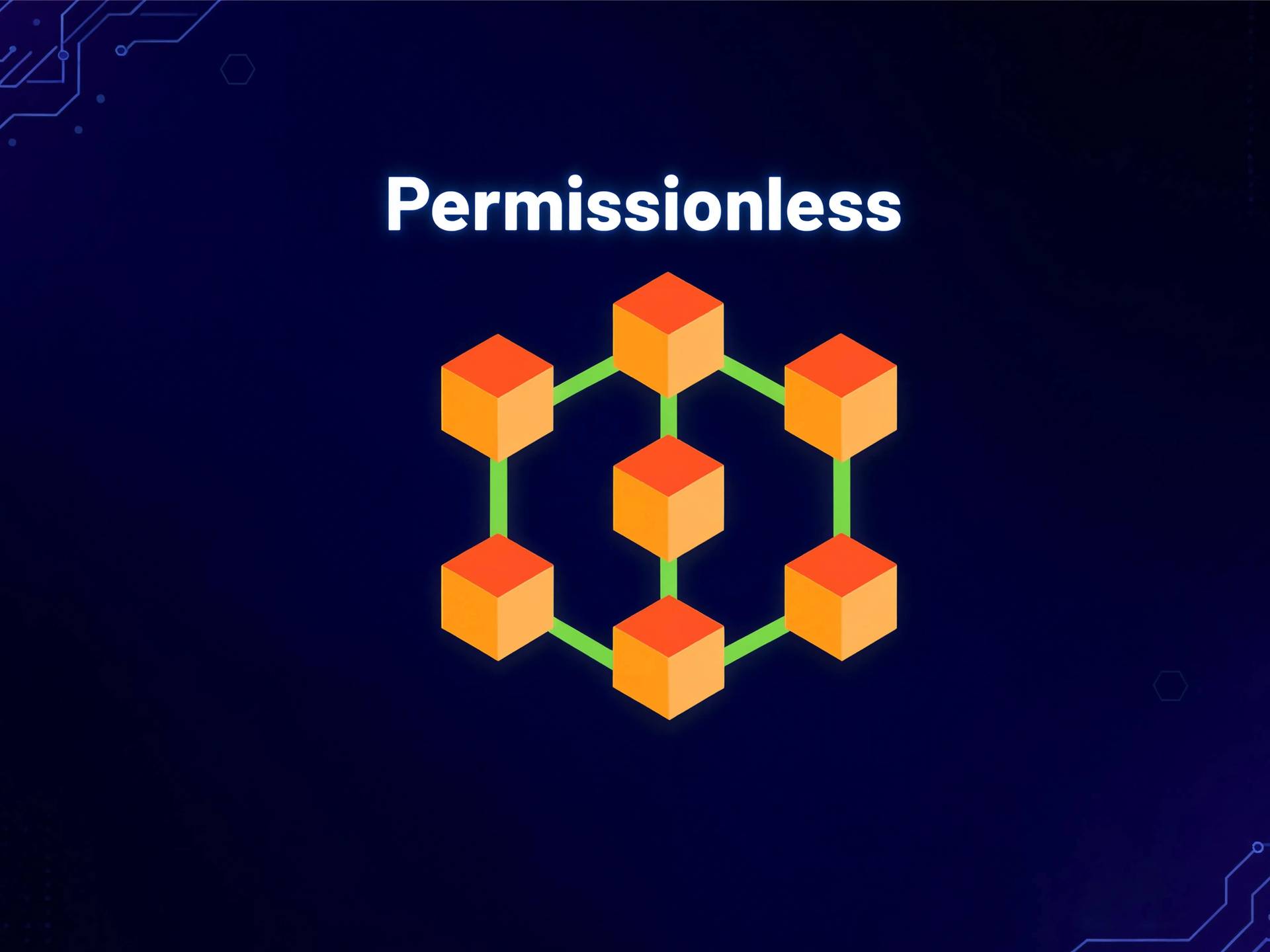
A permissionless blockchain is a distributed ledger that anyone can access, use, and help operate, including by contributing to its development and governance, without needing approval from a central authority, provided they follow publicly specified protocol rules.[4] The defining property is the absence of gatekeepers: no entity can regulate who joins the network or how it is used beyond enforcing the protocol's own technical and procedural constraints.[1][4]
Such systems are typically public and open-source, allowing anyone with an internet-connected device to join, transact, or validate without providing identification, although practical frictions such as transaction fees, hardware requirements, or technical knowledge can still limit who participates in practice.[2][4] Bitcoin, Ethereum, and Monero are commonly cited examples.[1]
The concept is frequently described as the cornerstone of cryptocurrency, standing in contrast to permissioned systems—including the traditional financial system and enterprise blockchains—where some entity limits who may participate and for what purpose.[1] Academic and policy work increasingly frame permissionlessness as a spectrum rather than an absolute, emphasizing degrees of openness across use, development, and governance rather than a simple binary distinction.[4][5]
Core Characteristics
A system is described as permissionless when there is no entity that can regulate who can use it and how it can be used; the term refers to a protocol being accessible to everyone without restriction and without requiring prior approval, so long as participants adhere to the protocol's publicly specified technical and procedural rules.[1][4]
Because these networks lack gatekeepers, they can in principle be used by anyone, including political dissidents or organizations blacklisted by banking systems—CoinMarketCap explicitly names WikiLeaks as such a user while also noting that criminals may use them.[1]
The same absence of central control means, according to the account, that no state can censor transactions on a permissionless blockchain, and that everyone has equal opportunity to participate regardless of who or where they are.[1] Academic treatments describe this property as censorship-resistance: the network infrastructure does not allow arbitrary banning or deplatforming of users for reasons other than violating protocol rules, although nodes may still exclude peers that break those rules or threaten the network.[4] At the same time, participation can still be constrained at off-chain layers, such as regulated exchanges or infrastructure providers, which may block access even when the underlying protocol remains technically open.[6]
Permissionless platforms generally do not require users to provide identification or complete know-your-customer (KYC) checks—the verification procedures that regulated financial institutions use to confirm a customer's identity—before granting access.[1]
Kraken frames this openness as a matter of financial autonomy, arguing that in the traditional system people must often receive authorization from a bank to withdraw, send, or access their own money, while cryptocurrencies run on public, open-source ledgers that are "permissionless by design," with no restrictions on who can join, manage, or modify them.[2]
Under this model, users can self-custody their own assets—holding them directly rather than through an intermediary—giving them, in Kraken's words, exclusive access to their digital wealth "without fear of censorship, confiscation or not being able to access their funds."[2]
Kraken also draws a direct contrast between traditional and crypto payments. In permissioned payment systems, all payments must be authorized by a bank; banks can set transaction limits that vary by customer, institution, and geography; additional fees apply to international payments; and transaction data is privately managed by banks, leaving outsiders unable to view or audit it.[2]
Payments from a self-custodial wallet, by contrast, require no authorization, impose no limits on how much or to whom value moves, carry no extra charges for cross-border transfers, and are described as completely transparent and auditable—anyone can view payments in real time using online tools called block explorers, which are public interfaces for reading a blockchain's contents.[2]
Consensus Mechanisms
Because permissionless networks admit anonymous, unvetted participants, they rely on consensus mechanisms—the rules by which a decentralized network agrees on the state of its ledger—to remain secure without a central operator.
The two most common are proof-of-work (PoW), in which miners expend computing power to add blocks, and proof-of-stake (PoS), in which validators lock up tokens for the right to do so.[1]
Under either mechanism, it is described as paramount for the system's long-term viability that these participants—miners and stakers—be incentivized to act honestly and in favor of normal operation, since the network's integrity depends on their behavior rather than on a trusted gatekeeper.[1]
Volunteers spread across the world collectively help manage these protocols using their own computers, and anyone may join because there are no gatekeepers deciding who can or cannot participate.[2] At the same time, research on large permissionless networks such as Bitcoin and Ethereum describes a separation between protocol-level consensus and off-chain governance processes, in which proposed protocol changes are discussed through open improvement proposal frameworks and only a subset of contributors can merge code or approve upgrades.[5]
Comparison With Permissioned Systems
Permissionless systems are defined largely by their opposite.
A permissioned system has some entity that limits who and how the system can be used; the clearest everyday example is the traditional financial system, which is permissioned because banks and states restrict who may use banks and other financial entities and for what purposes.[1]
Some blockchains are themselves permissioned in nature: they cannot be used by anyone for any reason and are usually operated by enterprises for a single purpose, with only whitelisted addresses permitted to transact.[1]
Facebook's Diem and enterprise blockchains are cited as permissioned networks that can restrict or censor users and certain types of activity, and that require the identities of users to be declared and recorded. Most such networks are cryptographically secured by a small number of validators authorized to produce blocks and contribute to the network.[1]
Blockworks frames the same distinction more broadly, defining permissionless as a system where anyone can participate without meeting someone else's conditions, in contrast to permissioned systems that require approval, licenses, or curated membership.[3]
It argues that while permissioning can promote order and safety, it frequently results in exclusion, inefficiency, and centralized power, citing a World Bank figure that "over 1.7 billion adults remain unbanked" as evidence of exclusion by permissioned financial systems.[3]
Examples of permissioned gatekeeping in technology include Apple's iOS ecosystem, which requires developers to submit apps for approval, comply with rules, and often pay fees, and social media platforms that moderate who may post and what content is acceptable.[3]
Applications and Frontiers
The practical appeal of permissionless systems is often illustrated through individuals excluded from traditional gatekept channels.
For example, an artist in Nairobi minting and selling non-fungible tokens (NFTs) without a gallery's approval, a farmer in rural Argentina depositing savings into a DeFi lending pool without opening a bank account, and a developer in Manila launching a token or decentralized application without asking an exchange or platform for listing rights.[3]
There's also a parallel argument that permissionless cryptocurrencies offer financial autonomy, transparency, and trustlessness by removing intermediaries and granting individuals direct control over their assets, empowering people worldwide and especially those excluded from traditional systems.[2]
Blockworks also acknowledges the challenges of permissionlessness, including scams, hacks, and public failures, the difficulty of resolving disputes and coordinating upgrades without centralized control, and scalability hurdles.[3]
Research on permissionless blockchains highlights a core privacy and security tension: transparent public ledgers enable independent verification and accountability, but the permanent visibility of transaction histories, balances, and asset flows increases the risk of deanonymization, targeted attacks, and behavioral profiling.[6] Recent analyses identify multiple categories of privacy and security threats, including dust attacks, transaction-linking techniques, exposure of remote procedure call infrastructure, maximal extractable value strategies, signature hijacking, smart contract vulnerabilities, and private key management failures, which together have been associated with multi-billion-dollar losses in documented exploits in 2024 and early 2025.[6] In response, researchers have proposed and, in some cases, deployed privacy-enhancing tools such as zero-knowledge proofs, ring signatures, and stealth addresses, while also observing a gap between the maturity of these techniques in the literature and their consistent, secure integration into production systems.[6]
Looking ahead, it projects several frontiers: decentralized identity built on decentralized identifiers (DIDs) and verifiable credentials, which would let individuals own their digital identities and choose when and how to share information without centralized issuers; the decentralization of artificial intelligence through open-source AI networks and marketplaces for data, algorithms, and compute, with SingularityNET named as a project envisioning shared AI development; an open metaverse of interoperable virtual spaces where users own assets and identities that can move freely across environments; and tokenized real-world assets such as real estate and bonds moving onto decentralized platforms, which the account suggests could eventually place property rights, investments, and public infrastructure funding on permissionless rails.[3]
The overarching argument is that permissionless ideals shift the question from "Who allowed you to do this?" to "What can you imagine, and how will you make it real?"[3]
The Permissionless Conference
Blockworks adopted "Permissionless" as the name of its flagship developer event, stating that the name captured the ethos that anyone can build, innovate, and participate without deferring to authority.[3]
The company describes the conference's mission as creating an open forum where builders in crypto and Web3 meet face-to-face, share ideas, challenge norms, and imagine what comes next—characterizing it, in its own words, as "a gathering not of elites, but of builders."[3]
The inaugural Permissionless conference took place in 2022, and Blockworks reports that more than 5,000 attendees participated, with panels covering the evolution of DeFi, NFT creativity, and the rise of decentralized autonomous organizations (DAOs).[3] The series has continued with Permissionless III, held on October 9–11, 2024 in Salt Lake City, and Permissionless IV, which took place June 24–26, 2025 at Industry City in Brooklyn, New York.
See something wrong?