0% read
Last updated:
Almanak
Almanak is an AI-driven decentralized finance (DeFi) strategy framework that combines a software development kit (SDK), agent-based strategy infrastructure, and non-custodial execution via Safe-based smart accounts across multiple EVM-compatible blockchains. It is designed to let users describe strategies in natural language or Python, convert those descriptions into executable code, and backtest the resulting strategies on historical data and mainnet forks before on-chain deployment where supported. Almanak positions itself as an agentic hedge fund or DeFi agent framework that can be used by both individual market participants and institutional teams to research, build, and execute automated trading and yield strategies.[4][5][1][2]
Overview
Almanak is designed to provide tools analogous to a quantitative trading desk by combining AI agents, simulations, and smart-contract infrastructure. It aims to automate the discovery of market inefficiencies and yield opportunities, the creation of corresponding strategies, and their subsequent execution on-chain across multiple EVM-compatible networks.[4][1]
Users can specify strategies in natural language or Python, which the system translates into production-ready smart contracts and off-chain logic. These strategies are backtested and stress-tested on historical data and mainnet forks before being deployed through non-custodial, Safe-based smart accounts. Almanak’s core components consist of a multi-agent AI system, referred to as an AI Swarm, and a strategy deployment infrastructure for both private smart accounts and public vaults, intended for use by individual DeFi participants, professional traders, and institutional asset managers.[4][5][2]
Key Features
Almanak’s architecture centers on two linked components: an AI Swarm of specialized agents for strategy ideation, alpha discovery, and optimization, and a deployment infrastructure that connects those agents to on-chain execution via Safe-based smart accounts, private Almanak wallets, and public ERC‑7540 vaults. Together these components are intended to provide a no-code or low-code environment for building, testing, and running DeFi strategies.[1][5]
Almanak also operates “The Kitchen,” a public environment with strategy templates and live demos that showcases how the AI agents design, simulate, and deploy strategies. The Kitchen lets users explore example vaults and workflows before building or deploying their own strategies.[2]
AI Swarm
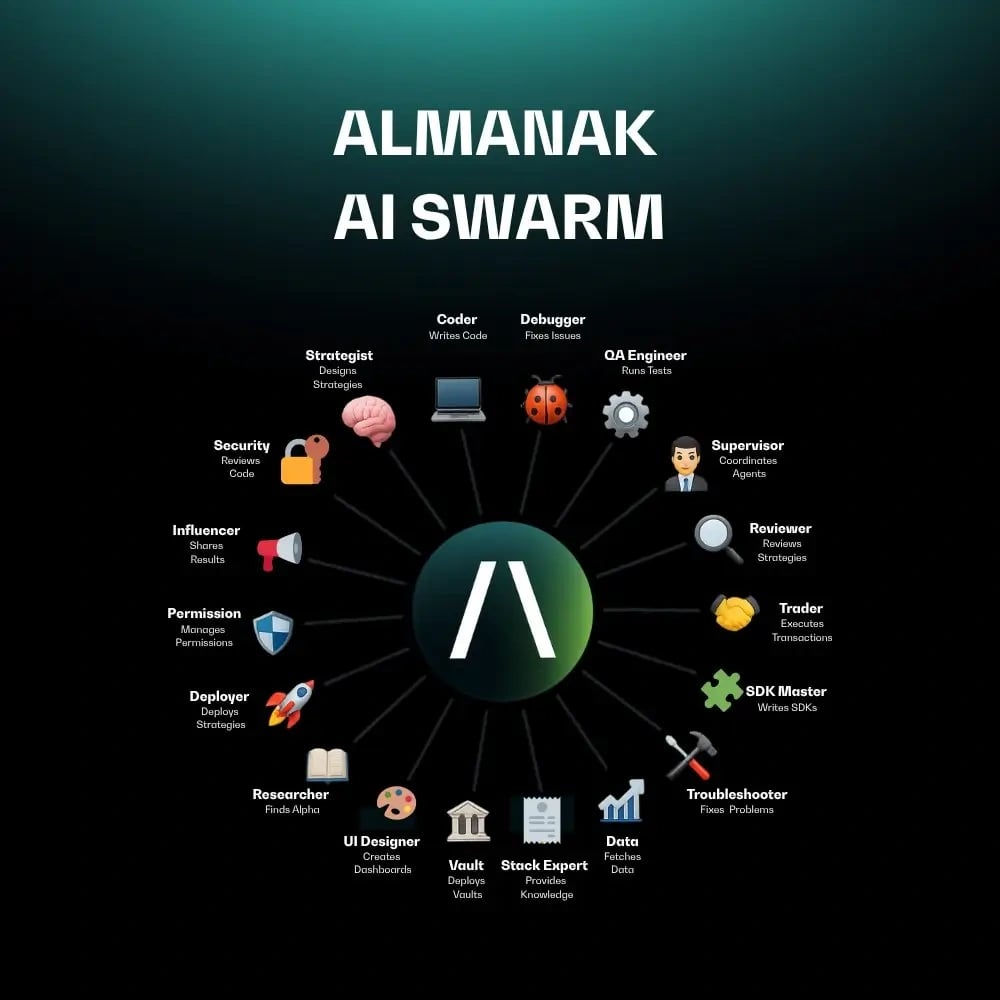
The Almanak AI Swarm is a coordinated network of 18 specialized AI agents that collaborate to design, evaluate, and deploy automated financial strategies. Each agent focuses on a distinct role across research, coding, simulation, and user interaction, with all actions logged so that users can inspect what the system is doing while retaining control over their assets via delegated permissions.[1]
The swarm is organized into three primary teams.
This team converts user-defined objectives into production-ready smart contracts and off-chain logic, audits and debugs the code, runs simulations, and prepares dashboards for monitoring strategy performance.[1][2]
The alpha-seeking team continuously scans blockchain markets to identify inefficiencies, yield opportunities, and potential trades, passing structured ideas and hypotheses to the strategy team for implementation.[1]
This team stress-tests and refines strategies across historical and projected market conditions, running backtests and scenario analyses to suggest parameter changes and improvements.[1][2]
Supporting agents handle user interaction, troubleshooting, and orchestration of the swarm, providing guidance and real-time status updates while coordinating the work of the three core teams.[1]
Strategy Deployment Infrastructure
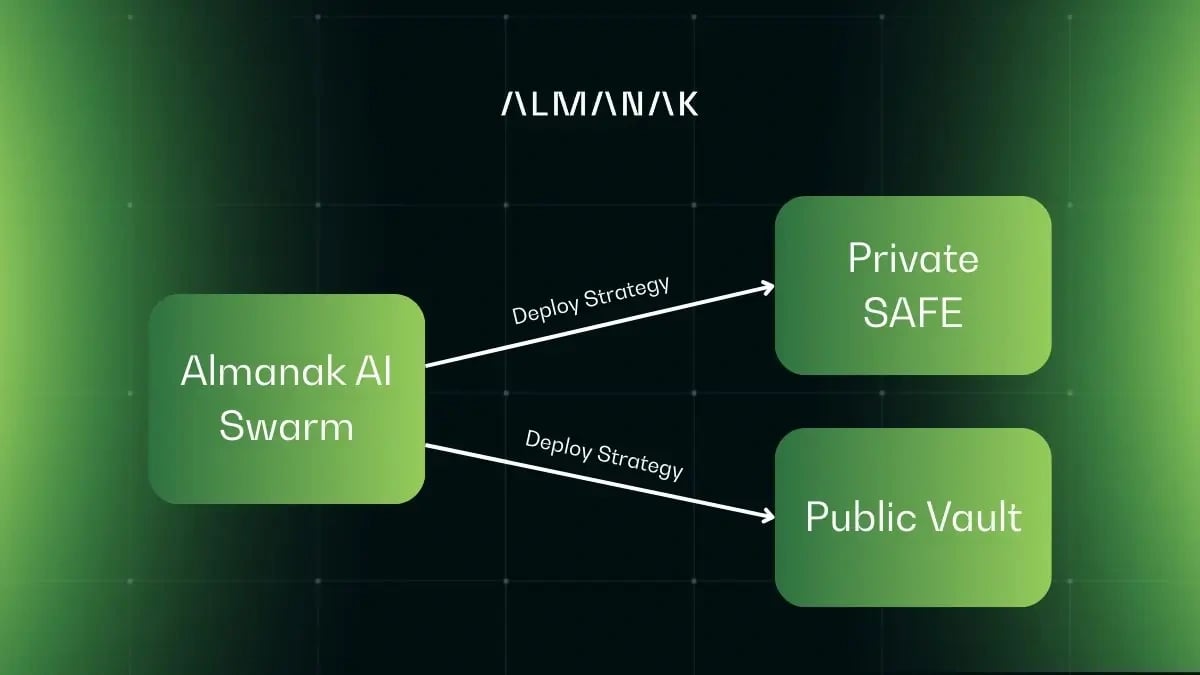
This component serves as the intermediary between AI-generated strategies and their on-chain execution, enabling secure, non-custodial deployment. Strategies can be deployed in two ways: to private Almanak wallets, which are Safe-based multisignature smart accounts with delegated permissions, or to public vaults, which can accept external deposits and support management and performance fees. Public vaults can be fully open or restricted to whitelisted participants, enabling tokenized AI strategies that function as on-chain investment vehicles for specific user groups.[1][4]
Key features of the infrastructure include cross-chain composability across multiple blockchains and DeFi protocols, a no-code interface for deploying strategies without programming knowledge, and non-custodial design so users retain direct control over their assets. Vaults are implemented using the ERC‑7540 standard, making vault shares liquid, composable DeFi assets that can integrate with other protocols, while Trusted Execution Environments (TEEs) are used to execute strategy logic without revealing it to other users or the host, preserving strategy privacy.[1][5][2]
Use Cases
- Personal Strategy Automation: Individual users can define financial goals, then have the AI swarm create, test, and deploy automated strategies to pursue those objectives, such as generating yield on existing assets.[1]
- Alpha Discovery: The alpha-seeking agents continuously surface investment ideas and market inefficiencies that users might not identify on their own, which can then be turned into executable strategies.[1]
- On-chain Fund Management: Experienced traders and asset managers can use the public vault infrastructure to create on-chain investment vehicles, define fee structures, and manage capital programmatically through Almanak’s AI agents.[5]
- Tokenized Strategy Trading: By tokenizing vaults using the ERC‑7540 standard, Almanak creates strategy vault tokens that can be traded or used as collateral in other DeFi protocols.[2]
- Community-Run Yield Vaults: Community-governed vaults, such as the alUSD (Autonomous Liquidity USD) stablecoin yield-optimization vault, demonstrate how users can coordinate around shared strategies which have attracted multi-million-dollar total value locked (TVL).[2]
- Ecosystem Simulation and Tokenomics Testing: Ecosystems such as NEAR and Injective have used Almanak’s simulation engine to model liquidity dynamics and token-economics scenarios, testing how design choices might affect market behavior before implementing them on-chain.[2]
Tokenomics
The Almanak token is designed to coordinate incentives between Strategy and Vault Curators, who design, deploy, and maintain strategies and vaults, and Liquidity Providers, who supply capital to those vaults. Emissions are allocated based on a demand-weighted function that takes into account vault total value locked (TVL) and recent, risk-adjusted performance, so that both curators and liquidity providers are rewarded when their vaults attract capital and generate returns.[1][3]
The total token supply is 1,000,000,000 tokens, with allocation ranges across community incentives, innovation and development, team, investors, advisors, and two Legion rounds, governed by multi-year vesting schedules intended to align long-term incentives.[3]
Token Utilities
- Governance and Emissions Control: Through a veToken model, locked tokens confer governance rights over protocol parameters and the allocation of emissions across vaults, allowing stakeholders to vote on where new token issuance is directed.[3]
- Staking for Compute and Boosts: Token holders can stake to access discounted AI compute and to boost the effective TVL or emission weight of specific vaults they support, increasing those vaults’ share of rewards.[3]
- Incentives for Curators and Liquidity Providers: Emitted tokens are used as incentives for Strategy and Vault Curators and for Liquidity Providers, distributing rewards according to vault TVL and performance so that successful strategies and well-capitalized vaults earn more.[3]
- External Protocol Bribes and Agentic Order Flow: External protocols can acquire and lock tokens to vote emissions toward vaults that interact with their smart contracts, effectively “bribing” for AI-managed order flow or “agentic traffic” that routes usage through their infrastructure.[3]
- Community: 33%
- Innovation and Development: 20%
- VC Investors: 20%
- Team: 21%
- Legion Round 1: 2.1%
- Legion Round 2: 2.4%
- Advisors: 1.5%[3]
Partnerships
- Legion: Almanak partnered with Legion to conduct a token sale and launch an Attention Capital Markets (ACM) campaign tied to its Points Season 1 programme, combining sale participation with points
- and leaderboard-based rewards.[1]
- Cookie: The platform collaborated with Cookie on the ACM initiative, which was designed to reward participants based on a combination of social engagement and capital investment in the protocol using SNAPS and cSNAPS leaderboards.[1]
See something wrong?