0% read
Last updated:
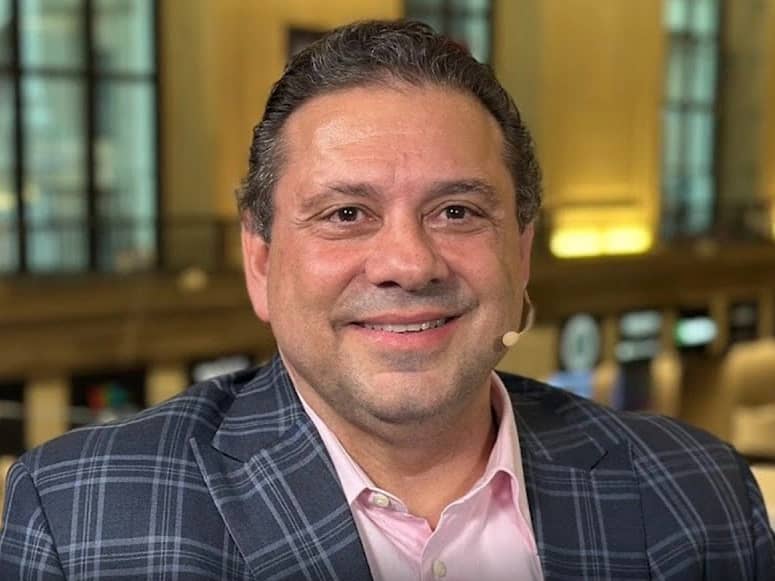
Demetrios Skalkotos
Demetrios "Demo" Skalkotos is the Chief DeFi and Protocol Officer at Blockdaemon, a role he assumed after holding leadership positions at firms including Fireblocks and IHS Markit. He is recognized for his expertise in enterprise sales, go-to-market strategy, and fostering institutional adoption of digital assets. [1] [2]
Education
Skalkotos attended Rutgers University from 1995 to 1999, where he earned a Bachelor's degree in Finance [3] [4].
Career
Skalkotos's career shows a consistent progression from enterprise software in traditional finance to executive leadership in the digital asset industry.
Early Career and IHS Markit
Skalkotos began his career in enterprise technology sales, holding a position as a Senior Account Executive at Siebel Systems from 2000 to 2005. Following this, he worked as an Application Sales Manager at Oracle from December 2005 to July 2007. In July 2007, he joined Markit (which later became IHS Markit) as a Director of Sales [3].
He spent over 14 years at IHS Markit, taking on roles of increasing seniority. His tenure culminated in the position of Managing Director, Global Head of WSO and Loan Platforms, a role he held until December 2021. In this capacity, he was responsible for leading the business unit that provided WSO software, services, and loan platforms to financial institutions. During his time at the company, he also served as the Global Head of Sales for GRRS & WSO [3].
Transition to Blockchain
After his extensive career in traditional FinTech, Skalkotos moved into the blockchain sector by joining Fireblocks, a digital asset infrastructure provider. He served as the firm's Head of Global Sales, where he led the global sales team until his departure in October 2022 [5].
Blockdaemon and Entrepreneurship
In October 2022, Skalkotos was appointed by Blockdaemon as the Global Head of its newly established institutional custody business unit, Blockdaemon Vault [5]. Upon joining, he expressed his excitement for the new role, stating, "I am excited by Blockdaemon and the launch of Blockdaemon Vault, which will help to create a new paradigm in how institutions interact with digital assets" [5]. In a company blog post, he articulated his mission: "My goal at Blockdaemon is to not only empower institutions to enter the blockchain economy, but to do so with the utmost confidence, peace-of-mind, and trust" [6].
After leading the Vault division, Skalkotos transitioned into an advisory role at Blockdaemon. He then embarked on an entrepreneurial venture, co-founding Expand Network, where he served as CEO from June 2023 to May 2025 [2].
In June 2025, he returned to Blockdaemon in a senior executive capacity as the Chief DeFi and Protocol Officer. This role is reflected on his public profiles as of early 2026 [1] [2].
Perspectives on Blockchain
Throughout his tenure in the digital asset space, Skalkotos has commented on the transformative power of blockchain technology and the growing trend of institutional adoption.
In an interview, he compared the emergence of blockchain to other major technological shifts he had witnessed during his career. He noted, "I’ve spent the better part of the last three decades talking about technology that empowers enterprises to grow... But in all my years, I have never seen a technology with as much disruptive potential as blockchain" [6].
His work has centered on providing enterprise-grade solutions to facilitate institutional entry into the digital asset market, a focus he has maintained across his roles at Fireblocks and Blockdaemon [5] [6]. He is also listed as a speaker for events hosted by the financial media brand Blockworks, where he discusses topics related to institutional crypto adoption [7].
Areas of Expertise
Skalkotos's career highlights several key areas of expertise:
- Institutional Digital Asset Adoption: Specializing in building and scaling enterprise-grade infrastructure and services to enable institutional participation in the crypto economy.
- Financial Technology (FinTech): Possesses deep experience in enterprise software, loan platforms, and financial market technologies from his time at IHS Markit, Oracle, and Siebel Systems.
- Go-to-Market & Sales Strategy: Demonstrated a consistent record of leading global sales and business development for complex technology solutions in both traditional and decentralized finance.
- DeFi for Institutions: His role as Chief DeFi and Protocol Officer indicates a strategic focus on connecting institutional finance with decentralized finance protocols and applications [1] [2].
Interviews
Institutional Blockchain Infrastructure and Staking at Scale #01
In an interview published on August 5, 2021, on the Crypto Valley Association Podcast, Demetrios Skalkotos, Global SVP of Sales at Blockdaemon, discussed aspects of blockchain infrastructure, institutional participation in digital asset networks, and operational considerations related to maintaining blockchain systems at scale.

Skalkotos reported that his involvement with blockchain began during the period commonly associated with initial coin offerings, following professional experience in traditional financial exchanges. He characterized this phase as one of accelerated market activity, with a wide range of projects emerging under varying technical and organizational standards. According to his account, this environment required systematic evaluation of project viability and long-term sustainability.
He described Blockdaemon as a company created to provide infrastructure services intended for institutional use. According to Skalkotos, the firm offers full node and staking infrastructure to entities such as exchanges, custodians, foundations, and financial institutions. At the time of the interview, he stated that Blockdaemon supported more than 40 blockchain protocols, including a substantial number operating under proof-of-stake consensus models. He indicated that the company’s role was focused on infrastructure provision rather than protocol governance or asset management.
Regarding staking, Skalkotos outlined its function within proof-of-stake networks as a process that enables asset holders to participate in network validation while retaining asset custody. He explained that institutional staking typically involves technical integrations between custodial systems and validator nodes, allowing participation without direct operation of the underlying infrastructure.
Operational risk management was identified by Skalkotos as a core consideration in infrastructure services. He described practices involving geographic distribution, use of multiple infrastructure providers, deployment of redundant nodes, and controlled failover procedures designed to limit risks such as double signing. He also referenced continuous monitoring practices conducted by specialized technical teams and the inclusion of mechanisms intended to address potential penalties arising from validator misbehavior.
In discussing broader industry developments, Skalkotos stated that blockchain adoption was likely to progress through incremental stages rather than through a single period of rapid transformation. He compared this process to earlier technological adoption cycles, noting that periods of expansion and contraction are common in emerging technology sectors. According to his perspective, the continued presence of blockchain-based systems would depend on their ability to address defined operational and institutional requirements over time. [8]
Crypto Trailblazers: Wall St On-Chain #02
On September 10, 2025, Demetrios Skalkotos participated in an interview on the SiliconANGLE theCUBE program theCUBE + NYSE Wired: Crypto Trailblazers, hosted by John Furrier. In this discussion, Skalkotos presented his perspective as Chief DeFi and Protocol Officer at Blockdaemon on the role of blockchain infrastructure in the interaction between decentralized finance and traditional financial institutions.
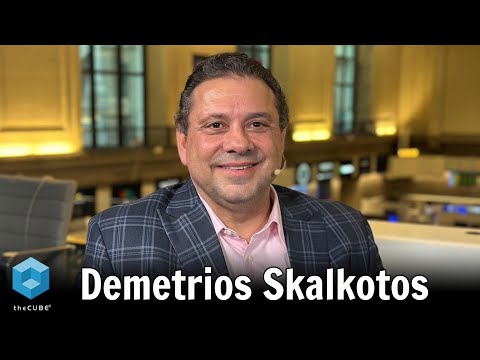
During the interview, Skalkotos described Blockdaemon’s operational structure, outlining its progression from providing blockchain node services to supporting additional infrastructure components. These include staking services, multi-party computation wallet technology, and DeFi-related infrastructure delivered through a unified interface. According to Skalkotos, this structure allows institutional users to access multiple blockchain networks through a single integration layer, covering more than 80 supported chains.
Skalkotos identified staking and yield-related activities as areas currently attracting institutional attention, particularly in relation to assets such as USDC, Bitcoin, Ethereum, and Solana. He also discussed the increasing use of cross-chain mechanisms, noting that interoperability between networks has become a functional requirement for institutions operating across multiple blockchain environments.
The interview addressed the coexistence of public, private, and hybrid blockchain models. Skalkotos explained that some organizations prioritize public blockchain transparency, while others require restricted data visibility, leading to the adoption of mixed architectures. In this context, interoperability was described as a practical necessity rather than a design preference.
Regarding the relationship between traditional finance and blockchain-based systems, Skalkotos characterized the ongoing integration as a gradual process. He referenced the use of stablecoins, exchange-traded products, and blockchain-based settlement processes as examples of areas where existing financial operations are being adapted rather than replaced. Additional topics discussed included institutional security and compliance requirements, workforce movement between traditional finance and digital asset sectors, and technical considerations such as maximum extractable value as blockchain usage expands.
The interview presents Skalkotos’s account of blockchain infrastructure as a supporting layer for institutional participation in decentralized systems, emphasizing incremental adoption within established financial frameworks. [9]
See something wrong?