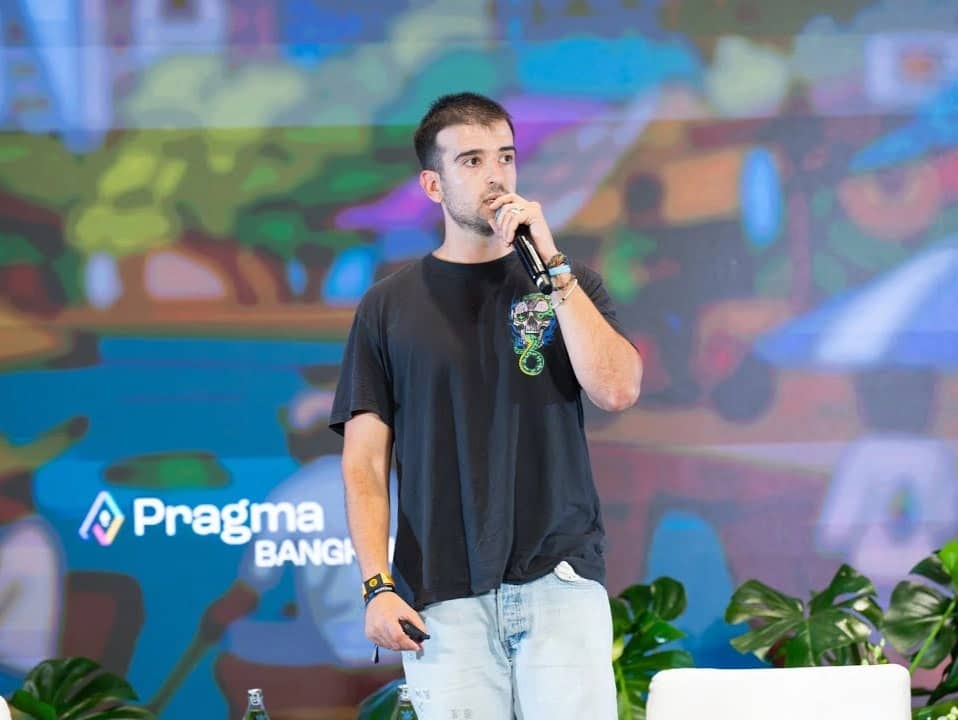
Konstantopoulos began his professional activities at Afixis, where he worked as a Software Engineer and Graphic Designer from August 2015 to November 2016 in Thessaloniki. He developed Python software for the creation of WAVE attendees' badges and designed posters for the WAVE Academic Expo, a scientific exposition for students from different fields, which served as a basis for later work with blockchain.
From February to September 2016, Konstantopoulos was a Co-Founder of Project M.A.R.T.I.S. and worked on the user interface and user experience of its Android application. The application communicated with a wearable device through Bluetooth Low Energy and provided information concerning dehydration, sunburn, and fever using measurements collected by the device.
Between January 2016 and January 2017, he served as a paper reviewer for ACSTAC, reviewing submissions to Anatolia College's Science and Technology Conference in the field of Informatics. During the same period, he served as a judge for the Math & Logic Competition hosted by NOESIS in collaboration with Anatolia College, where he evaluated the problem-solving performance of participating high-school students.
In November 2016, Konstantopoulos participated in ThinkYoung's Entrepreneurship School in Thessaloniki. The program involved developing an entrepreneurial idea, preparing a business and financial plan, and participating in activities and workshops concerning entrepreneurship and startups.
From November 2016 to July 2017, he worked as Social Media and Communications Manager and Graphic Designer at Zero Fuel Team in Thessaloniki. His responsibilities included maintaining social media platforms, producing content, responding to inquiries, coordinating a marketing and retention team, and creating visual materials such as posters and banners.
During the same period, Konstantopoulos served as an Event Organizer for the IEEE AUTH Student Branch, where he was involved in organizing events, workshops, and educational trips. In March 2017, he founded ThessSec in Thessaloniki, an initiative that organized bi-weekly meetings concerning information security and privacy. The activities included presentations and workshops covering Bitcoin, web application penetration testing, and network security.
From July to December 2017, Konstantopoulos worked as a Software Engineering Intern at Honda R&D Europe in Offenbach, Germany. His work included research into blockchain applications for energy markets and the development and testing of smart contracts using Solidity, the Truffle framework, OpenZeppelin, Ganache, Web3.js, and Web3.py.
He also worked on cryptographic key generation for Internet-of-Things devices, REST APIs in Python, and server configuration for prototyping and local network deployment.
Konstantopoulos worked as Lead Researcher at Loom Network from October 2017 to June 2019. He led teams working on the Loom Dashboard, Transfer Gateway, Delegated Proof of Stake, and Plasma projects. His work included implementing Delegated Proof of Stake on the Tendermint consensus engine.
During this period, he developed smart contracts that he stated secured more than $14 million. He also developed an implementation of Plasma Cash compatible with Ether and ERC-20 and ERC-721 tokens. He authored a reference paper on Plasma Cash that was presented at the MIT Bitcoin Expo, the Stanford Blockchain Conference, and Devcon4.
From March 2018 to March 2019, Konstantopoulos worked independently as a Smart Contract Auditor. His work involved reviewing smart contracts associated with initial coin offerings, ERC-20, ERC-223, and ERC-721 tokens, as well as other platforms.
The audits used automated tools and scripting to identify known vulnerabilities. The work also included recommendations concerning development practices and code optimization.
From July 2019 to July 2020, Konstantopoulos worked as an independent consultant on blockchain scalability, security, and interoperability. His projects included work for several blockchain and cryptocurrency initiatives.
For Loom Network, he developed the Plasma Cash protocol and engineered a Tendermint sidechain with multisignature communication with Ethereum. For Interledger, he developed an implementation of the Interledger Protocol in Rust. For Keep Network, he designed the cryptoeconomic structure of the TBTC mechanism for interoperability between Bitcoin and Ethereum.
His consulting work also included an audit of the Solidity codebase of Aragon Court for Aragon. For Celo, he developed a recursive SNARK prover and verifier for the network's Ultralight-sync mode and worked on its Proof-of-Stake rewards mechanism.
Konstantopoulos joined Paradigm as a Research Partner in July 2020. He became Chief Technology Officer in November 2021 and General Partner in June 2024.
His work at Paradigm has included research, software engineering, and investment activities. He has worked on open-source infrastructure for Ethereum written in Rust and has led teams associated with Reth, Foundry, Alloy, and other projects.
Reth is an Ethereum node written in Rust. Konstantopoulos introduced the project in December 2022, and its first alpha release, v0.1.0, was published on June 20, 2023. The project subsequently went through beta releases in 2024 and reached version 1.0 in June 2024. Reth 2.0 was released in April 2026.
Konstantopoulos also worked on Foundry, a development toolbox for smart contracts that was introduced in December 2021 and reached version 1.0 in February 2025. He leads development of Alloy, a Rust toolkit for the Ethereum Virtual Machine. Alloy was introduced in June 2023, released as v0.1 in June 2024, and reached version 1.0 in May 2025.
Other projects associated with his work include Solar, Revmc, Rivet, wagmi and Fig frame interface work, and flood, a load-testing tool for Ethereum Virtual Machine nodes.
Before joining Paradigm, Konstantopoulos authored ethers-rs, a Rust library and wallet implementation for Ethereum and Celo. His other Rust projects include an Ethereum Virtual Machine implementation, middleware for Fireblocks' APIs, and clap-mcp, a framework for connecting command-line applications with the Model Context Protocol.
His later work also included Centaur, a self-hosted framework for AI agents that Paradigm open-sourced in May 2026.
In addition to software development, Konstantopoulos has authored technical research concerning Ethereum transaction fees, scaling, Layer 2 systems, staking and restaking, consensus and protocol design, zero-knowledge proofs, hardware acceleration, randomness generation, intent-based architectures, and Ethereum hard forks.
His publications include research on EIP-1559, Optimistic Rollups, Ethereum reorganizations following the Merge, and Ethereum Proof-of-Stake. He also co-authored "Ethereum is a Dark Forest" with Dan Robinson, a paper examining transaction-ordering bots on Ethereum.
Konstantopoulos serves as Chief Technology Officer of Tempo, a payments network co-founded by Paradigm and Stripe. His development work has included Tempo's main codebase, wallet, and payment-protocol specifications.