0% read
Last updated:
Michael Dong
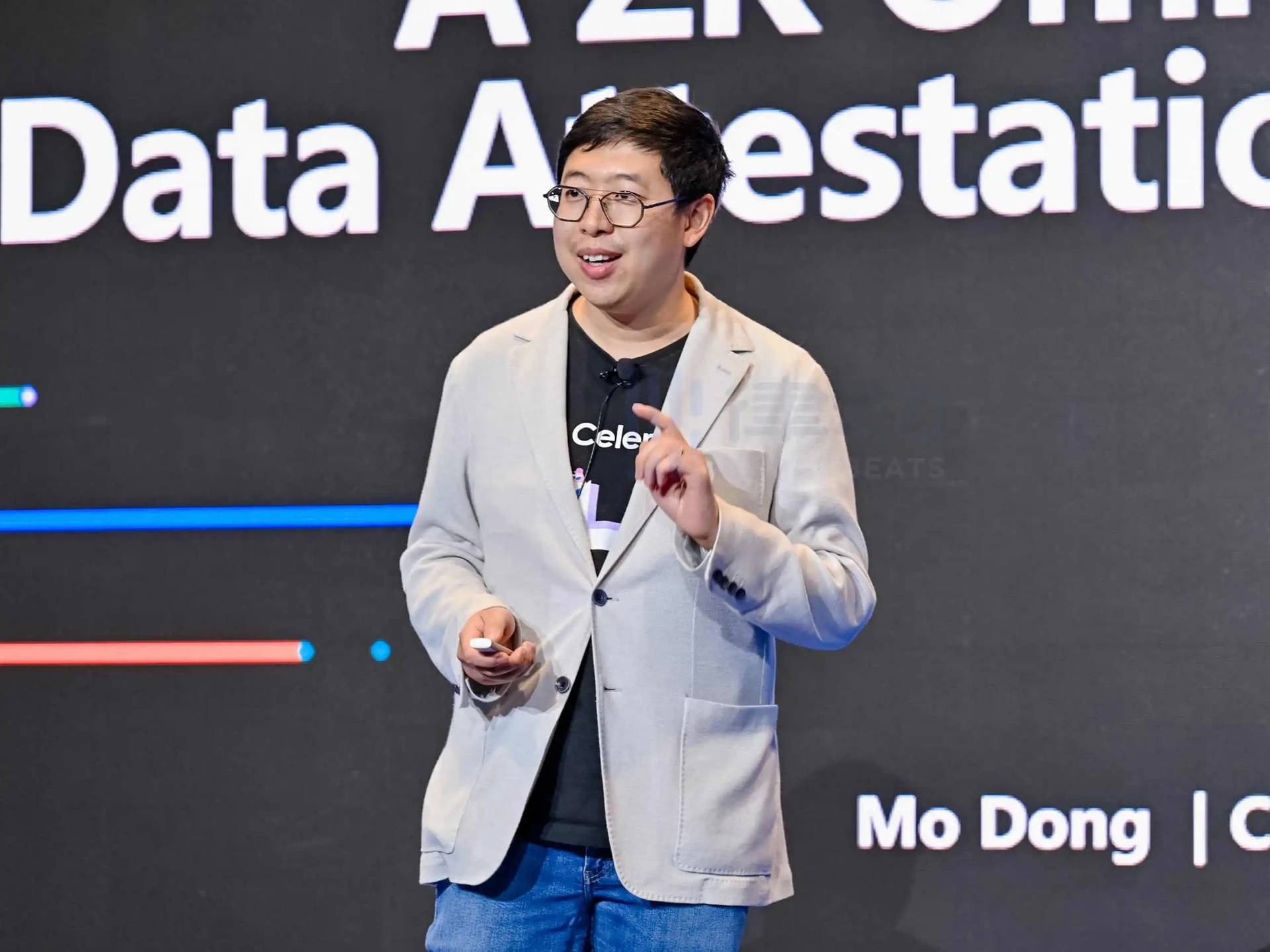
Michael "Mo" Dong is a Chinese-American computer scientist, entrepreneur, and investor known for co-founding the blockchain infrastructure projects Celer Network and Brevis. With a background in distributed systems, network protocols, and zero-knowledge cryptography, his work primarily focuses on addressing the scalability and computational limitations of blockchains. Before his ventures in the web3 space, Dong was a founding engineer at the network verification startup Veriflow, which was acquired by VMware. [1] [2] [3]
Education
Dong earned a Bachelor of Science in Electronics Engineering from Shanghai Jiao Tong University between 2008 and 2012. He then pursued his doctoral studies in the United States, obtaining a Doctor of Philosophy (Ph.D.) in Computer Science from the University of Illinois Urbana-Champaign (UIUC), which he completed in 2017. His Ph.D. research focused on high-performance distributed systems, algorithmic network verification, and the application of game theory to network protocol design. [1] [4]
During his academic career, Dong's research was published in top-tier international conferences, including ACM SIGCOMM and IEEE INFOCOM. His work has been cited thousands of times and was adopted by major technology companies like Google and AT&T for network protocol design and verification. [3] Dong has noted how his Ph.D. work directly translated to the challenges in the blockchain industry, stating, "My Ph.D. was in computer networking, specifically on things like algorithm design for network systems and game theory applications, which actually translates quite well to the blockchain world as blockchain is a large-scale distributed system with an interesting economic layer to it." [5]
Early Career
Before co-founding Celer Network, Dong had a career as an engineer and product manager in Silicon Valley. He was a founding member of Veriflow, a startup that developed technology for the formal verification of computer networks to prevent outages and security breaches. He served as an Engineering Team Lead and Product Manager at Veriflow from 2014 until 2018. The company was later acquired by VMware. [1] [3]
In addition to his role at Veriflow, Dong was also a founding engineer at Barefoot Networks, a company specializing in programmable networking hardware that was subsequently acquired by Intel. His early career also included internships at several major technology firms, including Nicira, Microsoft Research, and Google. [6] [2]
Career
Celer Network
In 2018, Dong co-founded Celer Network alongside fellow Ph.D. holders Junda Liu, Xiaozhou Li, and Qingkai Liang, whom he knew from their respective academic careers at universities like UIUC, MIT, and UC Berkeley. The team's collective expertise in distributed systems and networking protocols was the driving force behind the project. [1] [7]
Dong described the motivation for starting Celer as a direct response to the performance issues plaguing early blockchains. He stated in a 2018 interview, "Our core expertise lies in designing and building large-scale, high-performance distributed systems... When we looked at today’s blockchains in 2017, we saw this catastrophic scalability issue." [1] The project's initial goal was to "bring Internet scale to blockchains" by creating a Layer 2 scaling platform. [2]
Initially, Celer focused on off-chain scaling solutions, utilizing state channel technology to enable fast and low-cost transactions for payments and generalized smart contract interactions. Over time, the project evolved its focus toward blockchain interoperability. It became known for its Celer Inter-chain Message (IM) framework and cBridge, a cross-chain asset bridge that facilitates the transfer of tokens and arbitrary data across numerous blockchains. [7]
Brevis
In 2023, Dong co-founded Brevis as a spin-off from Celer Network, serving as the company's CEO. [1] [6] Brevis is a zero-knowledge (ZK) coprocessor designed to overcome the computational and data access limitations of smart contracts. The protocol acts as a trust-free compute layer that allows decentralized applications (dApps) to read historical data from any blockchain, run complex and customizable computations off-chain, and have the results verified on-chain through ZK proofs. This enables use cases in areas like advanced DeFi, data-driven reward systems, and on-chain gaming that would otherwise be infeasible due to on-chain gas costs and technical constraints. [8] [9]
Dong is a co-author of the Brevis technical whitepaper, "Micar: A ZK Coprocessor for Universal Blockchain Data Attestation," which details the system's architecture. As a Director of the parent entity, Brevis Network Ltd., he has overseen the development of its core technologies. [10] An early milestone for the project was a component referred to as "Zirco." [4] On February 11, 2025, Brevis unveiled "Pico," a high-performance, open-source, and Ethereum-equivalent Type 1 ZK Virtual Machine (ZKVM). Regarding the launch, Dong stated:
"Pico addresses a critical gap in the ZKVM market by providing what we believe many in the community have been waiting for: a fully open-source, performant, and Ethereum-equivalent ZKVM that is entirely focused on a decentralized prover network." [7]
In November 2024, Brevis announced it had raised $7.5 million in a seed funding round structured as a Simple Agreement for Future Tokens (SAFT). The round was co-led by Polychain Capital and Binance Labs. At the time of the announcement, the ZK coprocessor was in a beta mainnet stage and being used by partners, including Kwenta, JoJo Exchange, and Trusta. Dong noted that the funds would be used to expand the team, accelerate product development, and launch a decentralized prover network. [9]
Venture Capital and Investments
In addition to his roles as a founder, Dong is active in the broader web3 ecosystem as an investor. He serves as a Venture Partner at IOSG Ventures, a crypto-native venture capital firm. He has also made several angel investments in web3 infrastructure companies. His investment portfolio includes: [5]
- OpenGradient: Participated in an $8.5 million seed round in October 2024.
- ZkCloud: Participated in a $6 million seed round in January 2024.
- Ingonyama: Participated in a $21 million seed round in January 2024.
- LI.FI: Participated in a $5.5 million strategic round in July 2022. This information is based on public records and announcements related to these funding rounds. [5]
Publications and Technical Contributions
Throughout his career, Dong has made significant contributions to both academic research and applied technology. His doctoral research led to publications in prominent computer science venues, which have been widely cited and implemented in the industry. [3] As a co-founder of Celer and Brevis, he was a key architect of their technical visions, applying principles from distributed systems and formal methods to solve blockchain scaling and interoperability challenges. [1] He is also a co-author of the Brevis whitepaper "Micar: A High-Performance and Fully-Featured ZK Coprocessor," which outlines the technical foundation for enabling smart contracts to trustlessly compute over arbitrary blockchain data. [10]
Interviews
Cross-Chain Interoperability in Celer Network #01
In an interview published on April 9, 2022, on the YouTube channel Crypto Coin Show, Dr. Mo Dong, co-founder of Celer Network, discusses challenges related to interoperability in blockchain systems and outlines the approach taken by the project.

Dr. Dong describes the expansion of blockchain networks as resulting in multiple independent systems that operate without direct connectivity. According to his explanation, this structure leads to duplicated applications and liquidity across chains, as well as additional steps for users when transferring assets or interacting with protocols on different networks.
He states that Celer Network is designed as a communication layer intended to connect separate blockchains. One component mentioned is cBridge, an asset transfer mechanism that enables movement of tokens between supported networks. This function is presented as part of a broader architecture rather than a complete solution.
The interview also addresses a message-passing framework developed by the project. According to Dr. Dong, this system allows applications to interact across chains without requiring users to manually transfer assets between networks. In this model, interactions can be initiated from one blockchain while accessing resources or services on another.
Dr. Dong further describes potential use cases enabled by this approach, including cross-chain token swaps, governance processes spanning multiple networks, and decentralized finance operations such as lending. These functions are presented as examples of how applications may operate across more than one blockchain.
Security considerations are also discussed. The described model combines a proof-of-stake system based on Cosmos infrastructure with an additional delay mechanism influenced by optimistic rollup designs. Additional operational measures, such as transaction limits and multi-step validation processes, are mentioned as part of the system’s design.
Regarding the network token, Dr. Dong states that it is used for staking within the underlying blockchain, participation in governance processes, and distribution of fees associated with network activity.
The interview concludes with references to ongoing development and participation from developers, validators, and users within the ecosystem, as described by Dr. Dong. [11]
Brevis and Verifiable Off-Chain Computation #02
In an interview published on December 12, 2025, by the YouTube channel Web3Privacy Now, recorded during the Ethereum Cypherpunk Congress (ECC#2) in Buenos Aires in 2025, Michael Dong, co-founder and CEO of Brevis, describes limitations associated with current blockchain architectures and outlines the design approach of Brevis, referred to as an “infinite compute layer” for Web3.

Dong states that existing blockchain systems, particularly Layer 1 networks, rely on repeated execution of the same computations across multiple nodes to reach consensus. According to his explanation, this structure increases operational costs and constrains the range of applications that can be implemented directly on-chain, including features that require processing historical data at scale, such as trading activity analysis in decentralized exchanges.
He describes verifiable computing, based on zero-knowledge (ZK) proofs, as an alternative approach. In this model, a single entity performs a computation and produces a proof that can be verified by others without re-executing the process. This separates computation from verification, with verification designed to remain computationally inexpensive regardless of the original task.
Within this framework, Dong explains that Brevis enables computations to be executed in an off-chain environment while submitting proofs to the blockchain for verification. He characterizes this approach as a method for handling computational tasks that would otherwise be impractical to perform on-chain due to cost or resource constraints.
Dong indicates that Brevis has been integrated into decentralized applications including MetaMask, PancakeSwap, Uniswap, and Beefy. In these contexts, the system is described as supporting functions such as calculating trading-related metrics off-chain, generating attestations without disclosing underlying data, and distributing rewards based on verifiable activity. He also references implementations where users can demonstrate trading volume to obtain fee adjustments or prove token holdings without revealing wallet details.
He further references the use of Brevis in token incentive systems and real-world asset (RWA) contexts, including mechanisms for distributing rewards based on verifiable user interactions with protocols. These systems are described as operating without centralized verification, relying instead on cryptographic proofs.
From a technical perspective, Dong introduces the Pickle ZKVM, a RISC-V-based zero-knowledge virtual machine intended to support general-purpose computation. The system allows developers to write programs in higher-level languages that are compiled into verifiable proofs. He notes that this approach can be extended to broader blockchain processes, including the verification of block execution, where a single node performs computation and other nodes verify the result through proofs.
The presentation also includes a description of a proposed Brevis prover network, intended to coordinate proof generation across distributed participants. According to Dong, this network uses an auction-based mechanism, referred to as a truthful online double auction, to allocate computational tasks across different types de workloads.
The presentation describes Brevis, from Dong’s perspective, as an approach to extending blockchain functionality through off-chain computation combined with on-chain verification, with applications in decentralized finance, privacy-preserving systems, and protocol-level incentive design. [12]
See something wrong?