0% read
Last updated:
Verona
Verona is a blockchain-based verification network that describes itself as "the intelligence layer for AI," designed to make user-verified data portable, private, and programmable so that AI agents can transact on information the user owns.[1][2]
Overview
Verona is built around the idea that an "internet of agents" can only function if the information those agents act on holds up under scrutiny, and it positions itself as the component that guarantees that information.[4] The network allows a fact to be proven once — from a website, an email, a passport, an app, or hardware — after which the proof belongs to the user and can be reused by any agent the user authorizes without that agent seeing the data underneath.[4] Every contract on the network is checked against a machine-verified specification, so actions are evaluated against a provable set of rules rather than unverified claims.[4]
The company describes a single shared layer from which all participants draw: verified facts are sourced once and reused everywhere while the raw data never becomes visible.[1] The same verified fact can be consumed across multiple contexts, including AI agents, marketplaces, lending, and compliance, and the model is designed so that one verification can support many downstream uses.[1] Verona identifies several categories of participant that consume this layer — users, agents, enterprises, applications, and builders — each with a distinct relationship to verified data.[1]
Technology
Truth Engine
The Truth Engine is described as the part of Verona that "makes intelligence grounded," converting claims into provable, reusable facts. It performs zero-knowledge verification, a cryptographic method that proves a statement is true without revealing the data behind it, across several source types. These include websites through zkTLS, email through zkEmail, passports through zkPassport, and apps through attestations, allowing a fact to be verified "without revealing underlying secrets."[2]
Generalized Abstraction
Alongside the Truth Engine, Verona provides protocol-level abstractions for accounts, signatures, gas, payments, and devices, which the documentation says "remove friction for mainstream apps."[2] Under this model users log in with familiar credentials while developers "ship Web2-quality UX on verifiable infrastructure" — that is, deliver the ease of use associated with conventional web applications on top of cryptographically verifiable systems.[2] The developer stack includes Meta Accounts with gasless transactions, a contract library and integrations for tokens, oracles, and indexers, and tooling such as the Verona Agent Toolkit, a daemon command-line interface, a Mob signing client, and Abstraxion, together with a "For AI Agents" path offering one-line setup for agentic development using Meta Accounts and a Treasury.[2] [4]
Use Cases
- Human verification: Enables users to prove activities, loyalty status, ratings, or account standing while keeping underlying records private.
- Enterprise verification: Supports employment and income verification, customer acquisition, KYC/KYB, insurance, and lending through scoped cryptographic proofs.
- Agent authorization: Allows AI agents to access verified user attributes and perform tasks using attestations without directly holding sensitive documents or financial records.
- Developer applications: Enables developers to combine different verification methods into access, pricing, rewards, and other application logic, including on-chain policies and settlement. [8]
Tokenomics
The network's native asset is $VERONA, which the company describes as the way participants "hold a piece of" a growing verified network as applications and agents feed it with facts and demand draws on it.[1] Verona's tokenomics, set out in a document published on 25 June 2026, are built on the stated principle of "revenue, not emissions." The network runs on revenue tied to real money rather than on token issuance to subsidize activity.[5]
Two-Layer Design and Payments
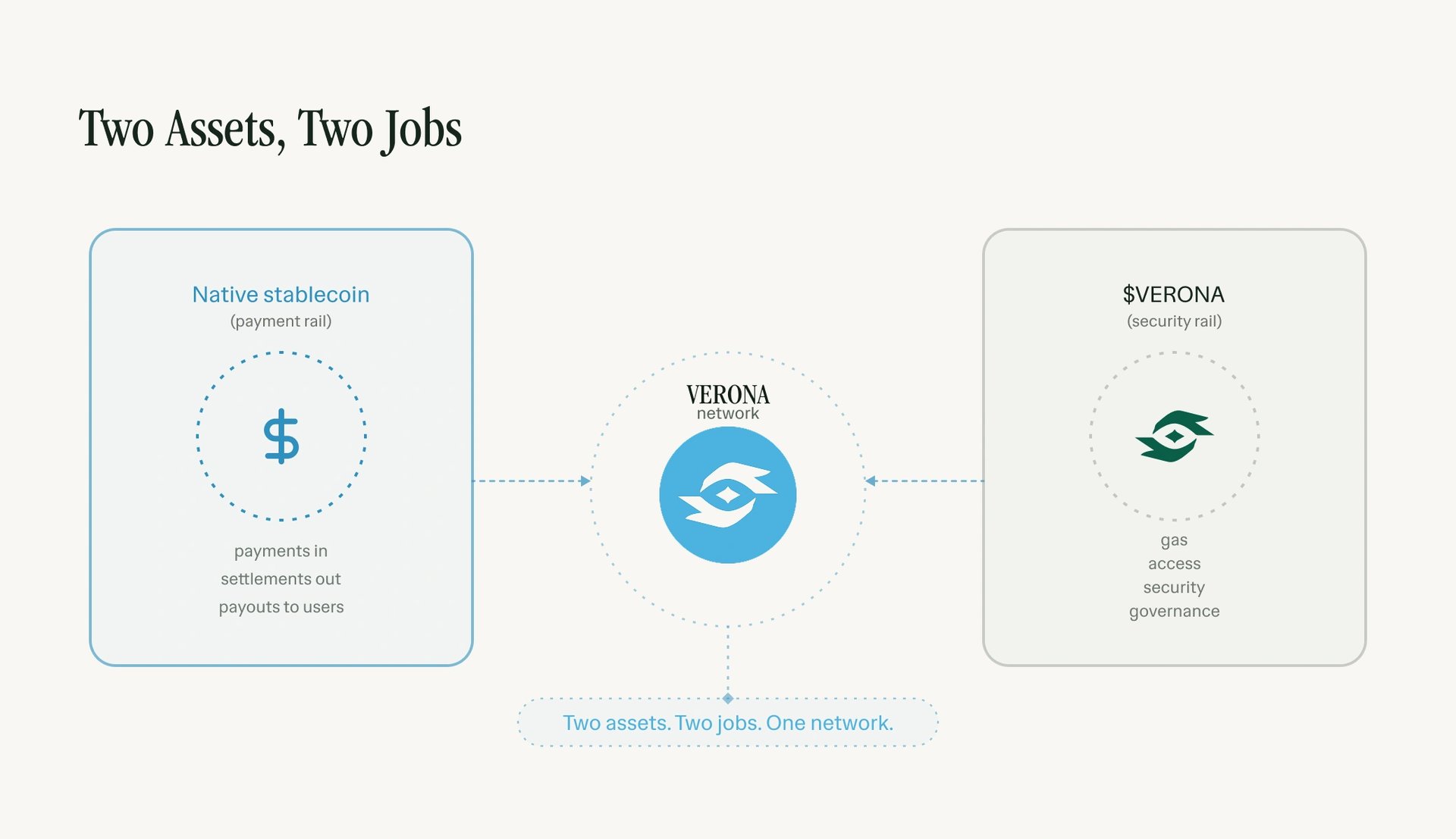
Verona separates its payment and network functions into two layers. A fully reserved digital-dollar settlement asset is intended to serve as the unit of account for users, agents, applications, and enterprises, with payments and commercial settlements conducted in stable terms.
$VERONA functions as the network’s native asset and is used for gas fees, staking-based access, network security through bonding, and governance. Verona also intends to use network revenue to purchase and burn $VERONA, while stable assets are used to settle verified actions. [5]
Token Utilities
- Payments: Users, agents, applications, and enterprises can pay using fiat, Verona’s native stablecoin, or supported tokens without requiring $VERONA.
- User rewards: Payments for permitted use of user data are made in stable terms rather than liquid $VERONA.
- Network demand: $VERONA demand is intended to arise from network usage and operation rather than mandatory token purchases. [5]
Ecosystem and Partnerships
Verona reports adoption by more than 150 brands, and its social profile names Uber and Nike among the companies leveraging the network. [3] In September 2026 the company announced two partnerships that extend the network's capabilities. In September 2026 it said Atbash was bringing its security layer to agents on Verona. Verona also announced that Pulsar Money was bringing its AI companion and points program to Verona. [3]
See something wrong?

Official Website:
Social Profiles:
Founders: