0% read
Last updated:
Nosh
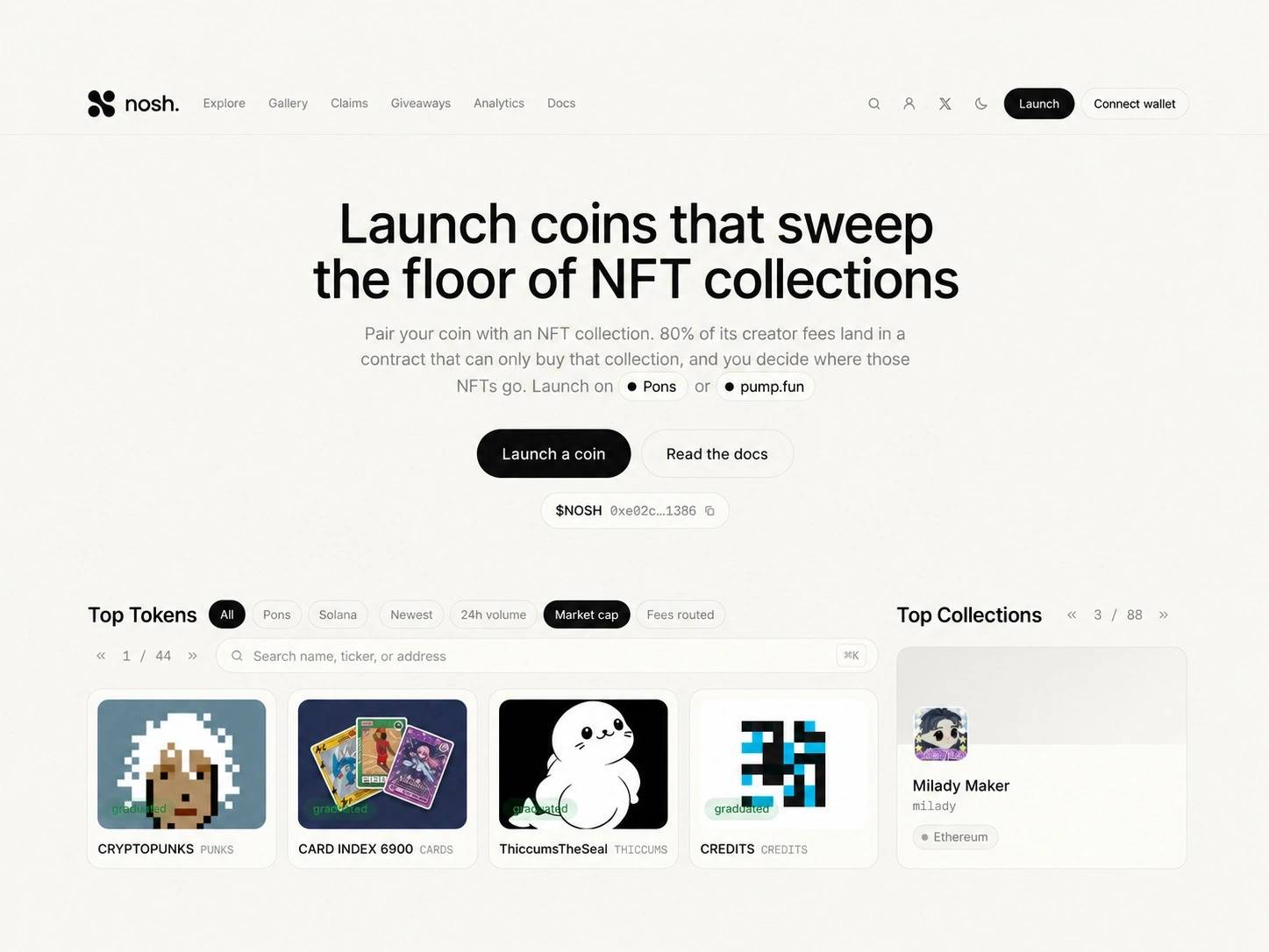
Nosh is a memecoin launchpad that pairs a newly launched token with an NFT (non-fungible token) collection and routes the majority of the token's trading fees into an on-chain contract that automatically buys, or "sweeps," the floor of that collection.[1] The platform operates on Robinhood Chain and uses the Pons V2 and Seaport 1.6 marketplaces to trade coins and acquire NFTs.[1] In September 2026, the team added 11 new NFT collections, including VeeFriends Iconics, Terraforms by Mathcastles, fuwa, and Original Blokyz, as pairing options on Pons based on community submissions.[3] Nosh has also reported working on infrastructure to expand support to additional chains such as Bitcoin Ordinals.[3][4]
Overview
Nosh connects two markets that usually operate separately: memecoin trading and NFT collecting. When a creator launches a coin through Nosh, they permanently pair it with an allow-listed NFT collection. As the coin trades, the fees it earns flow into a dedicated vault contract that can do only one thing — buy NFTs of the paired collection at floor price.[2] The intent is to turn a coin's trading activity into continuous buy pressure on a chosen NFT collection, with the purchased NFTs handed to the coin's own holders.
The design is built around constraints rather than trust. The platform states that "the vault cannot be talked into anything," meaning the vault has no owner-controlled withdrawal path and can release its ETH only inside a transaction that provably delivers an NFT under a posted price cap.[2] Pairing between a coin and its collection is fixed at launch and cannot be changed afterward, and the fee-distribution policy is likewise locked.[2] Nosh is launched on Pons, and the platform warns that "nothing here is financial advice" and that "contracts are unaudited until stated otherwise."[2][1]
The protocol token is $NOSH.[1] Nosh's on-chain system runs on Robinhood Chain and relies on Pons V2 and Seaport 1.6.[1]
Launch and Fee Routing
Each coin launched through Nosh begins with the Nosh Launcher, which deploys a small fee router for the coin and hands that router to Pons as the coin's creator-fee recipient. This assignment is permanent.[1] Coins first trade on the Pons bonding curve and later on a Uniswap v4 pool, and Pons credits creator fees into the router while they sit in escrow. According to the documentation, Pons credits "70% of the 1% curve fee, plus whatever creator tax you set" to the router.[1]
Creators can set a creator tax at launch of between 0 and 10 percent, capped by Pons, which sits on top of Pons's base creator share and flows into the router the same way. Buys made in the launch block pay Pons's decaying anti-snipe tax, which also lands in the router.[1] Every unit of value that reaches a router is split 80 percent to the paired collection's vault and 20 percent to the protocol treasury, a split hard-coded into the router bytecode. The router is implemented as an EIP-1167 minimal-proxy clone with no owner and no upgrade path; the documentation notes that "nothing goes to the coin's creator directly," and that a creator's "upside as a creator is the coin."[1]
Fees remain in Pons escrow until someone calls the harvest() function, which is permissionless and can be called by anyone. Harvesting claims the escrowed fees and forwards 80 percent to the collection's vault and 20 percent to the protocol treasury.[1][2] A coin can also be funded directly — anyone may pay ETH into a coin's fee escrow — but the documentation stresses that such paid-in money funds the vault without creating any entitlement to NFTs, because entitlement is determined by fees a coin actually earned on trades rather than by money paid in.[1]
Vaults and Sweeping
Every check must pass in the same transaction or the sweep reverts. Only token ids that the caller listed as candidates may arrive in a sweep — if any other token id is delivered, the sweep reverts — and the vault's NFT balance must increase by at least the number of NFTs promised in the sweep call.[1] The floor cap that bounds each purchase is posted by a keeper from live floor data and expires after one hour, a cap time-to-live enforced on-chain.[1][2] The documentation states that a vault cannot be drained even by someone holding a key, because ETH leaves only inside a sweep that demonstrably brings NFTs in under the cap, and NFTs leave only through a claimed raffle.[1]
Because a vault is shared across coins paired to the same collection, a single NFT can be paid for by more than one coin. To prevent the mixing of "burn-money" and "raffle-money," a purchase is only executed when every coin it would be charged to wants the same outcome, so an NFT is never burned when another coin's holders part-funded it expecting a draw.[1]
Keeper and Governance
The keeper is an operator key with tightly bounded discretion. It can post floor caps subject to the one-hour time-to-live, feed listings into sweeps, and open raffles with a holder snapshot. It cannot move ETH out of a vault, cannot pick or re-roll a raffle winner, and cannot block a raffle from settling, since anyone can request the draw and anyone can deliver the result.[1] The keeper's remaining discretion is which NFTs to buy and at what price within the floor cap, and which holder snapshot to publish; every input it posts is on-chain and can be checked after the fact.[1]
The owner role can pause sweeps for a collection or rotate the keeper, but cannot withdraw vault ETH. ExternalSweepVaults are the sole exception, since their ETH can leave through the time-locked, publicly announced withdrawal — which is why they carry the audit key.[1] Collections are added by the registry owner, and once a collection is listed it becomes available for any coin to pair with.[1]
See something wrong?