0% read
Last updated:
EF Mandate
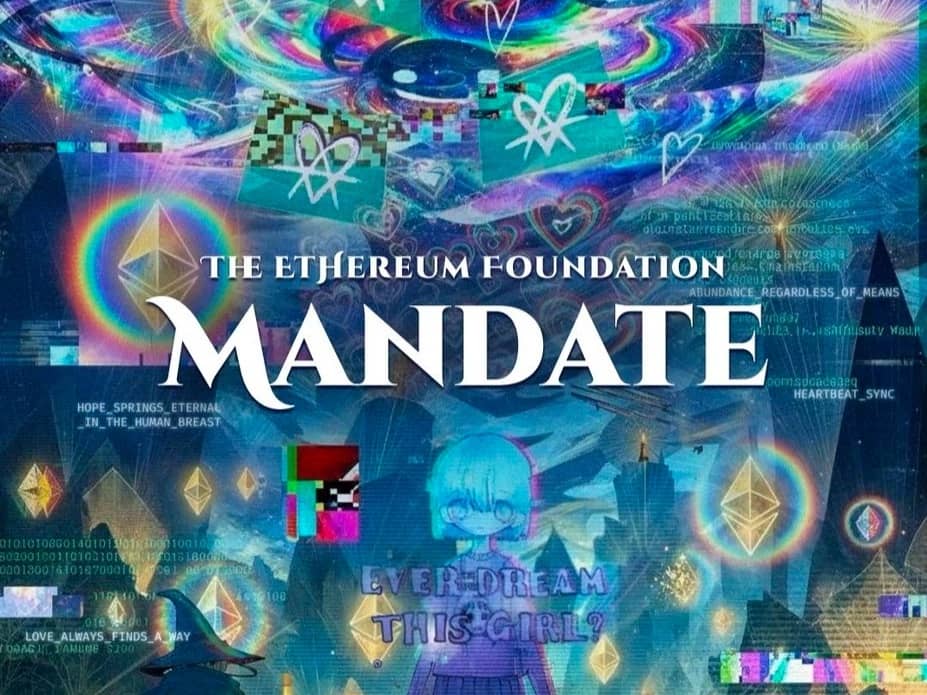
The EF Mandate is a foundational document published by the Ethereum Foundation (EF) on March 13, 2026. [1] [2] Described as a combination of a constitution, a manifesto, and a guide, the 38-page document articulates the core principles, philosophy, and responsibilities of the Ethereum Foundation. [1] [3] Its primary purpose is to clarify the EF's role as a steward within the Ethereum ecosystem and to formally codify the values that guide its decisions, with the central goal of protecting and preserving user self-sovereignty. [4] [2]
Overview
The EF Mandate serves as a guiding "north star" for the Ethereum Foundation's actions and a public declaration of its commitment to Ethereum's long-term health, decentralization, and resilience. [1] The document was authored by the EF Board and was initially created for internal members before the decision was made to release it publicly. [4] The foundation cited the maturation of the Ethereum ecosystem as a key reason for the publication, stating that as a system matures, its implicit culture and values must be made explicit and "legible in text." [2]
The release was also framed as a response to a changing global context, including intensifying political conflict, the proliferation of opaque, unaccountable systems managing daily life, and the rise of pervasive AI-mediated environments. [2] [4] The EF Board noted the document was published simply because "it is time," highlighting a sense of urgency in reinforcing Ethereum's core values. A significant aspect of its release was its publication on-chain, making the Mandate a permanent and immutably available artifact on the Ethereum blockchain, described as the "World Computer." [4] [2]
History and Context
The publication of the EF Mandate on March 13, 2026, followed a period of significant internal transition and evolution for the Ethereum Foundation. [3] During the summer of 2025, the organization underwent leadership restructuring and saw several high-level executive departures, suggesting the Mandate was created in part to re-establish a clear and public vision following this period of internal flux. [1]
A key principle enshrined in the Mandate, the "Walkaway Test," was first publicly introduced by Ethereum co-founder Vitalik Buterin on January 12, 2026. [1] This concept, which posits that Ethereum should be robust enough to thrive even if the EF disappeared, became a central tenet of the foundation's philosophy formalized in the Mandate. Upon its release, Buterin commented that the document largely "formalizes the approach the organization had already been taking" for years and that its contents "would not be a surprise to the community," but emphasized that the formal clarification was an important step for the ecosystem. [5]
Core Principles and Philosophy
The EF Mandate codifies a set of principles that define Ethereum's purpose and guide the foundation's stewardship. The central theme woven throughout the document is the preservation and expansion of user self-sovereignty. [3]
The Two Promises of Ethereum
The Mandate articulates Ethereum's core value proposition through two fundamental promises to humanity:
- The World Computer: To provide a common, trustless, permissionless, and persistent computational substrate for humanity. It is described elsewhere as "decentralized infrastructure for permissionless compute, communication, and association." [1] [3]
- Self-Sovereign Coordination: To enable large-scale human coordination that is free from coercion, capture, domination, or manipulation. [1] [5]
CROPS: The Non-Negotiable Properties
A cornerstone of the Mandate is the introduction of "CROPS," an acronym for four indivisible and non-negotiable properties that must serve as the baseline for all EF decisions concerning Ethereum. The document states that these properties must never be traded away for short-term growth or convenience. [1] [2]
The CROPS properties are:
- Censorship-resistant: Ensuring the network can resist attempts to block or censor valid transactions and user interactions.
- Open-source: Guaranteeing that the protocol remains open, permissionless, and free (as in freedom) for anyone to use, inspect, and build upon. Some interpretations combine this with resistance to capture.
- Private: Protecting user privacy as a fundamental right and a core aspect of the network's design.
- Secure: Maintaining the protocol's robustness and integrity to protect user assets and data against attacks.
In addition to these core properties, the Mandate also highlights user experience principles, stating that interactions should be Seamless and Extraction-Resistant, meaning they should be intuitive and designed to prevent value from being unfairly extracted from users. [2] The CROPS principles are considered the essential foundation for achieving the Mandate's ultimate goal: to "uncapture the individual" and preserve personal freedoms. [3]
The Philosophy of "Subtraction" and the Walkaway Test
The Mandate formally establishes a long-term philosophy of "subtraction," defining the Ethereum Foundation's ultimate success by its own diminishing relevance. The goal is to progressively "subtract" the EF from the ecosystem as Ethereum becomes more robust, decentralized, and self-sufficient. The document states that the foundation's success will be measured by "how unnecessary it becomes." [3]
This philosophy is embodied in the "Walkaway Test" (also referred to as the "Test of Project Abandonment"). The test is the EF's primary guiding principle, articulating a future state where the Ethereum protocol is so resilient and self-sustaining that it could continue to function, thrive, and evolve even if the Ethereum Foundation and its core contributors were to disappear entirely. This principle ensures the network does not become dependent on any single institution for its survival and long-term development. [1] [5]
The Role of the Ethereum Foundation
The EF Mandate provides a clear and deliberate definition of the Ethereum Foundation's role, explicitly limiting its powers to prevent overreach and reinforce the decentralized nature of the ecosystem. [2]
Stewardship, Not Ownership
The document firmly establishes the EF's role as that of a steward, not a ruler. It contains explicit clarifications that the EF is not Ethereum's "parent, ruler, or final authority." [2] [3] While acknowledging its history as Ethereum's "first steward" or "original steward," the Mandate recognizes that the foundation is now "one of many" organizations and participants supporting the network. This framing positions the EF as a fellow participant in the ecosystem rather than a governing body. [2] [5]
Minimal Sufficient Intervention
The Mandate formalizes a long-standing operational approach of "minimal sufficient intervention." This principle dictates that the EF should provide early-stage support to projects and initiatives—through grants, research, and other resources—with the goal that they eventually become independent and self-sustaining. The foundation aims to empower developers and projects without exercising direct or long-term control, systematically reducing its own influence over time. [5]
Focus on Foundational Tasks and "The Zero Option"
The EF's contemporary activities are defined as focusing on foundational tasks that other entities in the ecosystem are less likely to undertake. These areas include:
- Long-term core protocol research and development.
- Funding and supporting public-goods security initiatives.
- Coordinating efforts between different core development teams to foster a healthy protocol environment. [3]
In relation to this focus, Vitalik Buterin articulated that the EF would concentrate on developing "the zero option." This refers to building user experiences and tools that uncompromisingly prioritize the core CROPS principles of security, privacy, and user agency, leaving the development of applications focused on broader mass-adoption to the wider ecosystem. [1]
Key Concepts and Terminology
The Mandate and its surrounding commentary introduced and popularized several key terms and metaphors to describe Ethereum's purpose and the ecosystem's structure.
- Sanctuary Technology: A term used by Vitalik Buterin to conceptualize Ethereum's purpose. It describes the network as a "sovereignty-preserving technological refuge" designed to serve as a haven for preserving self-sovereignty and preventing any single entity from gaining total control over cyberspace. [1] [5]
- Infinite Garden: This metaphor is used to describe the broader, collaborative ecosystem in which Ethereum exists. It comprises the "open technologies, builders, and communities working to keep digital infrastructure resilient." [3]
- Machinery of Freedom: A phrase from the closing section of the EF Mandate that describes the long-term vision for the technology. The goal is to build "the machinery of freedom — not just for today, but for the next thousand years." [1]
Publication and Accessibility
The EF Mandate was published directly on the Ethereum blockchain, making it a permanent and censorship-resistant document that "live[s] on the World Computer." [2] [4] This method of publication ensures that the document is freely available for anyone to read, interpret, and "remix," encouraging a decentralized engagement with its principles.
While the Ethereum Foundation maintains a "canonical version" for its own internal guidance, it imposes no obligation on any other person or entity to adhere to this specific version. This approach encourages a living interpretation of the principles, with the hope that they will persist and evolve within the community long after the foundation itself is no longer active. [2]
See something wrong?