0% read
Last updated:
MOVA
MOVA is a public blockchain designed for payment and settlement applications, including cross-border transfers, consumer payments, and business transactions. Its architecture combines DAG-based consensus, parallel transaction processing, modular smart contract environments, and integrations with traditional financial infrastructure. [3]
Overview
MOVA is a public blockchain designed for payment and settlement applications, including cross-border transfers, consumer payments, and business-to-business transactions. Its architecture combines parallel transaction execution, asynchronous directed acyclic graph (DAG) consensus, and a modular smart contract environment. The network is structured around separate layers for consensus, security, execution, settlement, and contract services, with different node roles supporting payment processing, exchanges, and clearing operations. It also incorporates asset issuance, multi-currency and stablecoin settlement, gateway integration, and KYC mechanisms to support connections with existing financial systems.
MOVA is designed to integrate with traditional financial infrastructure rather than replace it, providing developers and financial institutions with SDKs, standardized APIs, and modular services for building payment applications. Its stated technical objectives include high transaction throughput, sub-second confirmations, verifiable state consistency, transaction traceability, and layered encryption. The network also emphasizes regulatory compatibility and enterprise integration through its gateway design and role-based node structure. [1] [2]
Architecture
System
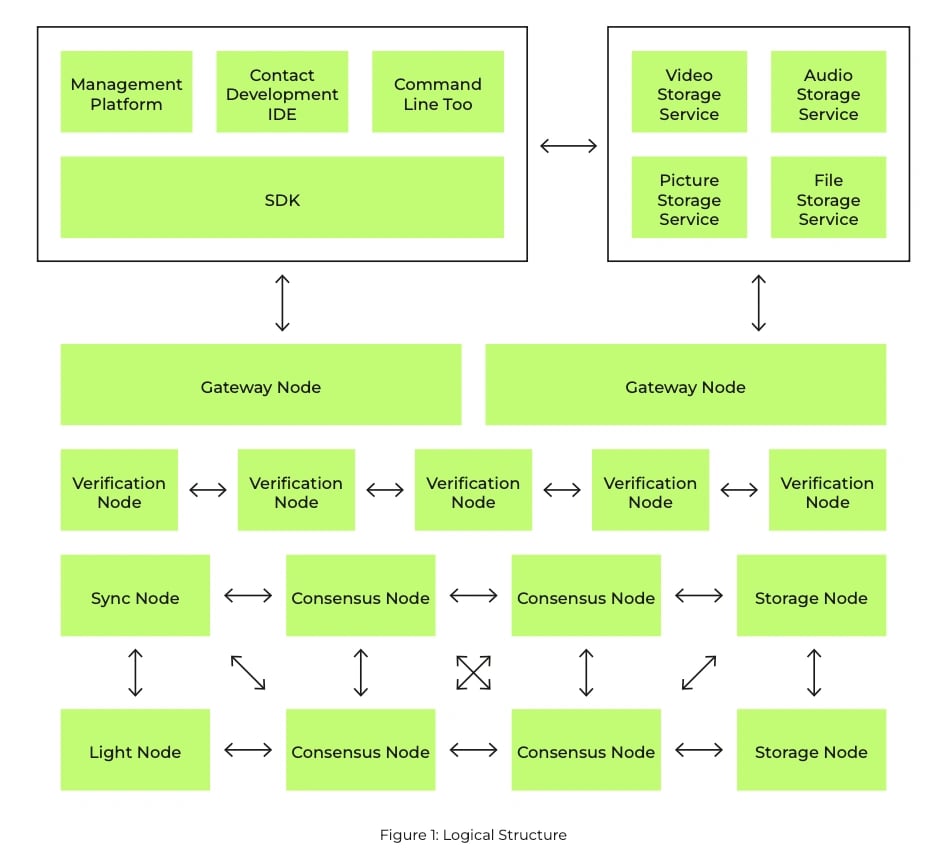
MOVA’s system architecture consists of modular components that manage the on-chain transaction lifecycle, including transaction access, validation, consensus, block generation, ledger storage, and data synchronization. Its development tools include a management platform for administering chains and monitoring nodes, a smart contract IDE supporting EVM and WASM, command-line tools for configuration and deployment, and multi-language SDKs for interacting with contracts through RPC interfaces. The network uses several specialized node types: gateway nodes connect off-chain services to on-chain protocols and collect and pre-execute transactions; verification nodes check signatures and validate state commitments; consensus nodes order transactions and participate in consensus; sync nodes maintain full ledger copies without voting; and light nodes verify ledger state using block headers and VerkleTree data. Storage nodes and related APIs provide distributed storage for files associated with transactions, such as invoices and payment records.
MOVA uses an event-driven, DAG-based processing model to support concurrent transaction handling. Transactions enter through client RPC requests or peer-to-peer broadcasts, undergo preliminary signature checks, and proposal nodes select and simulate them in batches before submitting them as events to consensus nodes. These nodes broadcast events across the network and apply a witness algorithm to determine confirmation: an event is finalized when events in a subsequent round strongly observe an absolute majority of witness events from the preceding round. The DAG is then processed asynchronously to generate transaction blocks, which are verified in parallel and written to the global state database and historical ledger. [5]
Core
MOVA’s core architecture is based on a proprietary directed acyclic graph (DAG) system with modular components for transaction execution, consensus, validation, and scheduling. It uses parallel execution, asynchronous event processing, and in-memory caching to improve transaction throughput and reduce processing delays. The platform states that its architecture can reach peak throughput of 100,000 transactions per second on a single chain. Individual modules can be configured or replaced according to application requirements, with support for synchronous and asynchronous communication, local and remote interfaces, and both WASM and EVM execution environments. A unified scheduling system coordinates transaction verification, DAG construction, read
- and write-set generation, ordering, and event processing.
The platform supports Ethereum asset standards, including ERC-20, ERC-721, ERC-1155, and ERC-998, alongside native multi-asset functions such as asset registration, cross-chain mapping, compliance restrictions, batch transfers, and atomic swaps. It also provides development and operational tools, including a visual management console, command-line interface, multi-language SDKs, online contract IDE, and node monitoring. For payment records and compliance documents, MOVA incorporates content-addressed distributed storage with encrypted file sharding, redundancy, storage proofs, and IPFS integration. Its payment-proof NFT module is designed to link transaction records to documents such as invoices and supply-chain records. [4]
Features
Node Roles
MOVA uses a multi-role node architecture in which network responsibilities are distributed across specialized node categories. Gateway nodes connect wallets, point-of-sale systems, and enterprise services to the blockchain by converting off-chain requests into on-chain transactions. Verification nodes pre-process transactions, validate signatures, execute contracts, and generate read and write sets, while consensus nodes vote on events and maintain ledger ordering. Sync or witness nodes store full ledger copies, replay transactions, and support synchronization, whereas light nodes retain account-related data and provide local transaction verification for wallets and mobile or POS devices. Storage nodes maintain KYC records, invoices, payment proofs, and contracts through fragmented, encrypted storage.
MOVA outlines different node configurations for various participants: small and medium-sized businesses may use gateway and verification nodes; clearing institutions may operate consensus and storage nodes; wallet developers can access the network through light nodes or SDKs; and cross-border payment providers may use sync nodes distributed across multiple regions. The proposed governance and incentive mechanisms include consensus-node staking, block rewards, transaction-fee sharing, reputation-based slashing, and regulator-approved whitelisting. These mechanisms are presented as potential future features, not established components of the network. [6]
Smart Contracts
MOVA’s smart contract system supports payment and settlement applications through three execution environments: EVM for Solidity-compatible contracts, WASM for contracts developed in multiple programming languages, and ChainTable, which provides SQL-style on-chain execution for developers familiar with traditional databases. Contract processing includes parameter validation, execution environment selection, contract execution, state updates, and middleware handling of events, assets, and permissions. The network also includes system contracts for chain configuration, queries, governance voting, and multisignature operations, along with SDKs that support contract deployment, data access, context queries, cross-contract calls, and role identification. The standard development process involves building, testing, compiling, uploading contract ABI and bytecode, deploying, and monitoring contracts, with optional compliance auditing. MOVA also outlines a planned contract marketplace containing templates for automated settlement, reversible payments, scheduled triggers, invoice NFT registration, and multisignature custody. [8]
DAG-Based Consensus
MOVA’s HashCube is a proprietary, DAG-based consensus architecture designed to support concurrent transaction ordering, parallel execution, and deterministic finality without mining or sharding. It consists of two interconnected layers: a transaction ordering network, which assigns sequence positions and propagates transaction metadata, and an execution network, which validates transactions, processes state changes, and records the ledger. Before execution, each transaction receives a deterministic pre-ordering identifier containing a globally unique sequence number, a nanosecond-precision timestamp, a transaction digest, and the publisher’s address and signature. Transactions are represented as nodes in a directed acyclic graph, with sequence information and references establishing their ordering relationships. The ordering network distributes transaction digests and metadata, not full transaction data, allowing nodes to independently calculate the same global transaction order. MOVA reports that this component can process ordering at a throughput of up to millions of transactions per second under stress-testing conditions.
The execution network retrieves full transaction data in sequence-based batches and processes transactions that have no dependencies in parallel. It generates and validates read and write sets before applying deterministic updates to the state database, with multiple verification nodes providing additional validity checks. Its infrastructure separates global relay nodes, which distribute transaction data and consensus information, from execution and ledger nodes, which process transactions and maintain regional ledger copies. For transaction integrity and finality, multiple execution nodes independently verify transactions, compare transaction hashes, and provide execution proofs that can be accessed by monitoring systems, wallets, and block explorers. Nodes that repeatedly fail to participate in voting, submit incorrect results, or demonstrate abnormal behaviour may be flagged, excluded from network propagation, or removed from the validator set, with staking penalties applied. [11]
P2P Network
MOVA’s peer-to-peer (P2P) network is built on a modified libp2p framework designed to support transaction broadcasting and synchronization across a distributed network. Nodes discover and connect to one another through seed nodes or a HyperCube architecture, which manages routing and message distribution. Each chain instance maintains an independent routing table to isolate communications between different sidechains, while different physical node types can operate across separate machines within a shared network environment. The architecture uses Protocol Buffers (ProtoBuf) for message serialization and supports multiple communication protocols over the same connection. Its security and transmission features include TLS encryption, node identity verification, protocol negotiation, prioritized message queues, forwarding retries, and frame-based transmission of larger messages. It also supports JSON, ProtoBuf, and CBOR serialization formats for compatibility across different development environments.
The network is designed to support large-scale node participation, with the documentation describing capacity for tens of thousands of concurrently connected nodes and a theoretical capacity of millions. For payment applications, MOVA reports message propagation latency below 200 milliseconds between global backbone nodes, alongside automatic reconnection and network recovery when nodes go offline. Its routing system also supports bandwidth prioritization for high-priority messages and configurable broadcast groups based on regional compliance requirements. [7]
Tokenomics
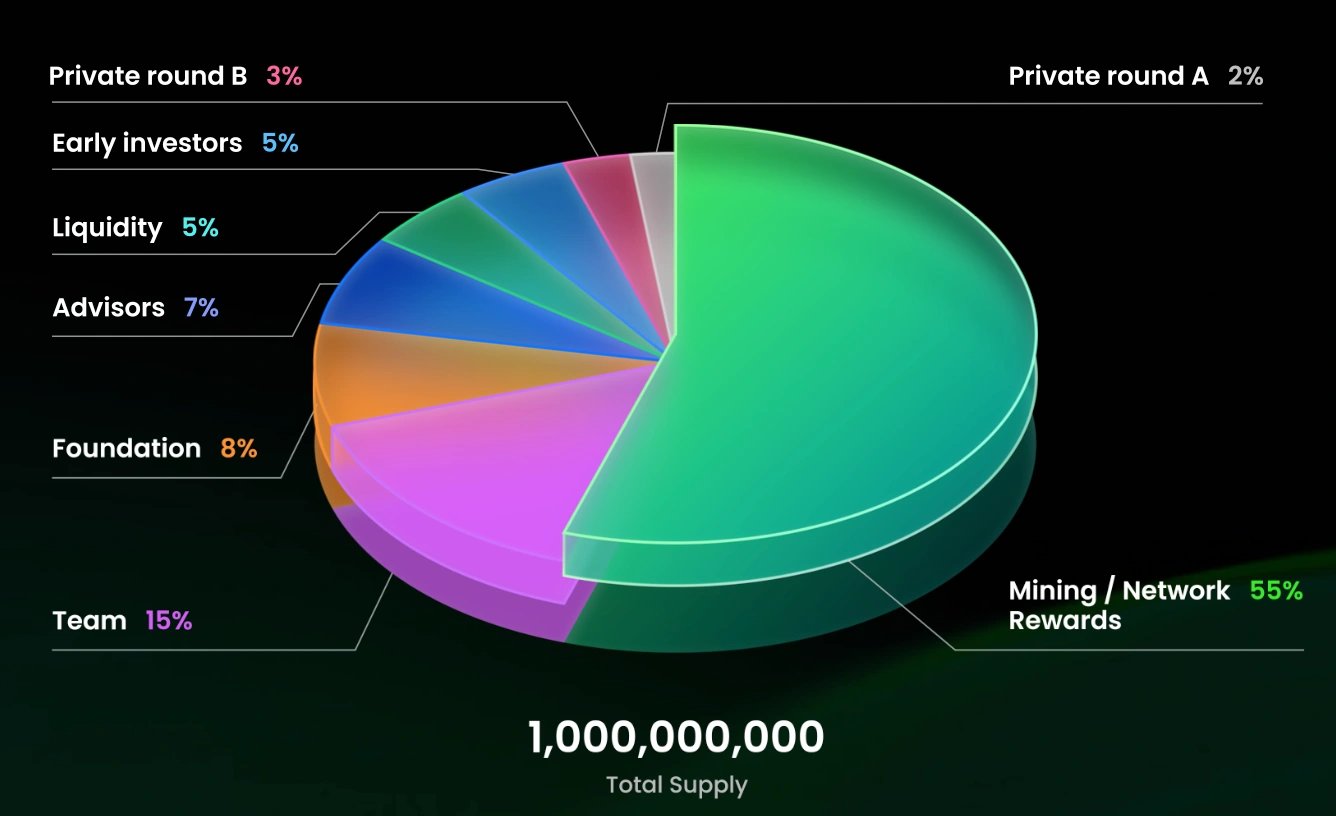
MOVA has a total supply of 1B tokens and has the following allocation: [10]
- Mining/Network Rewards: 55%
- Team: 15%
- Foundation: 8%
- Advisors: 7%
- Liquidity: 5%
- Early Investors: 5%
- Private Round B: 3%
- Private Round A: 2%
Partnerships
- Nexus Protocol
- Echo
- Obelisk
- Vortex
- Tesseract
- Synapse Network
- Meridian Finance
- Lexicon
See something wrong?
Official Website:
Social Profiles: