0% read
Last updated:
Trustless Manifesto
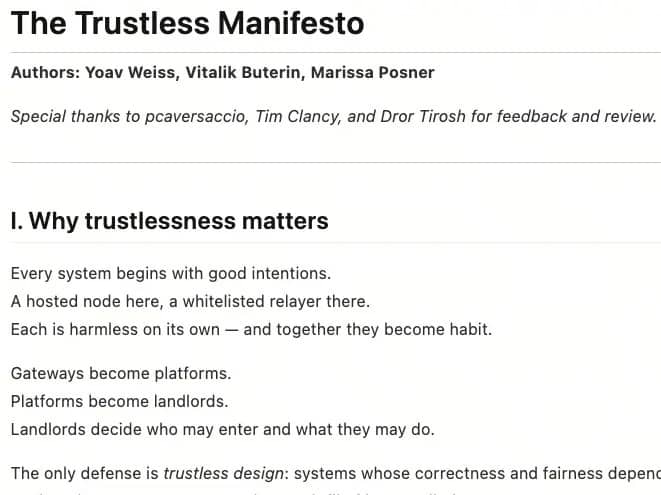
The Trustless Manifesto is a foundational document published on November 11, 2025, that serves as a philosophical and practical guide for developers and users in the blockchain ecosystem. [1] Co-authored by prominent Ethereum figures Vitalik Buterin, Yoav Weiss, and Marissa Posner, the manifesto re-establishes "trustlessness" as the essential, non-negotiable principle of decentralized systems like Ethereum. [2] It warns against the gradual erosion of decentralization through convenience, outlines principles for building self-sovereign systems, and includes an on-chain pledge for supporters to publicly affirm their commitment to its ideals. [1]
Overview
The Trustless Manifesto was introduced to the broader community through social media posts by co-author Vitalik Buterin on November 13, 2025, two days after its official publication on the trustlessness.eth.limo domain. [3] The document's primary argument is that trustlessness should not be treated as an optional feature to be added later, but as the fundamental purpose of blockchain technology. It posits that without a trustless core, other benefits like efficiency, scalability, and user experience are merely "decoration on a fragile core." [3]
The manifesto defines a trustless system as one whose correctness and fairness depend solely on mathematics and consensus, not on the goodwill of intermediaries. It critiques the prevailing trend in the crypto industry, which it terms "the drift toward dependence on trust," where seemingly harmless shortcuts for convenience collectively lead to systemic centralization. [4] To counteract this, the manifesto provides a clear framework, including six requirements for a trustless system and three "laws" for protocol designers. A key component of the project is an interactive pledge, which allows individuals to sign the manifesto by sending a transaction to an Ethereum smart contract, creating a permanent, on-chain record of their support. [1]
Background and Motivation
The manifesto was published at a time when some commentators believed the cryptocurrency industry was losing its original identity. [4] Analysts noted a shift away from the cypherpunk ethos of decentralization and disintermediation towards a "hyperfinancialized" and "greed-driven state" that prioritized short-term profit and "maximal extraction." This culture encouraged developers to cut corners on decentralization in favor of speed and user convenience, leading to a system that began to resemble the trusted, intermediary-based structures that blockchain was designed to replace. [4]
The authors argued that this trend was a dangerous deviation from the original purpose of blockchain. As stated in one analysis, the manifesto reinforces the idea that:
"Ethereum was not created to make finance efficient, but was made so people could coordinate without trust in intermediaries." [2]
The manifesto directly addresses this by stating that "decentralization erodes not through capture, but through convenience." [1] It was positioned as a "wake-up call" for the community to recommit to the more difficult but essential work of building and supporting genuinely trust-minimized infrastructure. Real-world events, such as a major AWS outage that disrupted several blockchain projects, were cited as practical examples of the risks of depending on centralized infrastructure, underscoring the manifesto's timely relevance. [5]
Core Principles and Definitions
The manifesto is structured around a precise set of definitions, requirements, and laws designed to guide the development of trustless systems.
Definition of Trustlessness
The document provides a clear and actionable definition of trustlessness, stating that a system is trustless when "any honest participant can join, verify, and act without permission and without fear." [1] This is contrasted with systems that depend on intermediaries, which the manifesto warns will inevitably gain control. It describes a "slippery slope" for such systems:
"every system that depends on intermediaries becomes the intermediaries... gateways become platforms, platforms become landlords." [3]
This principle is presented as the foundational element of Web3, with the manifesto arguing that "the only defense is trustless design." It emphasizes that trustlessness is not merely a desirable feature but the core value proposition of the technology. [3] A central quote from the document encapsulates this idea:
"Trustlessness is not a feature to add after the fact. It is the thing itself." [1]
Six Requirements for a Trustless System
To achieve this ideal, the manifesto outlines six specific criteria that a system must meet to be considered trustless:
- Self-sovereignty: Users must authorize their own actions directly. No other entity can act on a user's behalf without their explicit consent.
- Verifiability: Any participant must be able to independently confirm the system's state using only publicly available data.
- Censorship resistance: Any valid action must be capable of being included in the system within a reasonable timeframe and at a reasonable cost.
- Walkaway test: If any operator disappears or acts maliciously, another operator must be able to replace them without requiring permission from a central authority.
- Accessibility: Participation in the system must be practically achievable for ordinary users, not just experts with significant capital or specialized hardware and skills.
- Transparency of incentives: The system's rules and reward mechanisms must be governed by the protocol itself and be publicly visible, not by private agreements or opaque off-chain processes.
These six requirements provide a comprehensive framework for evaluating the decentralization and resilience of any blockchain-based system. [1]
Three Laws of Trustless Design
To help developers implement these requirements, the manifesto proposes three "harsh" but necessary laws for protocol design:
- No critical secrets: No part of the protocol's operation should depend on private information held by a single actor (other than a user's own private keys).
- No indispensable intermediaries: Any critical participant in the network, such as a sequencer or relayer, must be replaceable by any other willing participant who follows the protocol's rules. The manifesto criticizes systems where running such infrastructure is "theoretically" possible but practically infeasible for most.
- No unverifiable outcomes: Every change to the system's state must be fully reproducible and verifiable from public data, leaving no room for outcomes that must be trusted on faith.
These laws are intended to eliminate single points of failure and control at the protocol level. [1]
The "Drift Toward Dependence"
A central thesis of the manifesto is its critique of the current state of the crypto ecosystem, which it describes as "the drift toward dependence on trust." [1] This concept refers to the gradual accumulation of centralized shortcuts, each seemingly harmless on its own but collectively undermining the system's decentralized foundation. The manifesto outlines an inevitable progression:
"A hosted node here, a whitelisted relayer there. Each is harmless on its own — and together they become habit. Gateways become platforms. Platforms become landlords. Landlords decide who may enter and what they may do." [4]
The authors assert that this drift is not a future-tense problem but is "already here." They provide several concrete examples of this trend: [4]
- Centralized Infrastructure: The vast majority of decentralized applications (dApps) rely on hosted Remote Procedure Call (RPC) providers, which in turn run on centralized cloud services like AWS, GCP, and Cloudflare. This creates a systemic vulnerability where an outage at one of these providers could disable a large portion of the ecosystem. [4]
- Centralized Rollup Sequencers: Many Layer 2 scaling solutions, which are critical for Ethereum's scalability, have launched with a single, centralized sequencer responsible for ordering transactions. This creates a single point of failure and a potential chokepoint for censorship or manipulation. Projects such as Optimism and Arbitrum were noted for this initial design choice, which exposes the networks to risks like transaction censorship and artificially high fees. [5]
- Delegated "Self-Custody": The practice of users storing their assets on Centralized Exchanges (CEXes) is identified as being antithetical to the principle of self-custody. [4]
- Centralized Interoperability: Many cross-chain bridge and interoperability solutions have reintroduced trusted intermediaries in the form of "solvers" or "relayers." These entities act as gatekeepers that control the execution of cross-chain transactions, recreating the centralized model that blockchain was meant to overcome. [4]
- Persistent Upgrade Keys: The continued use of administrative keys to upgrade smart contracts, often justified as temporary "training wheels," is criticized as an excuse to indefinitely delay full decentralization and maintain centralized control. [4]
To illustrate the long-term danger of this trend, the manifesto presents an analogy to the history of email. While the email protocol itself remains open and decentralized, the practical ability for an ordinary user to run their own email server has been almost completely eliminated by centralized chokepoints like spam filters and corporate reputation systems. The manifesto warns that Ethereum's access layer could suffer the same fate if the drift toward convenience continues unchecked. [1]
On-Chain Pledge
A unique and actionable component of the Trustless Manifesto is its on-chain pledge. The document includes a call to action for supporters to "sign" it by interacting with a specific Ethereum smart contract. This action records the signer's Ethereum address in a permanent, immutable, and public list on the blockchain. [1]
The purpose of this mechanism is to allow individuals to make a public and verifiable commitment to upholding the manifesto's principles in their own work and participation within the ecosystem. The smart contract for the pledge is located on the Ethereum Mainnet at the address 0x32aa964746ba2be65c71fe4a5cb3c4a023ca3e20. [1] Upon its release, co-author Vitalik Buterin announced on the social media platform X that he had signed the manifesto, encouraging others to do the same. [3]
Authors and Key Figures
The manifesto was authored and supported by several influential figures within the Ethereum ecosystem.
Authors
- Vitalik Buterin: As a co-founder of Ethereum, Buterin's co-authorship lent significant weight and visibility to the manifesto, signaling its importance to Ethereum's core development philosophy. [4]
- Yoav Weiss: A security researcher at the Ethereum Foundation, Weiss is widely known for his leading role in the development of Account Abstraction (ERC-4337). His involvement underscores the manifesto's relevance to the technical challenges of decentralizing critical network infrastructure like bundlers and relayers. [1]
- Marissa Posner: A researcher at the Ethereum Foundation and co-author of the manifesto. [2]
Contributors and Supporters
The manifesto's website also credits several individuals for providing feedback and review during its creation: Dror Tirosh, Tim Clancy, and pcaversaccio. [1] In his social media announcement, Vitalik Buterin also tagged Ethereum researcher Justin Drake, suggesting his support for or involvement with the initiative. [3]
Reception and Impact
The publication of the Trustless Manifesto was widely covered by crypto-native media outlets, including Cryptorank, The Defiant, and OneSafe. [2] [5] [4] The media coverage framed the document as a major call to action for the Ethereum community to recommit to its foundational principles. Because the authors are key personnel at the Ethereum Foundation, the manifesto was interpreted by some as part of the Foundation's official push for greater decentralization across the network. [2]
The document sparked significant debate within the community on the topic of "how trustless crypto really is," highlighting the considerable gap between the ecosystem's stated ideals and its current, more centralized reality. [4] However, analysis also pointed to the practical challenges of adhering to the manifesto's strict principles. The high cost and effort required to build truly trustless systems, both for development teams and for end-users, were identified as significant barriers. In a market that often prioritizes speed and profit, these additional costs can incentivize the very centralized shortcuts the manifesto warns against. The manifesto confronts this trade-off directly, arguing that the costs of building trustless systems are non-negotiable for the long-term health and purpose of the ecosystem. [4]
See something wrong?