0% read
Last updated:
Alex Odagiu
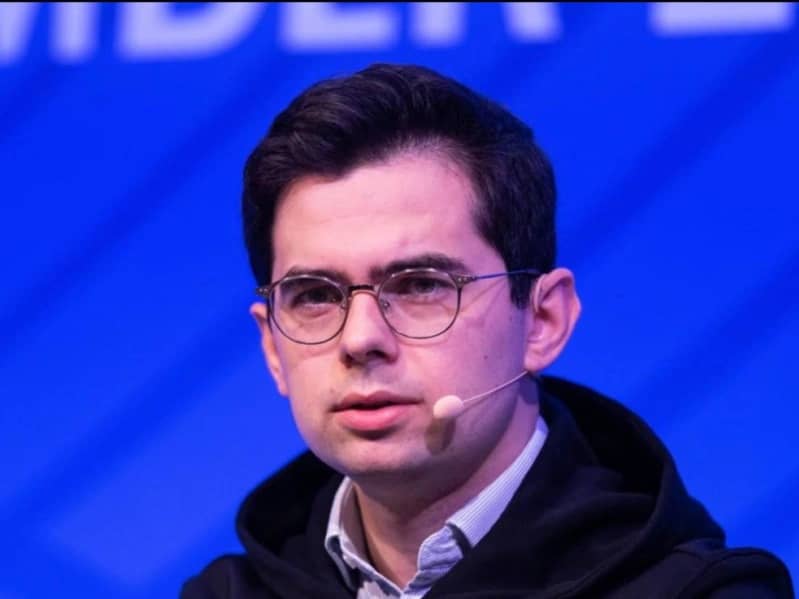
Alex Odagiu is the chief executive officer of BNB Standard Corporation in October 2026. He previously worked in investment banking and venture investing, including at Goldman Sachs and YZi Labs, and joined BNB Standard’s board in June 2026.[1][2]
Education and Career
Odagiu studied Economics and Mathematics at the University of St Andrews from 2010 to 2014, earning an M.A. (Hons).[1][2]
He began his career in Goldman Sachs’ Investment Banking Division in London. His professional profile lists him as an analyst from January 2013 to January 2016 and an associate from January 2016 to January 2018; BNB Standard’s leadership biography identifies Goldman Sachs International as his first employer.[1][2]
From January 2019 to January 2021, Odagiu worked as an investor at L1 in London, identified in BNB Standard’s biography as Letterone Technology.[1][2]
Odagiu joined Binance Labs, later renamed YZi Labs, in September 2021. His professional profile dates his Investment Director tenure from September 2021 to September 2025, while YZi Labs’ leadership biography gives January 2022 as the start of that role. He then served as an Investment Partner from September 2025 to October 2026.[1][2]
At YZi Labs, Odagiu identified and evaluated investments, conducted due diligence, structured deals, and advised portfolio companies on scaling, fundraising, and operations. He also helped lead token, equity, and strategic investments and worked with founders across the BNB Chain ecosystem, including through the Most Valuable Builder accelerator program. YZi Labs invests in ventures across web3, artificial intelligence, and biotechnology.[2][3][1]
BNB Standard
Investment Banking
Alex Odagiu worked at Goldman Sachs in London, United Kingdom, from 2013 to 2018. During this period, he held positions in the Investment Banking Division, first as an Analyst from 2013 to 2016 and subsequently as an Associate from 2016 to 2018, which served as a foundation for his later work with cryptocurrencies.
Investment at L1
Between 2019 and 2021, Odagiu worked as an Investor at L1 in the London Area, United Kingdom.
Investment Director and Investment Partner at YZi Labs
In September 2021, Odagiu joined Binance Labs, subsequently renamed YZi Labs, as an Investment Director. He held the position until September 2025, when he was appointed Investment Partner.
As Investment Partner, his responsibilities included token, equity, and strategic investments. He remained in the position until October 2026, when he left the firm following his appointment as chief executive officer of BNB Standard Corporation.
Interim President and Board Director at CEA Industries
In June 2026, YZi Labs and CEA Industries, a Nasdaq-listed company, entered into a cooperation agreement. Following the agreement, Odagiu, Ella Ling Zhang, and Matthew Roszak joined CEA Industries' board of directors. Odagiu was appointed interim president.
During his tenure, Odagiu addressed corporate disclosure practices and compliance with U.S. Securities and Exchange Commission requirements in public posts and reposts concerning the company. He also circulated a letter to the board on behalf of stockholders and shared an opinion article discussing the development of digital-asset treasury companies.
In his role as interim president, Odagiu worked on a validator strategy for BNB Chain. The company's plan involved operating a validator through a specialist infrastructure provider selected through a competitive process and subject to corporate governance oversight. Under the proposed arrangement, treasury BNB would remain with qualified custodians during staking. Validator rewards were expected to depend on network activity and operational performance rather than constitute guaranteed returns. The company also outlined plans to publish validator information through its treasury dashboard following the validator's launch on mainnet.
Chief Executive Officer at BNB Standard Corporation
On October 19, 2026, CEA Industries' board appointed Odagiu chief executive officer and principal executive officer. He succeeded Brent Miller as principal executive officer, while Miller retained his position as chief financial officer. Odagiu also continued serving as a board director.
The appointment followed recommendations from the company's CEO Search Committee and Nominating & Governance Committee. Matthew Roszak chaired the search committee, while board chair Carly E. Howard confirmed that the board had unanimously approved its recommendation. Roszak referred to Odagiu's tenure as interim president when discussing the appointment.
In October 2026, CEA Industries changed its corporate name to BNB Standard Corporation. The company's business structure included a digital-asset treasury focused on BNB and participation in the BNB ecosystem, alongside operating units Fat Panda and Surna Cultivation Technologies.
Odagiu oversaw the rebranding process and the launch of the company's website and treasury dashboard in October 2026. On October 26, he attended the company's Nasdaq Opening Bell ceremony in Times Square, held in connection with the corporate rebranding and his appointment as CEO.
In outlining his priorities as CEO, Odagiu identified four areas of focus: increasing the amount of BNB held per share, establishing an operating business on BNB Chain through the planned validator, providing public updates on the company's progress, and introducing institutional investors to the BNB ecosystem. [1] [2] [3] [4]
Interviews
Crypto Market Developments #01
On December 5, 2025, Alex Odagiu of YZI Labs participated in an interview on the Global Blockchain Show YouTube channel, discussing developments in cryptocurrency markets, including trading infrastructure, stablecoins, digital asset treasury companies, structured financial products, and artificial intelligence.

Odagiu described the migration of trading activity from off-chain systems to on-chain platforms as one of the developments shaping the market cycle. He cited Hyperliquid and Aster as examples of platforms operating in decentralized trading markets. He also discussed the expansion of stablecoins, whose applications, in his assessment, extend beyond the settlement of trading profits and losses to include yield distribution. He noted that the introduction of additional stablecoins could lead to liquidity fragmentation and identified distribution networks as a factor influencing their adoption.
The interview also addressed digital asset treasury companies and structured financial products. Odagiu described the growth of treasury companies holding digital assets as an indication of increased interaction between traditional financial institutions and cryptocurrency markets. He discussed Ethena as an example of a protocol using strategies that combine long positions in staked Ethereum with short positions in perpetual futures contracts to generate returns from cryptocurrency market activity.
Regarding artificial intelligence, Odagiu identified data analysis, investment research, pattern recognition, and trading automation as areas where AI tools could be applied. He explained that these tools can assist with processing on-chain information and managing liquidity positions. However, he also pointed to limitations involving inaccurate outputs and hallucinations, emphasizing the need to verify AI-generated information. He further suggested that the broader availability of AI tools could reduce the competitive advantages initially obtained by market participants using them.
Odagiu also discussed projects he considered underrepresented in market discussions. Among them was Kanto Network, which he associated with institutional participants including Goldman Sachs, Citadel, Virtu, and DTCC. He also mentioned USDI, a project seeking to bring cash flows associated with GPU infrastructure onto blockchain networks, connecting financial applications with demand for computing resources in the artificial intelligence sector. [5]
Crypto Adoption and Financial Infrastructure #02
In an interview published on July 13, 2026, on the YouTube channel MAD Society TV, Alex Odagiu, an investment partner at YZi Labs, discussed developments in the cryptocurrency industry, institutional participation, regulatory frameworks, and the use of blockchain technology in financial services and gaming.

Odagiu described bear markets as periods in which investors and founders can concentrate on company development and identify projects with long-term prospects. He noted that some of the investment returns achieved by his firm had originated from investments made during market downturns. He also addressed security breaches affecting cryptocurrency projects, pointing to recurring exploits and the activities of state-sponsored groups and other malicious actors. According to Odagiu, these incidents highlight the need for stronger security practices and risk management.
On institutional adoption, Odagiu attributed the increased involvement of traditional financial institutions partly to regulatory developments in the United States. He contrasted the current environment with the attitudes prevalent in the banking sector around 2017 and 2018, when employees involved with cryptocurrency could face professional scrutiny. He observed that financial institutions now increasingly require strategies for digital assets and blockchain adoption, citing potential revenue sources, operational cost reductions, and the tokenization of real-world assets as factors influencing this change.
Odagiu also discussed the development of stablecoin applications. He explained that stablecoins initially served cryptocurrency trading activities, allowing users to retain funds in digital currencies without converting them into traditional fiat currencies. Their use subsequently expanded into decentralized finance products and payment services. He pointed to transactions in emerging markets, including those involving populations with limited access to banking services, as an area of application.
Addressing the relationship between artificial intelligence and blockchain, Odagiu discussed the use of programmable financial systems for automated transactions. He argued that traditional banking infrastructure presents limitations for agentic finance, particularly regarding divisibility, programmability, and continuous operation. In his assessment, blockchain networks can support financial processes that operate around the clock and execute transactions according to predefined instructions.
Odagiu stated that broader institutional participation would require cryptocurrency companies to develop applications with practical uses, maintain their operations over time, and adopt more professional business practices. He described the industry's tendency to abandon projects that fail to gain traction as a characteristic that may need to change as the sector develops.
Discussing the future of banking, Odagiu predicted that traditional banks would change their existing operating models and increasingly adopt stablecoins as part of their financial infrastructure. He suggested that banks could eventually operate much of their infrastructure through blockchain networks, with stablecoins serving as a denomination for their financial services.
The interview also covered GameFi and the metaverse. Odagiu described the previous market cycle's investment in these sectors as an example of projects driven primarily by financial incentives rather than gameplay. He noted that many of these projects lost users and experienced substantial declines in token values after the incentives that initially attracted participants diminished.
Regarding future applications, Odagiu discussed the possibility of using blockchain networks to support ownership and exchange of in-game assets, including digital items and collectibles. However, he maintained that the implementation of these systems would depend on the quality of the underlying games. In his view, players are primarily interested in gameplay, while asset ownership and the ability to trade or transfer digital items become relevant after users have established an interest in a particular game. [6]
See something wrong?