0% read
Last updated:
Huma Finance
Huma Finance is a blockchain-based financial protocol focused on payment financing and real-world asset (RWA) credit markets through on-chain infrastructure. The protocol provides permissionless and institutional versions of its platform, enabling users and financial institutions to access tokenized payment receivables, liquidity pools, and structured financing mechanisms. [1]
Overview
Huma Finance is a PayFi network that leverages blockchain infrastructure to finance real-world payment assets. The protocol connects capital providers with payment-related financial activities, including cross-border settlements, card payments, and payroll advances, using on-chain settlement mechanisms. Huma operates through two versions: a permissionless protocol launched in 2025 that allows broader participation in liquidity pools, and an institutional version designed for regulated financial entities seeking access to payment financing and real-world asset opportunities. The platform is built around integrating decentralized finance infrastructure with payment flows to provide access to yield-generating credit markets. Huma’s focus is on improving the efficiency of payment settlement and expanding access to financing through blockchain-based financial systems. [2] [7]
Features
Feathers
Huma Feathers are part of Huma Finance’s loyalty and reward system, tracking community participation and engagement within the protocol. The system uses Feathers as a measurement mechanism for allocating future HUMA rewards directly, while Feather balances are converted into tokens based on a Feather-to-HUMA tokens allocated and the token's seven-day average price. [8]
Modes
Huma Finance provides two participation modes for liquidity providers: Classic Mode and Maxi Mode, which differ in how returns are distributed between stable yield and protocol rewards. Classic Mode is designed for users seeking more predictable returns, offering a base annual percentage yield and a standard allocation of Huma Feathers via the PayFi Strategy Token (PST). Maxi Mode removes the base yield component and instead emphasizes higher Huma Feather rewards through the Maxi PayFi Strategy Token (mPST), targeting users seeking greater exposure to protocol incentives. Both modes use the same underlying liquidity pool structure, and users can switch between them at any time by paying the applicable blockchain transaction fees. The distinction between the two options primarily depends on whether users prioritize consistent yield or greater participation in Huma’s reward system. [5]
Huma Institutional
Huma Institutional is a permissioned version of the Huma Protocol designed for institutional participation in payment financing and real-world asset (RWA) markets. The protocol incorporates structured finance features, tokenization mechanisms, and on-chain transparency tools to represent and monitor real-world receivables through blockchain infrastructure. Its architecture uses modular components that allow financial structures to be configured for different use cases, including tranche policies, yield calculation methods, fee structures, and first-loss protection mechanisms. Tranche policies define how profits and losses are distributed between different investor groups, while yield managers determine how returns and fees are calculated across pools. The protocol also supports tokenized real-world assets through special purpose vehicle (SPV) structures and allows multiple layers of first-loss coverage to be configured for risk management. [3]
Defensive Looping
Defensive Looping is a leverage strategy designed to increase yields on yield-bearing assets while reducing some of the risks associated with traditional DeFi looping strategies. It combines recursive borrowing with mechanisms such as automated leverage adjustments based on yields and borrowing rates, primary-market redemption pathways, and reserve structures designed to absorb potential asset impairments. Traditional looping strategies can face risks such as negative carry when borrowing costs exceed asset yields, liquidation cascades driven by secondary-market price volatility, and losses from declines in collateral assets. Defensive Looping addresses these risks by introducing automated deleveraging when borrowing costs threaten to outweigh the yield generated, reducing reliance on secondary-market pricing through direct, issuer-based redemption mechanisms, and using isolated reserve layers to provide additional protection for assets backed by real-world cash flows.
The strategy is designed to improve capital efficiency for PayFi and real-world asset (RWA) markets by allowing liquidity providers to access leveraged returns while maintaining sustainable borrowing costs for underlying users. By separating lender returns from borrower rates through structured leverage mechanisms, Defensive Looping aims to support the broader adoption of yield-generating real-world assets on-chain. The approach focuses on creating a more controlled framework for leverage that incorporates risk-management features, making credit markets more suitable for institutional and large-scale financial applications. [4]
HUMA
HUMA is the native utility and governance token of the Huma ecosystem. Its primary functions include enabling protocol governance, supporting ecosystem incentives, and providing access to future protocol features. Token holders can stake HUMA to participate in governance decisions, with voting power influenced by staking duration. Governance areas include liquidity allocation, ecosystem incentive programs, protocol parameter adjustments, and distribution of protocol rewards. The token is also used to incentivize participation across the Huma ecosystem. Liquidity providers can receive HUMA rewards based on capital commitments, while ecosystem partners and community contributors may earn rewards based on contributions such as transaction activity, protocol growth, development, and community engagement. Future value accrual mechanisms are planned to explore how protocol revenue can support ecosystem development and align participant incentives. While Huma uses stablecoins for real-world transaction settlement, HUMA is intended to support additional protocol functions, including potential future features such as real-time redemption. [6]
Tokenomics
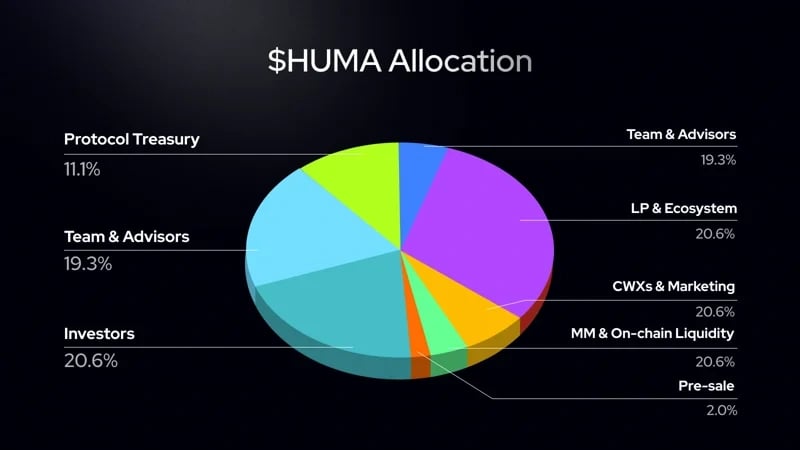
HUMA has a total supply of 10B and has the following allocation: [6]
- LP & Ecosystem: 20.6%
- CWXs & Marketing: 20.6%
- MM & Onchain Liquidity: 20.6%
- Investors: 20.6%
- Team & Advisors: 19.3%
- Protocol Treasury: 11.1%
- Pre-sale: 2%
Partnerships
- Distributed Global
- Hashkey Capital
- Folius Ventures
- ParaFi Capital
- Circle
- Robot Ventures
- Fenbushi Capital
- Anagram
- Hard Yaka
- Stellar Development Foundation
- Turkiye Bankasi
- Race Capital
- 500 Emerging Europe
- Blockchain Founders Club
See something wrong?

Official Website:
Social Profiles:
Founders: