0% read
Last updated:
EVAA Protocol
EVAA Protocol is a decentralized lending and liquidity protocol built on the TON Blockchain that enables users to supply assets to generate yield and borrow through overcollateralized loans. The protocol uses features such as isolated lending pools and leveraged liquidity strategies to support lending, borrowing, and capital efficiency within the TON DeFi ecosystem. [1]
Overview
EVAA Protocol is a Telegram-native decentralized liquidity protocol built on the TON Blockchain that enables users to supply digital assets to liquidity pools and earn passive income or borrow assets through overcollateralized loans. The protocol operates through smart contracts that enable deposited assets to generate returns based on borrowing demand, while supplied assets can also serve as collateral for borrowing. EVAA is designed as an open-source platform, enabling developers to interact with its smart contracts and build additional applications or services on top of the protocol. User funds are held in smart contracts intended to be publicly verifiable, formally reviewed, and independently audited, with security measures such as bug bounty programs and external assessments. The protocol charges blockchain transaction fees and a borrowing origination fee, while providing users with flexible access to lending and borrowing services within the TON ecosystem. [2]
Features
Isolated Lending Pools
EVAA Protocol uses isolated lending pools to separate assets with different risk profiles, liquidity characteristics, and market demands into independent smart contract environments. This structure limits the impact of potential issues within a single pool, such as asset price declines or liquidity disruptions, by preventing risks from spreading across other pools in the protocol. Each isolated pool operates under its own rules for supported assets, borrowing limits, collateral requirements, and repayment conditions, allowing users to choose pools based on their preferred risk exposure. EVAA’s existing pools support different asset groups, including core TON ecosystem assets, liquidity provider positions, alternative tokens, and stablecoin-focused strategies. The protocol also enables third-party developers to create customized isolated pools using EVAA’s smart contracts, enabling new lending markets while ensuring that risks remain contained within each pool rather than affecting the broader ecosystem. [3]
Yield Strategies
Leveraged Liquidity Provision
EVAA’s leveraged liquidity-provision model is designed to improve capital efficiency within the TON ecosystem by enabling users to reuse on-chain assets through lending and borrowing strategies. The protocol introduces an LP Pool that accepts liquidity provider tokens from decentralized exchanges such as DeDust and Storm Trade as collateral, enabling users to borrow assets and reinvest them into liquidity positions to increase exposure and potential returns. By separating LP assets into an isolated pool, EVAA limits platform-specific risks while allowing users to participate in leveraged farming strategies without affecting other lending markets. Users can continue to receive liquidity provider rewards and trading fees from their underlying DEX positions while their LP tokens are supplied as collateral within EVAA. This approach creates a lending layer for TON-based liquidity markets, allowing users to increase liquidity utilization while maintaining risk separation through EVAA’s isolated pool architecture. [4]
Leveraged Liquid Staking
Leveraged liquid staking is a strategy that allows users to increase their staking exposure by using liquid staking tokens (LSTs) as collateral to borrow additional assets. Through liquid staking protocols, users receive LSTs that represent their staked assets while continuing to earn staking rewards and maintaining the ability to use those tokens across decentralized finance applications. By borrowing additional cryptocurrency against their LSTs and restaking the borrowed assets, users can amplify their staking positions and potentially increase returns. However, the strategy introduces additional risks, including market volatility, liquidation events, and potential deviations of LST prices from the underlying asset's value. Successful leveraged liquid staking requires careful risk management and consideration of borrowing conditions, collateral requirements, and market fluctuations. [5]
Hedged Liquidity Provision
Hedged liquidity provision is a DeFi strategy that combines liquidity pool participation with borrowing mechanisms to manage exposure to asset price volatility. On platforms such as DeDust and StonFi, users provide assets to automated market maker pools, such as TON/USDT, and earn transaction fees generated by trading activity. Through EVAA, users can borrow the opposing asset to create a more balanced liquidity position, allowing USDt holders to borrow TON or TON holders to borrow USDt while reducing directional exposure to either asset. This approach can improve capital efficiency by allowing users to maintain liquidity positions while managing market risk, but it introduces additional considerations, including borrowing costs, interest rate differentials, and liquidation risk. The overall profitability of the strategy depends on the relationship between liquidity rewards, lending yields, borrowing rates, and changes in asset prices. [9]
Leveraged DEX Trading

Leveraged DEX trading is a strategy that uses borrowed funds from decentralized lending protocols to increase exposure to an asset’s price movements. By using collateral to borrow additional assets, traders can open larger long or short positions than their initial capital would allow, potentially increasing gains while also amplifying losses. In a leveraged long position, users borrow stablecoins against collateral, purchase more of an asset they expect to appreciate, and repay the loan by selling at a higher price if the trade succeeds. In a leveraged short position, users borrow an asset, sell it for stablecoins, and attempt to repurchase it at a lower price before returning the borrowed asset. While leverage can improve capital efficiency and trading opportunities, it introduces risks including liquidation if market movements cause collateral values to fall below required thresholds. [10]
Token
The EVAA token is designed as a utility and governance asset within the EVAA Protocol ecosystem, supporting community participation, protocol development, and user incentives. Token holders can participate in governance decisions related to platform features, lending pool management, supported collateral assets, incentive programs, risk policies, and other protocol updates. The token also provides utility through mechanisms such as fee reductions, staking or locking within security modules, eligibility for additional rewards, and boosted returns on supplied or borrowed assets. These functions are intended to encourage participation in the protocol while supporting liquidity, security, and ecosystem growth within TON DeFi. The EVAA token does not represent ownership or governance rights over any company or entity associated with the protocol. [6]
Tokenomics
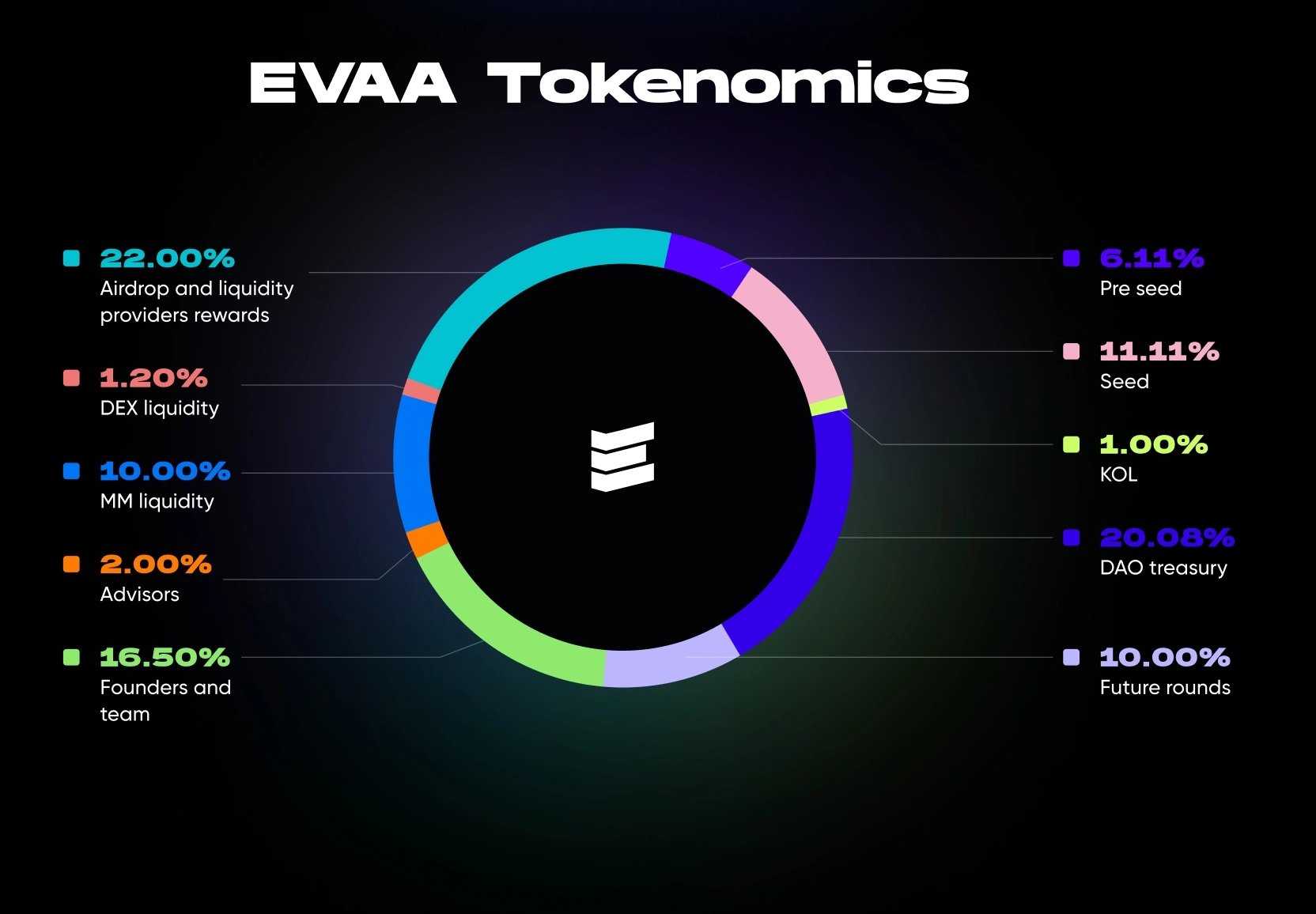
EVAA has a total supply of 50M tokens and has the following distribution: [11]
- Airdrop/Liquidity Providers: 22%
- DAO Treasury: 20.08%
- Founders and Team: 16.5%
- Seed: 11.11%
- Future Rounds: 10%
- MM Liquidity: 10%
- Pre-seed: 6.11%
- Advisors: 2%
- DEX Liquidity: 1.2%
- KOLs: 1%
Partnerships
- Animoca Ventures
- TON Ventures
- Polymorphic Capital
- PAKA
- Mythos Ventures
- Frens Syndicate x VC DAO
- WAGMI Ventures
- Existential Capital
- TON Coin Fund
- TONStarter
See something wrong?

Official Website:
Social Profiles:
Founders:
Blockchains: