0% read
Last updated:
Unibase
Unibase is a decentralized artificial intelligence (AI) infrastructure project designed to provide memory, identity, and interoperability layers for autonomous agents. It enables AI systems to store data persistently, communicate securely across different platforms, and operate within verifiable on-chain environments.[1]
Overview
Unibase is an AI-agent infrastructure project. Its main product, Membase, provides a shared long-term memory for AI agents and tools including Claude Code, Cursor, Codex, and ChatGPT, searchable and updatable through MCP, REST, and Python and TypeScript SDKs. Unibase also develops BitAgent, an on-chain agent platform; the Agent Interoperability Protocol (AIP) and Unibase DA; and Unibase Pay, an x402 payment facilitator for AI agents. UB is used for staking, governance, and network services.[5][6][7][8][9][2]
Core Components
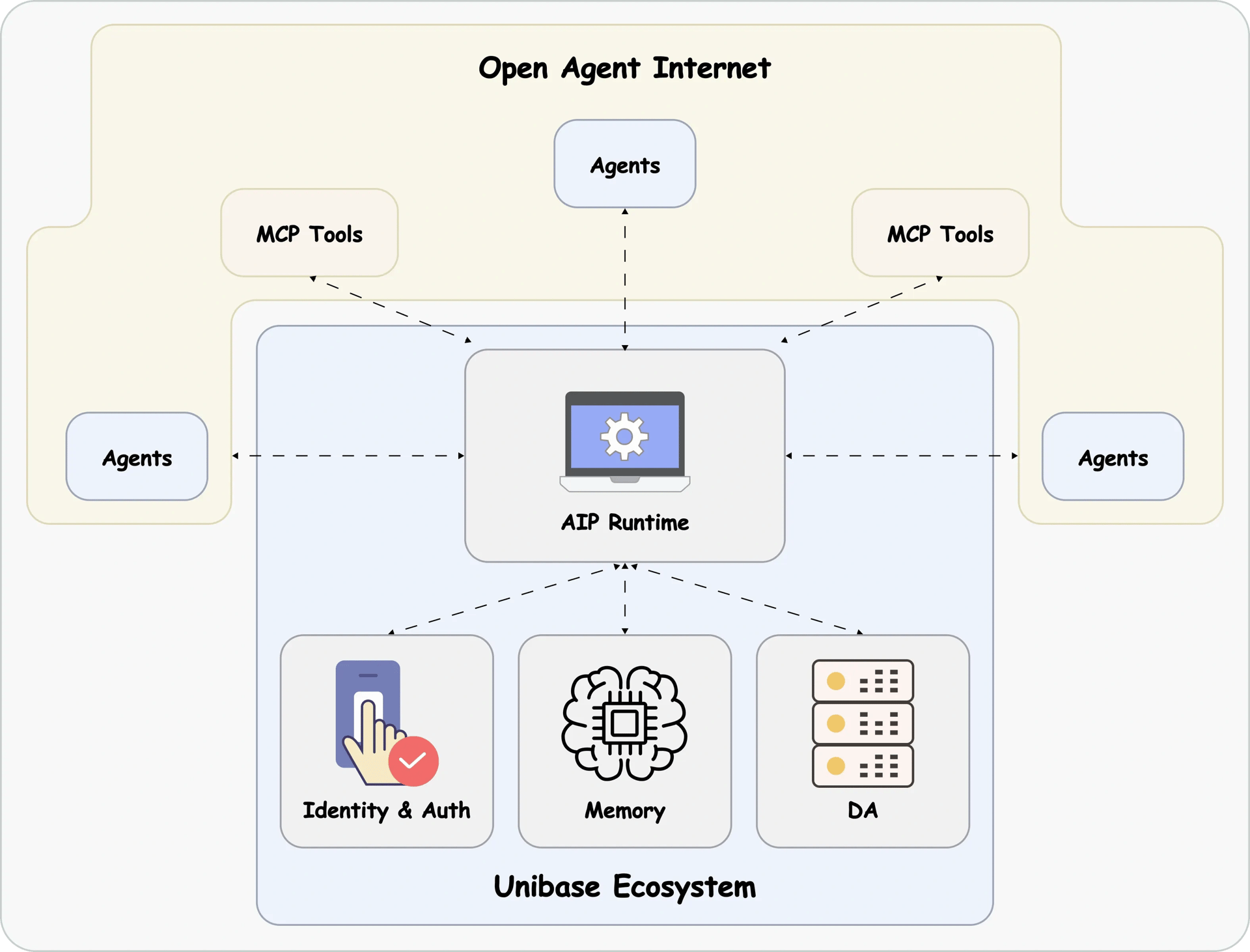
Unibase's infrastructure is composed of three primary technological pillars that work in conjunction to enable autonomous AI agents.[1]
Membase
Membase refers to both the membase.ai product and a separate protocol-level module in Unibase documentation. The membase.ai product is a shared long-term memory service/API for AI agents and tools, available as a hosted service or in optional local mode and accessible through MCP, REST, and Python and TypeScript clients.[5][6][7]
Unibase's status page lists protocol-level Membase 2.0 as live on BNB Chain mainnet and testnet through a Hub interface.[12]
As of October 2026, membase.ai offers Membase as a hosted memory API, free during beta, with an optional local mode. The service provides shared long-term memory for connected AI tools and agents, accessible through MCP, REST, and Python and TypeScript clients. The vendor reports that its unibaseio-membase-core engine scored 93.1% on LoCoMo and 92.6% on LongMemEval_S; these are vendor-run engine benchmark results, not results for the hosted service.[5][6][7][10][11]
Agent Internet Protocol (AIP)
Unibase renamed the Agent Interoperability Protocol to the Agent Internet Protocol on July 16, 2026.[13] AIP supports agents discovering, authenticating, communicating, and transacting across platforms. Current documentation describes A2A messaging, ERC-8004 on-chain identity, x402 payments, and ERC-8183 settlement, with SDKs, a platform and gateway, and direct and polling connection modes.[13][14]
Unibase’s status page lists AIP as live on Base and BNB Chain.[12] AIP’s protocol-level integration with Membase concerns memory persistence in the Unibase protocol; it is distinct from the membase.ai shared-memory service/API.[15][5][6][7]
Unibase DA
Unibase DA is a decentralized data availability and storage design. Current documentation describes ZK fraud proofs, an Honest-One security model, and Reed–Solomon erasure coding.[16]
Unibase lists DA on Base Sepolia testnet, with Base mainnet in audit and Ethereum on the roadmap.[12][16] Its protocol documentation positions DA as a data substrate for protocol-level Membase and AIP. The current membase.ai product pages do not establish that the hosted API stores account memory on Unibase DA.[16][15][5][6][7]
Ecosystem
BitAgent
BitAgent is a decentralized multi-agent collaboration platform built on the Unibase infrastructure. It allows users and organizations to deploy autonomous AI agents that feature persistent memory, verifiable on-chain identities, and cross-platform interaction capabilities. Agents on the BitAgent platform use Unibase's Membase for long-term memory and the AIP protocol for communication and collaboration across various platforms, including social media, exchanges, and decentralized autonomous organizations (DAOs). The platform also integrates token-based incentives and governance mechanisms to encourage ecosystem participation.[4]
UB
The UB token functions as the utility and governance asset within the Unibase ecosystem, supporting its decentralized AI infrastructure. It facilitates protocol-level operations, network participation, and incentive mechanisms for users and developers. UB is used to pay fees for memory storage, agent deployment, and interoperability services. Holders can also stake tokens to activate or promote agents, participate in governance through veUB voting, and earn rewards for contributing useful prompts, data, or reusable knowledge to the system.[2][9]
Tokenomics
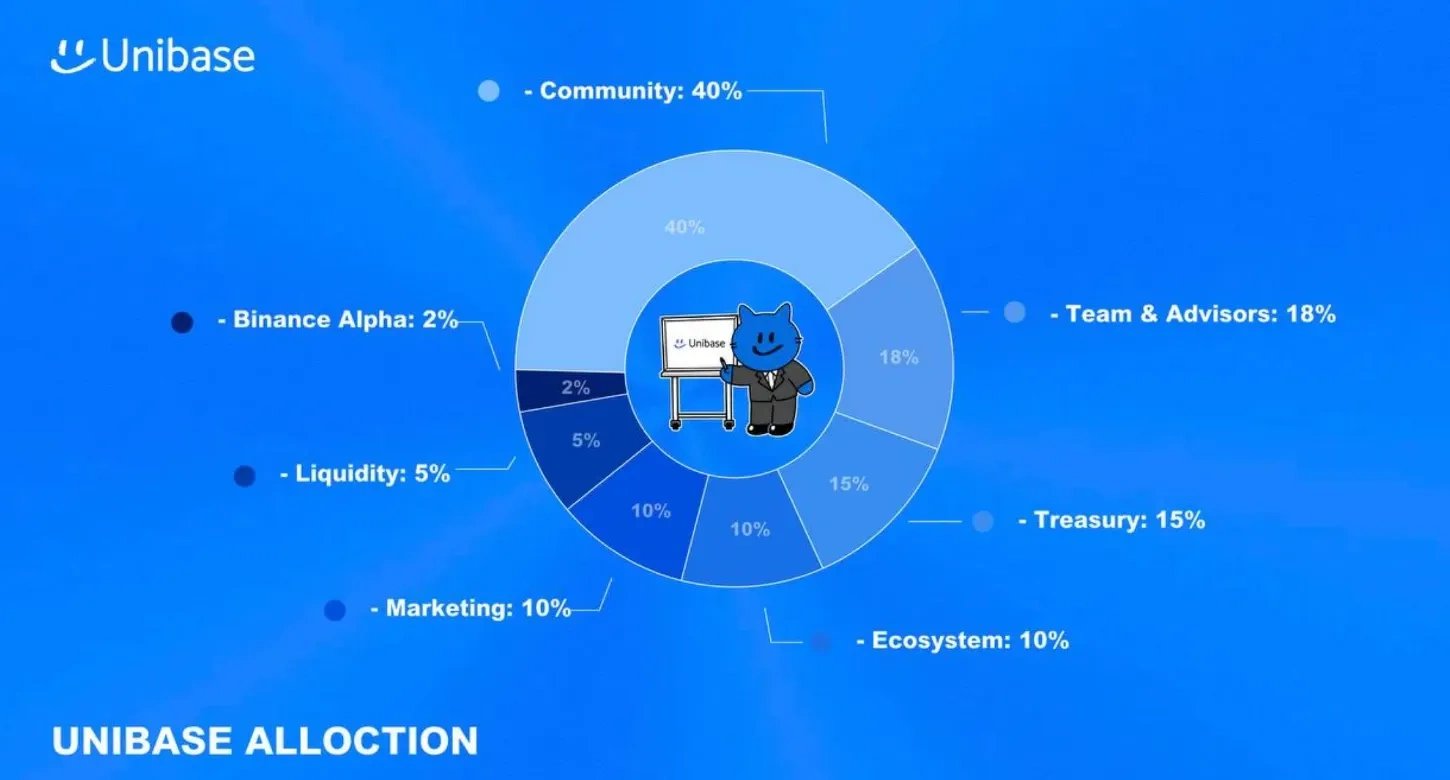
The total supply of UB is 10,000,000,000 tokens, distributed according to the following allocation model:[2]
- Community: 40%
- Team & Advisors: 18%
- Treasury: 15%
- Ecosystem: 10%
- Marketing: 10%
- Liquidity: 5%
- Binance Alpha: 2%
Partnerships
See something wrong?
Official Website:
Contract:
Social Profiles:
Blockchains: