0% read
Last updated:
Ares
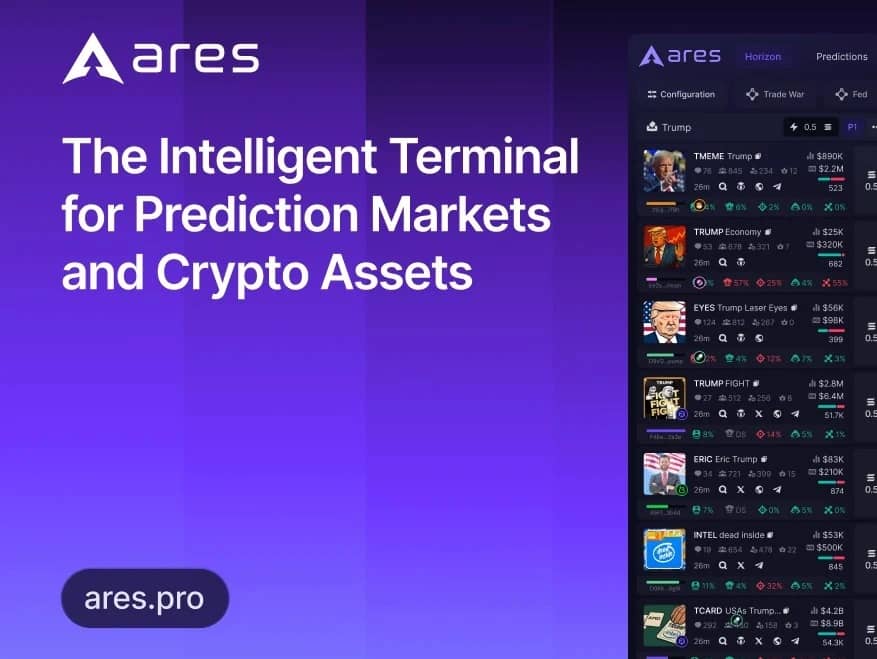
Ares is a Solana-native decentralized trading protocol and terminal. It unifies memecoin trading, prediction markets, real-time Telegram signals, wallet intelligence, and multi-decentralized-exchange (DEX) execution into a single workspace.[1][2]
Ares presents itself under two overlapping product framings. Its documentation describes a Solana-first trading terminal built around memecoin discovery, on-chain execution, and Telegram intelligence. By contrast, its consumer-facing website positions Ares as a prediction-markets trading platform and mobile app that lets users trade across Polymarket and Kalshi.[2][3]
Platform and Access
Ares runs as a responsive web application optimized for desktop and supporting mobile browsers. The web terminal is described as the primary interface for the broader Solana trading workspace. As of August 2026 the team has additionally launched AresPro Mobile (Beta) as a native social trading app for prediction markets powered by Polymarket.[2][3][7] The consumer website prompts users to download a mobile app and open the web app.[3]
Access to the private beta requires either an invite link or a place on the waitlist. Invite codes are consumed once per account during the one-time-password (OTP) onboarding flow.[2]
To log in, users provide an email address and OTP, which creates or links an embedded wallet. The consumer site additionally advertises sign-in with Apple or Google and states that a user's prediction-market accounts are "automatically set up" so trading can begin immediately.[2][3]
Hardware-wallet passthrough is not supported, but existing private keys can be imported. Funding is handled by sending Solana (SOL) and SPL tokens directly to any wallet address shown in the app's Wallet Management surface, and the minimum trade size is 0.001 SOL.[2]
Wallet Model and Portfolio Control
Ares uses embedded, non-custodial wallet accounts powered by Turnkey, a wallet infrastructure and key-management provider that generates and holds keys client-side in the user's browser.[5] The company states that Turnkey keeps private keys client-side, that Ares never holds user funds, and that users can export their keys or move to full self-custody at any time.[2]
Within the terminal, users can create multiple wallets, import existing keys, set wallet privacy, and transfer funds. Ares describes these operations as first-class, meaning they can be performed without leaving the workspace while keeping wallets ready for execution.[2]
Portfolio management tools include drag-to-select organization, public and private visibility toggles, emoji labels, and consolidated, distribution, and one-off transfer flows.[2]
Active wallets, set from a Wallet Summary popover, drive the user's watchlist, the token "My Positions" tab, the token inflow feed, and the source of funds for trading.[2]
Portfolio and single-wallet pages stream holdings, trade history, realized profit and loss (P&L), and developer-minted tokens. They also provide toggles between SOL and US-dollar denomination and advanced filtering.[2]
Trading Terminal and Execution
Execution is handled by a component called the DexIntegrator. This router sends instructions across Pump.fun, Raydium (including AMM V4, CPMM, CLMM, and LaunchLab pools), Meteora (DLMM, CP AMM, DAMM, and DBC), Jupiter, and additional Solana memecoin and token-trading venues and DEX front-ends such as Moonshot, Bags, Believe, and LetsBonk. The system uses Jito-aware fee presets.[2]
Telegram and Wallet Intelligence
Ares integrates Telegram signals directly into its terminal. Users can connect their Telegram profile through an in-app widget, subscribe to channels that Ares describes as vetted, or onboard their own channel by adding the account as an administrator.[2]
Within the interface, the Telegram tracking feed renders enriched "call cards" showing caller context, hit rates, liquidity, bonding progress, and tags. It plugs into the same panel and filter system used for the Memes workspace.[2]
For discovery, two surfaces — TG Discovery and the Telegram Leaderboard — rank channels by hit rate, multiplier, recency, and follower growth. They include one-click subscribe and unsubscribe controls backed by the platform's tg-tracking APIs.[2]
When a trade is executed directly from a Telegram call, the user can optionally tip the caller 1%, with the tip displayed before confirmation.[2]
The company advertises a unified signal graph that combines wallet tags, Telegram calls, and bonding-curve data into a single schema. This enables compound filters such as "Pump.fun tokens with >5 TG mentions, >2 tracked whales,<30 min age."[2]
The consumer website describes related capabilities including whale and insider tracking to follow large positions, insider activity, and capital flows; deep trader analytics covering win rates, historical performance, position sizing, and trading behavior; and the ability to track any wallet and monitor live positions.[3]
Prediction Markets and Leverage
Ares includes a prediction-markets dashboard, described as in beta and gated behind a "prediction_markets" feature flag.[5]
Powered by Kalshi, this dashboard surfaces trending narratives, rich event metadata, and charting. On-platform order routing is described as planned but not yet released in the documentation.[2]
The consumer website presents a broader prediction-markets product that lets users trade Polymarket and Kalshi side by side from a single terminal. It advertises "AI-powered market intelligence" that includes daily market briefings, breaking-news alerts, and analysis that the site says "instantly shows which markets are affected and how the news is moving them."[3]
For leveraged exposure, eligible users can increase prediction-market positions by posting pUSD as collateral through a product called Dimes Multiply. This product is described as an external middle-layer leverage protocol that provides leverage liquidity for prediction-market exposure via a committed credit facility. In this design, pUSD serves as the margin collateral asset posted by users, while Dimes Multiply funds and manages the remaining notional position through its credit facility, including associated risk and liquidation controls for fast-moving narrative markets.[6]
The consumer website advertises leverage of up to 10× specifically on Polymarket, alongside real-time risk management for leveraged trading.[3] Ares also maintains dedicated documentation covering collateral, fees, liquidity, and risk for its leverage functionality.[2]
History, Team, and Governance
Ares, also branded Ares Pro and AresPro Mobile, is described as a Solana-native, non-custodial trading terminal and Telegram copy-trading bot. It unifies prediction-market trading on Polymarket and Kalshi with Solana-based memecoin and wallet-tracking workflows.[5][4] The project positions its web terminal as a customizable multi-panel workspace and its Telegram bot as a companion interface for copy trading and signals-based execution across these venues.[4]
Ares was founded by CEO Morgan Lai, whose background includes roles as a venture partner and as the chief executive and co-founder of an AI startup. The team is described as being based between New York City and San Francisco.[7] Ares is presented as an official partner of Polymarket and as backed by investors including Alliance, Foundation Capital, UOB, and other firms.[7]
Security and wallet custody are handled through Turnkey-powered embedded wallets, which are described as keeping private keys in the user’s browser so that Ares does not custody user funds. Users can create, import, export, or delete wallets from the Wallet Management surfaces.[5][4] The documentation specifies that security incidents should be reported by email using a dedicated security address and subject line and advises users to disconnect compromised wallets and move funds where possible, emphasizing the non-custodial nature of the system.[5] In line with its leverage-trading design, leveraged prediction-market exposure on Ares is described as relying on pUSD collateral posted by users while Dimes Multiply funds additional exposure through its credit facility, allowing the platform to offer leveraged markets without operating its own leverage and hedging stack.[6]
See something wrong?